
The Miracle of the First Swim
Olive Ridley Turtle Hatchlings
Lepidochelys olivacea
VULNERABLE
South Goa
Under the silver glow of a Goan moon, the quiet stretch of Galgibaga Beach transforms from a tourist’s paradise into a high-stakes nursery. Deep beneath the sand, a tiny heartbeat quickens. After 50 days of silent incubation, a hatchling no larger than a coin uses its "caruncle," or egg tooth, to break free from its parchment-like shell. This is the start of an epic saga for the Olive Ridley turtle (Lepidochelys olivacea), the smallest and most abundant sea traveler, whose survival depends on a delicate balance of nature and human vigilance. In the dark, dozens of siblings begin a coordinated "scramble," digging upward through the sand until they reach the cool night air. Their target: the shimmering horizon of the Arabian Sea.
The Critical "Last Walk"
Guided by the natural light reflecting off the waves, the hatchlings begin their trek. This "last walk" is vital; as they crawl, they "imprint" on the geomagnetic field of the beach, a biological GPS that will help females return to this exact spot 15 years later to lay their own eggs. However, the journey is fraught with peril. Predators like feral dogs, birds, and crabs wait in the shadows. But in South Goa, these tiny voyagers have a powerful ally: the Goa Forest Department.
Guardian of the Sands: Conservation in Goa
The moon was a thin silver sliver over Galgibaga, casting just enough light to turn the Arabian Sea into a sheet of hammered metal. Located in the deep south near Canacona, the northern portion of this beach is a strictly enforced "completely protected turtle zone" where no commercial structures or beach shacks are permitted. It is one of the most pristine and least commercialised beaches in India. On this stretch of South Goa, the shacks are absent, the music of Palolem a distant memory, replaced only by the rhythmic respiration of the tide. A forest guard, with skin as weathered as the driftwood he sat upon, clicked off his red-tinted flashlight. White light was the enemy here; it confused the mothers and blinded the hatchlings. He waited in the humid salt air, a silent sentinel for a ritual older than the cliffs of Canacona.
Then, he saw it.
A break in the surf. A dark, domed shape emerged, moving with a heavy, rhythmic heave. It was an Olive Ridley, her shell slick and glistening. She moved with agonizing slowness, dragging her hundred-pound weight across the soft, dry sand above the high-tide line. This was the "Arribada" in miniature—the arrival.
The guard watched from twenty yards away, his breath held. He had seen this hundreds of times, yet the magic never curdled. The turtle began to dig, her rear flippers moving with mechanical precision, scooping out a tear-drop-shaped chamber. One by one, the eggs dropped—leathery white spheres, full of the promise of the deep ocean.
But Galgibaga was shifting. Even here, the glow of distant lights threatened to lead the future astray.
As the mother finished, camouflaging her nest with a final sweep of sand before retreating to the waves, the forest guard sprang into action. He didn't disturb the site; instead, he marked it with a small bamboo stake and recorded the coordinates. In a few weeks, he would help relocate these eggs to the protected hatchery further up the dunes, shielding them from stray dogs and the accidental footsteps of sunrise trekkers.
Two months later, the beach belonged to the tiny.
Under a blanket of stars, the sand began to boil. Dozens of miniature flippers erupted from the earth. The hatchlings, no bigger than a matchbox, didn't hesitate. They didn't look back at the dunes or the palms; they looked for the brightest horizon—the sea.
The forest guards stood by the shoreline, a shadow among shadows, ensuring no crows swooped down in the pre-dawn grey. They watched the last of the brood catch a retreating wave, their tiny bodies disappearing into the vast, dark blue.
"Travel well," they whispered into the wind. In fifteen years, if the oceans were kind and the beaches stayed dark, one of them would return to this exact grain of sand to start the story all over again.
To ensure these hatchlings reach the water, the Goa Forest Department implements rigorous protection measures at key South Goa sites like Agonda and Galgibaga.
Protected Hatcheries: When a mother turtle nests, forest guards and local volunteers often relocate the eggs to fenced-in, "ex-situ" hatcheries to protect them from poachers and predators.
24/7 Patrolling: Dedicated "Temporary Service Labour" (TSL) teams—comprising local youth—patrol the beaches night and day during the nesting season (November to April).
Light & Noise Control: Under the Goa Tourism Shack Policy, beach shacks in nesting zones are prohibited from playing loud music or using bright artificial lights, which can disorient hatchlings and lead them toward land instead of the sea.
Community Involvement: The department rewards locals who report new nesting sites, turning former egg-collectors into "Turtle Protectors".
What makes Olive Ridleys special?
Olive Ridleys are famous for a phenomenon known as the Arribada (Spanish for "arrival"). During an Arribada, tens of thousands of females emerge from the ocean simultaneously to nest, swamping the beach in a massive, synchronized event. While Goa primarily sees "solitary" nesters, the sheer resilience of these turtles—who migrate up to 9,000 km—makes every successful hatchling a conservation victory.
Despite being the most abundant sea turtle in the world, their populations have declined by over 30%. They are listed as Vulnerable on the IUCN Red List and protected under Schedule I of India’s Wildlife Protection Act, 1972, granting them the highest level of legal protection.
Some major Nesting Sites in India:
Odisha: Home to the world's largest rookeries at Gahirmatha
Rushikulya, and the Devi River mouth
Andaman & Nicobar Islands: Vital nesting grounds for both Olive Ridleys and Leatherback turtles.
Goa: Key sites include
Morjim and Mandrem (North Goa), and
Agonda and Galgibaga (South Goa).
As the first wave of the Arabian Sea washes over the hatchling, its struggle for survival truly begins. Only 1 in 1,000 will reach adulthood, but thanks to the watchful eyes on the Goan shore, these tiny travelers have the best possible start.
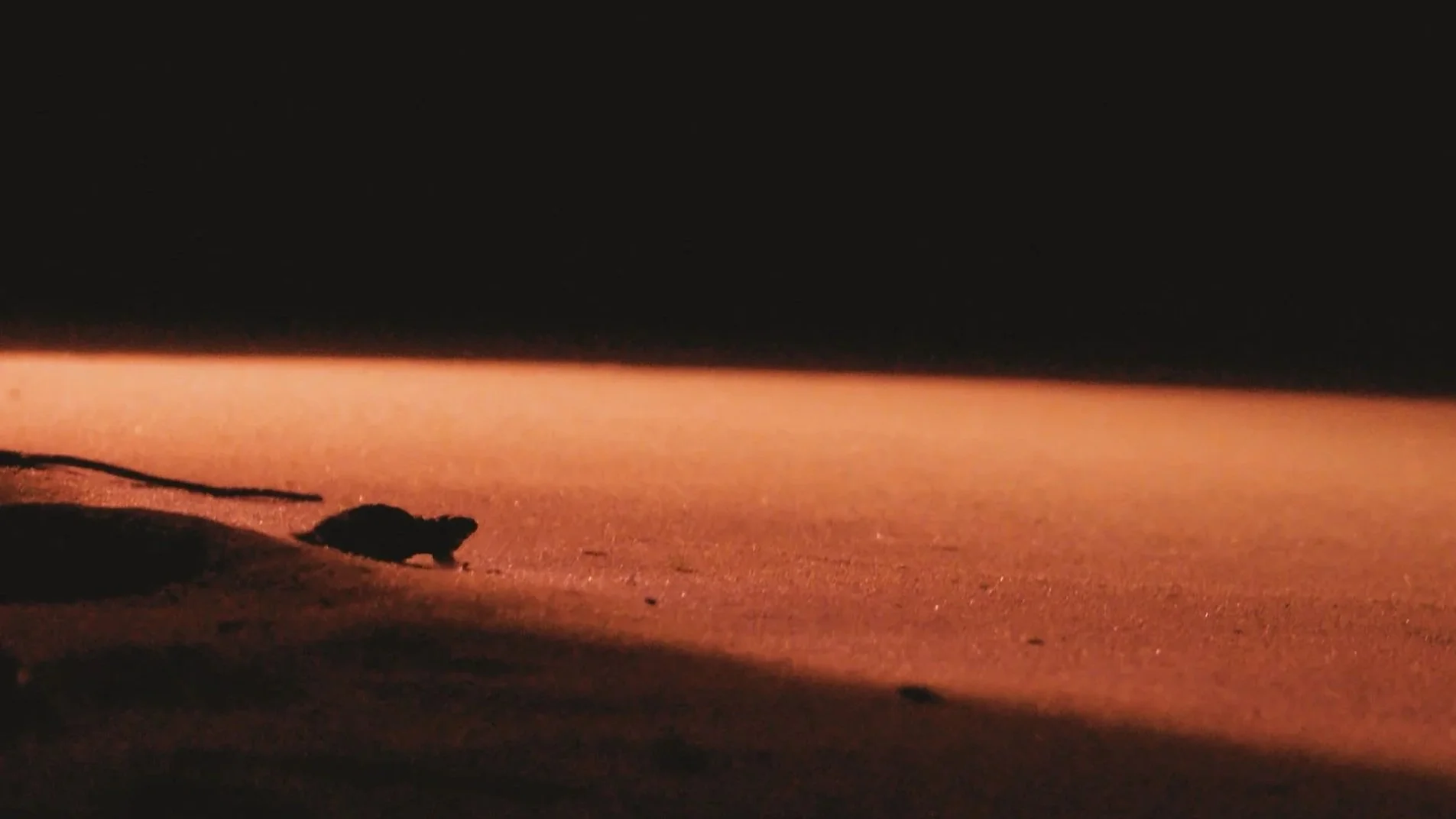
A tiny 20 gram Olive Ridley hatchling makes its way to the Arabian Sea guided by the natural light reflecting off the waves. This "last walk" is vital; as they crawl, they "imprint" on the geomagnetic field of the beach, a biological GPS that will help the females return to this exact spot 15 years later to lay their own eggs
Olive Ridley Turtle
The Olive Ridley turtles are the smallest and most abundant of all sea turtles found in the world, inhabiting the warm waters of the Pacific, Atlantic and the Indian Oceans. These turtles, along with their cousin the Kemps Ridley Turtle, are best known for their unique mass nesting called Arribada, where thousands of females come together on the same beach to lay eggs. Though found in abundance, their numbers have been declining over the past few years, and the species is recognized as Vulnerable by the IUCN Red list.
Growing to about 2 feet in length, and 50 kg in weight, the Olive Ridley gets its name from its olive colored carapace, which is heart-shaped and rounded. Males and females grow to the same size; however, females have a slightly more rounded carapace as compared to the male. They are carnivores, and feed mainly on jellyfish, shrimp, snails, crabs, molluscs and a variety of fish and their eggs. These turtles spend their entire lives in the ocean, and migrate thousands of kilometers between feeding and mating grounds in the course of a year.
No one knows exactly how long Olive Ridleys live, but like other sea turtles, they likely live for decades. Olive Ridleys reach maturity around 14 years of age at which point they display one of the most extraordinary behaviors in the natural world. Similar to Kemp’s Ridleys, immense swarms of Olive Ridleys gather offshore of nesting beaches. Then, all at once, they come ashore and nest in what is known as an "arribada", meaning "arrival" in Spanish. During these arribadas, hundreds to thousands of females come ashore to lay their eggs in synchrony. At many nesting beaches, the nesting density is so high that previously laid egg clutches are dug up by other females while excavating the nest chamber to lay their own eggs.
Interestingly, females return to the very same beach from where they first hatched, to lay their eggs. During this phenomenal nesting, up to 600,000 and more females emerge from the waters, over a period of five to seven days, to lay eggs. They lay their eggs in conical nests about one and a half feet deep which they laboriously dig with their hind flippers. The coast of Orissa in India is the largest mass nesting site for the Olive Ridley, followed by the coasts of Mexico and Costa Rica. After an incubation period of 45-65 days, the eggs begin to hatch, and these beaches will see multitudes of crawling Olive Ridley turtle babies, making their first trek towards the vast ocean. During this trek they are exposed to predators like feral dogs, birds, crabs, jackals and hyenas lurking around, waiting to feed on them. The local fishermen community, along with WWF, has been involved in protecting the Olive Ridley rookeries at some of the larger sites like Rushikulya, in Orissa. The nesting sites are fenced off and patrolled till the hatching and ensure a safe passage for the hatchlings to the sea. It is estimated that approximately 1 hatchling survives to reach adulthood for every 1000 hatchlings that enter the sea waters. This may also be the reason why arribadas happen and a single female can lay 80 to 120 eggs and sometimes even twice in a season; to increase the hatchlings survival rate.
There are many theories on what triggers an arribada, including offshore winds, lunar cycles, and the release of pheromones by females. However, scientists have yet to conclusively determine why exactly arribadas occur. Not all females nest during an arribada—some are solitary nesters while others employ a mixed nesting strategy. For example, a single female might nest during an arribada, as well as nest alone during the same nesting season. Females nest every year, one to three times a season, laying clutches of approximately 100 eggs. When finished laying, most sea turtles cover their eggs with sand using their rear flippers to pack the sand firmly on top of their clutch. However, since the Olive Ridley is so small and relatively light, they do not have the power to use their rear flippers in this way—instead, they use their whole bodies, beating the sand down with their lower shells after covering the eggs. The sex of hatchlings is determined by the temperature of the sand during the second trimester of incubation. Once the turtles hatch out of their eggs and climb to the surface, the hatchlings make their way to the sea. Hatchlings orient seaward by moving away from the darkest silhouette of the landward dune or vegetation to crawl towards the brightest horizon. On developed beaches, this is toward the open horizon over the ocean.
Olive Ridleys face serious threats across their migratory route, habitat and nesting beaches, due to human activities such as turtle unfriendly fishing practices, development and exploitation of nesting beaches for ports, and tourist centres. Though international trade in these turtles and their products is banned under CITES Appendix I, they are still extensively poached for their meat, shell and leather, and their eggs, though illegal to harvest, have a significantly large market around the coastal regions. However, the most severe threat they face is the accidental killing of adult turtles through entanglement in trawl nets and gill nets due to uncontrolled fishing during their mating season around nesting beaches.
To reduce accidental killing in India, the Orissa government has made it mandatory for trawls to use Turtle Excluder Devices (TEDs), a net specially designed with an exit cover which allows the turtles to escape while retaining the catch. However, this has been strongly opposed by the fishing communities as they believe TEDs result in loss of considerable amount of the catch along with the turtle. WWF-India, along with its partners, disproved this theory by conducting a study to measure the loss of catch through TEDs, revealing the loss to be a very small percentage of the total catch. This result, along with regular meetings with the fishing communities, is slowly helping to change their mindset and encourage use of TEDs, thereby aiding the conservation of Olive Ridley turtles.
Increasing pollution of nearshore and offshore marine habitats threatens all sea turtles and degrades their habitats. Ingestion of marine debris is another threat to all species of sea turtles. Olive Ridleys may ingest marine debris such as fishing line, balloons, plastic bags, plastic fragments, floating tar or oil, and other materials discarded by humans which they can mistake for food. They may also become entangled in marine debris, including lost or discarded fishing gear, which can lead to injury or death.
For all sea turtles, changing environmental conditions like higher sand temperatures can be lethal to eggs or alter the ratio of male and female hatchlings produced (due to temperature dependent sex determination). Rising seas and storm events change beach morphology and cause beach erosion, which may flood nests or wash them away. Changes in the temperature of the marine environment are likely to alter habitat suitability, as well as the abundance and distribution of food resources, leading to a shift in the migratory and foraging range and nesting season of Olive Ridleys.


Related Posts



Abscondita chinensis, a captivating species of firefly belonging to the family Lampyridae and subfamily Luciolinae, is a luminous wonder native to tropical Asia. Known for its remarkable bioluminescent displays, particularly during its mating season, it plays a vital role in its ecosystem as a predator and contributes to the charm of natural environments. It lives in various habitats, and its bioluminescence, especially during mating, adds a magical quality to its existence. However, threats from pollution and climate change highlight the need for conservation efforts to protect this insect. These were photographed in Telangana.
#wildartworks, #Canon, #Wildlife, #naturephotography, #earthcapture, #conservationphotography, #wildlifeonearth, #bbcearth, #natgeowild, #natgeoindia, #Kawal, #KawalTigerReserve, #hyticos, #nirmal, #wildtelangana, #telanganawildlife, #telanganaanthropods, #telanganabeetle, #beetle, #Insectsoftelangana, #Absconditachinensis, #Lampyridae, #Luciolinae, #firefly, #asynchronousfirefly, #synchronousfirefly,