
Dark-backed Sibia/ Black-backed Sibia
Heterophasia melanoleuca
Doi Pha Hom Pok National Park, Chiang Mai, Thailand
The dawn at Doi SanJu—a windswept ridge within the rugged, high-altitude folds of Doi Pha Hom Pok National Park in northern Chiang Mai—does not break cleanly. Instead, it bleeds into existence through layers of dense, moving mountain fog. Standing on the mountain road tracking the border between Thailand and Myanmar, the early morning air is cold and laden with the scent of damp moss, pine needles, and wet broadleaf evergreen bark.
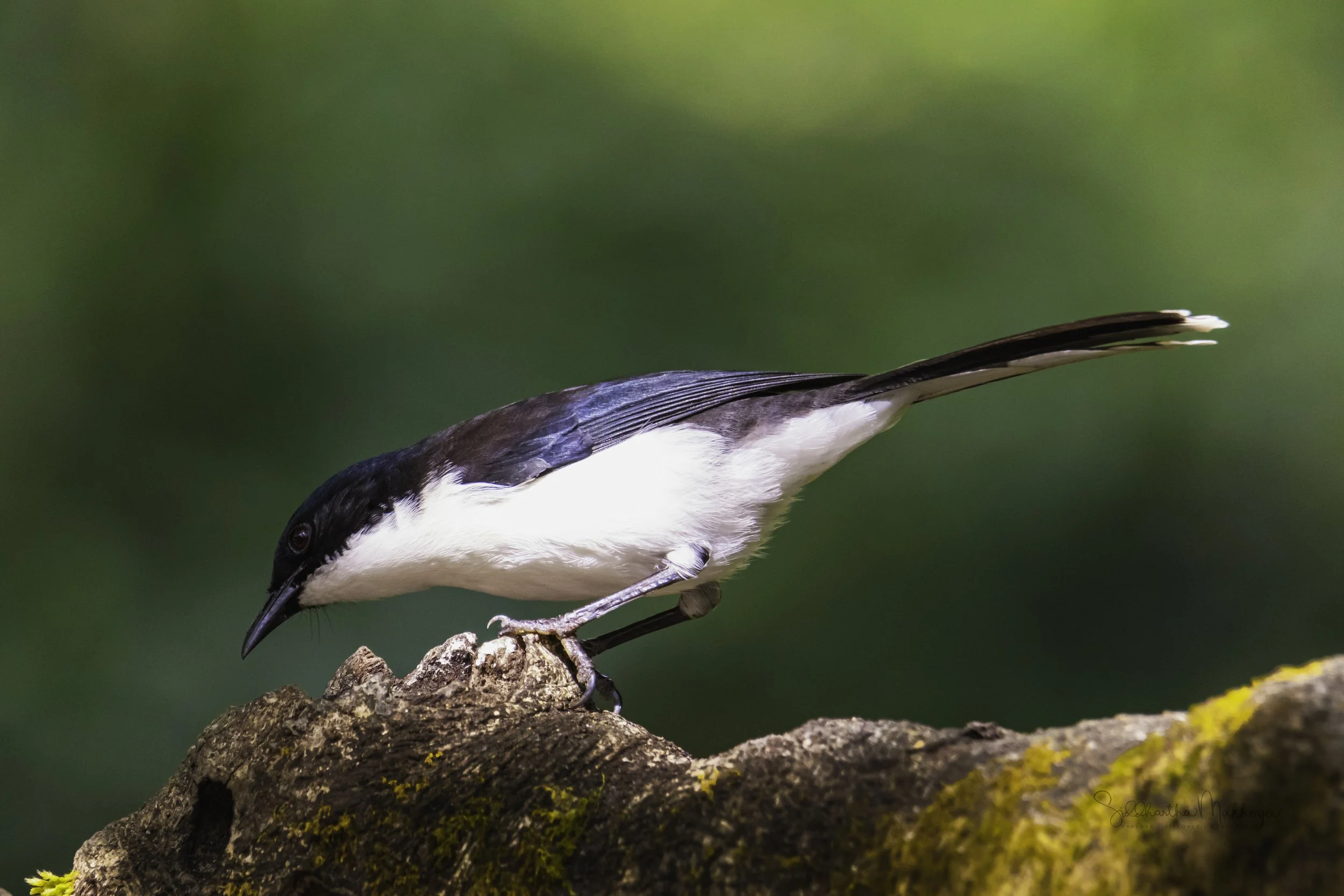
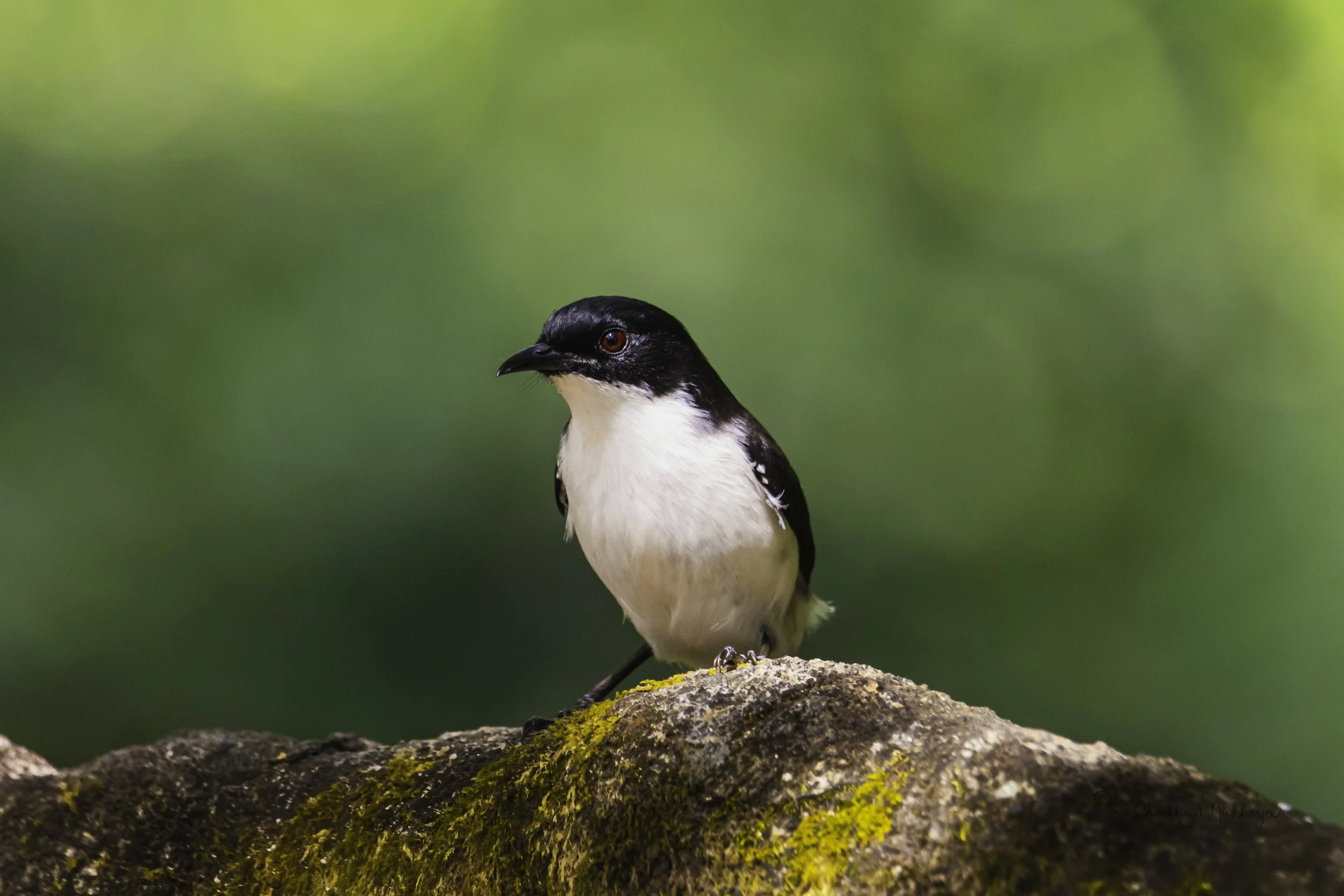
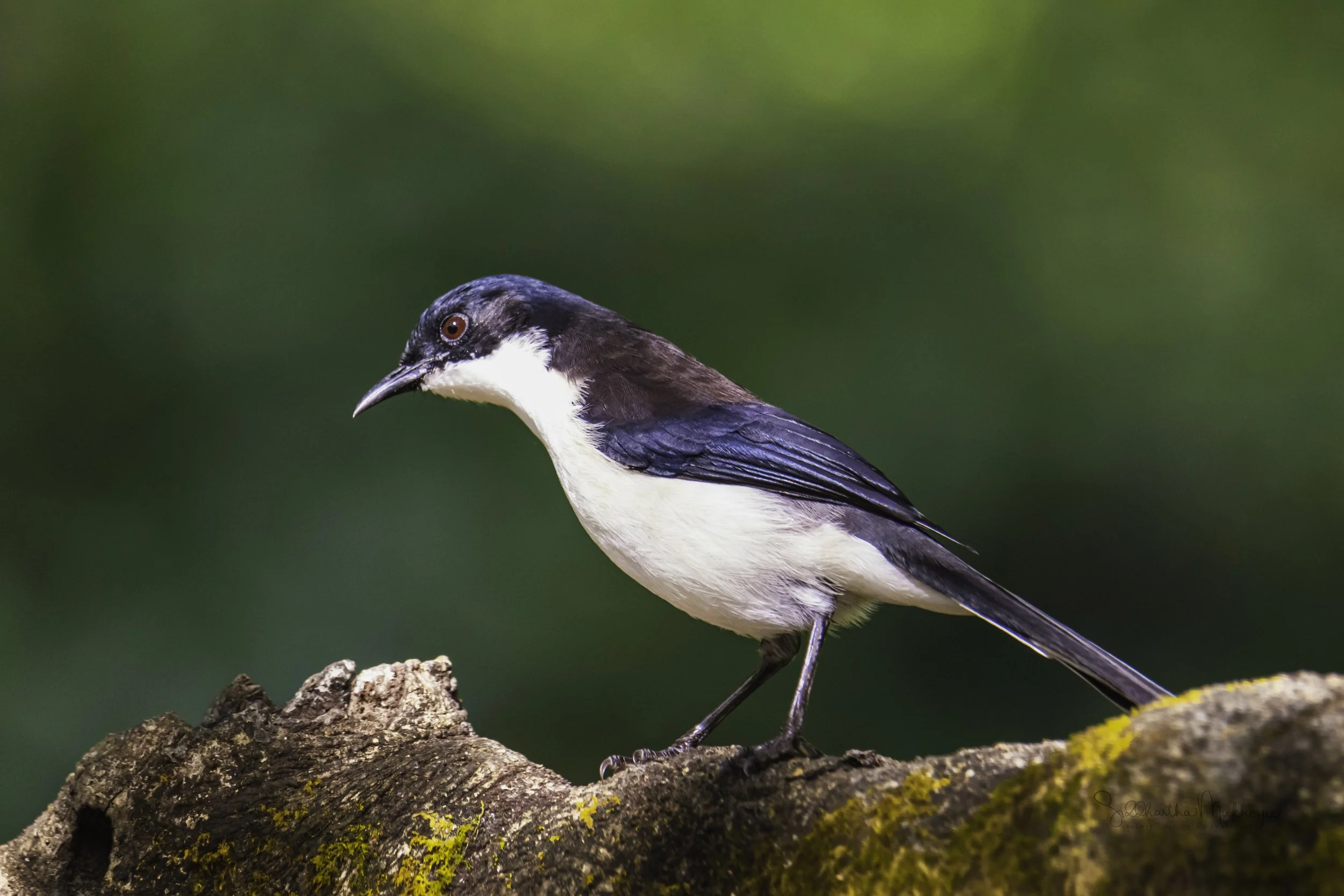
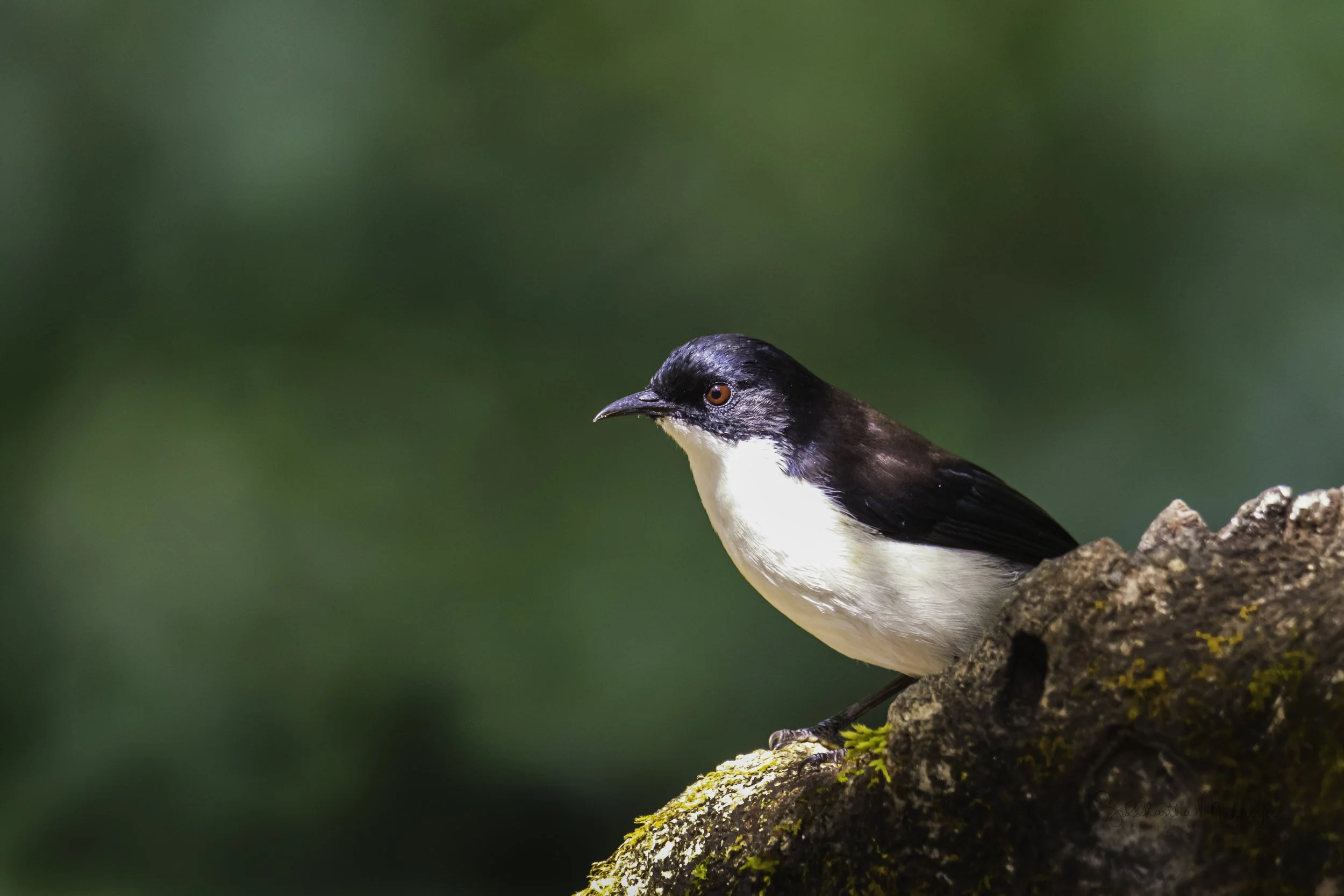
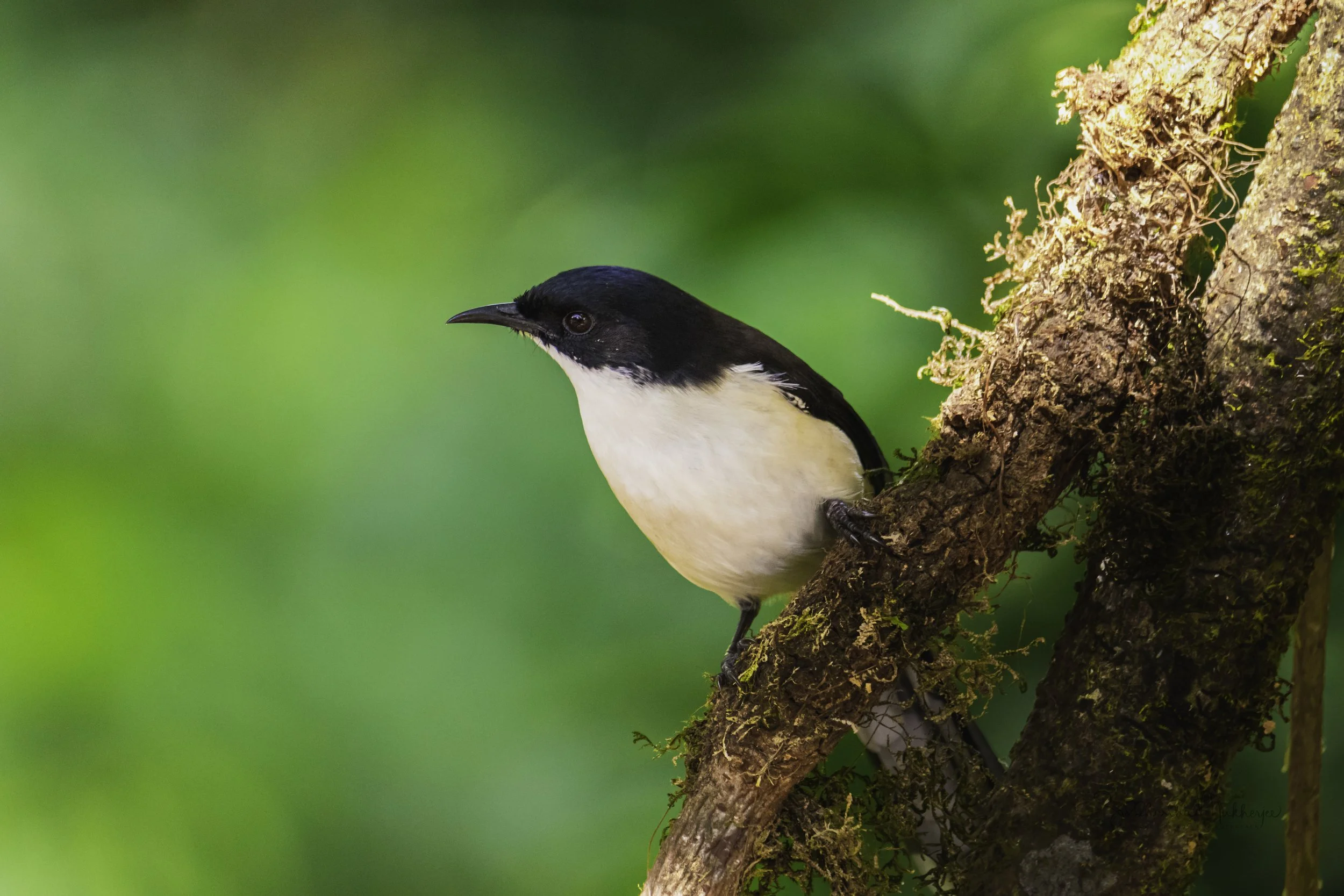
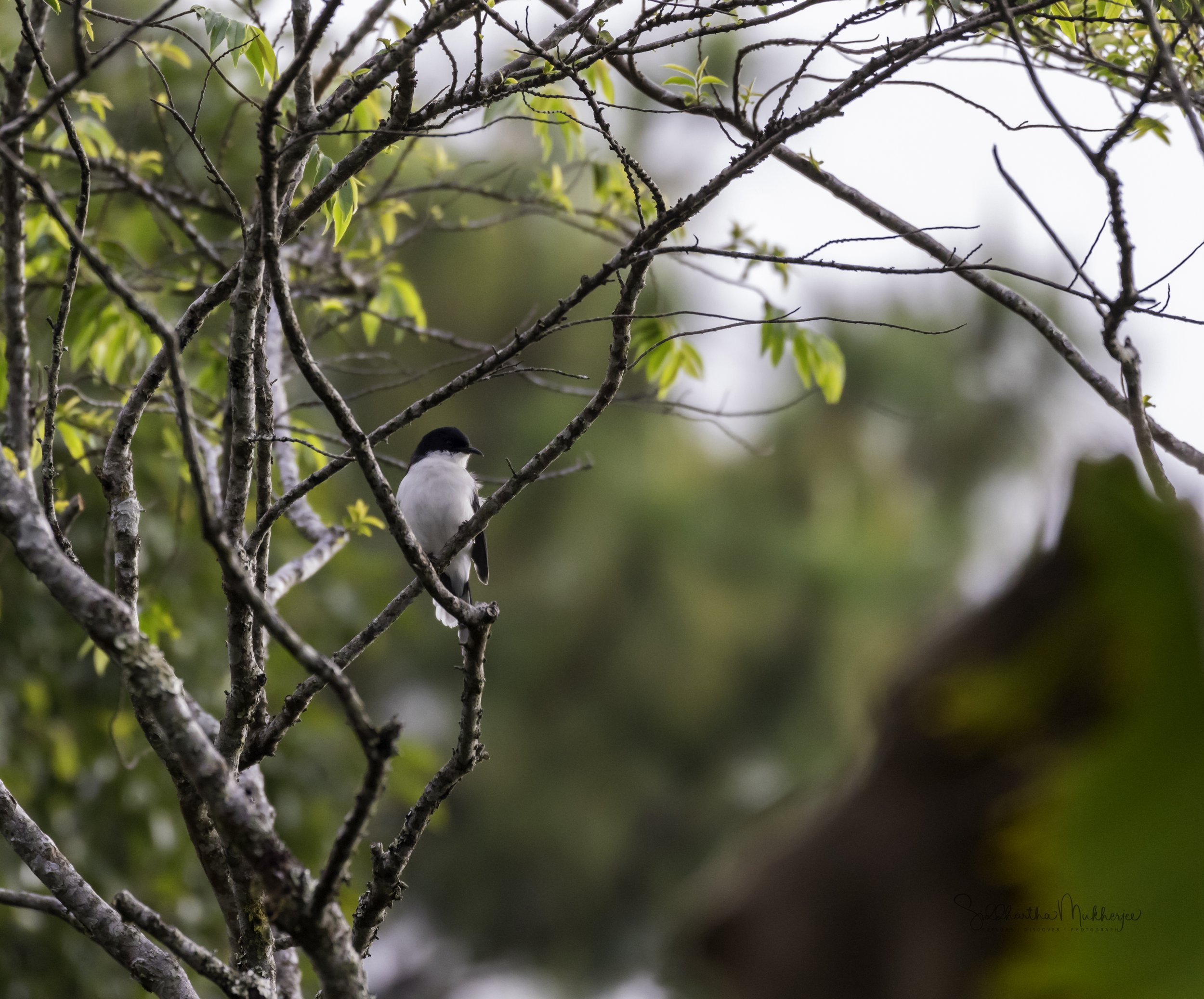
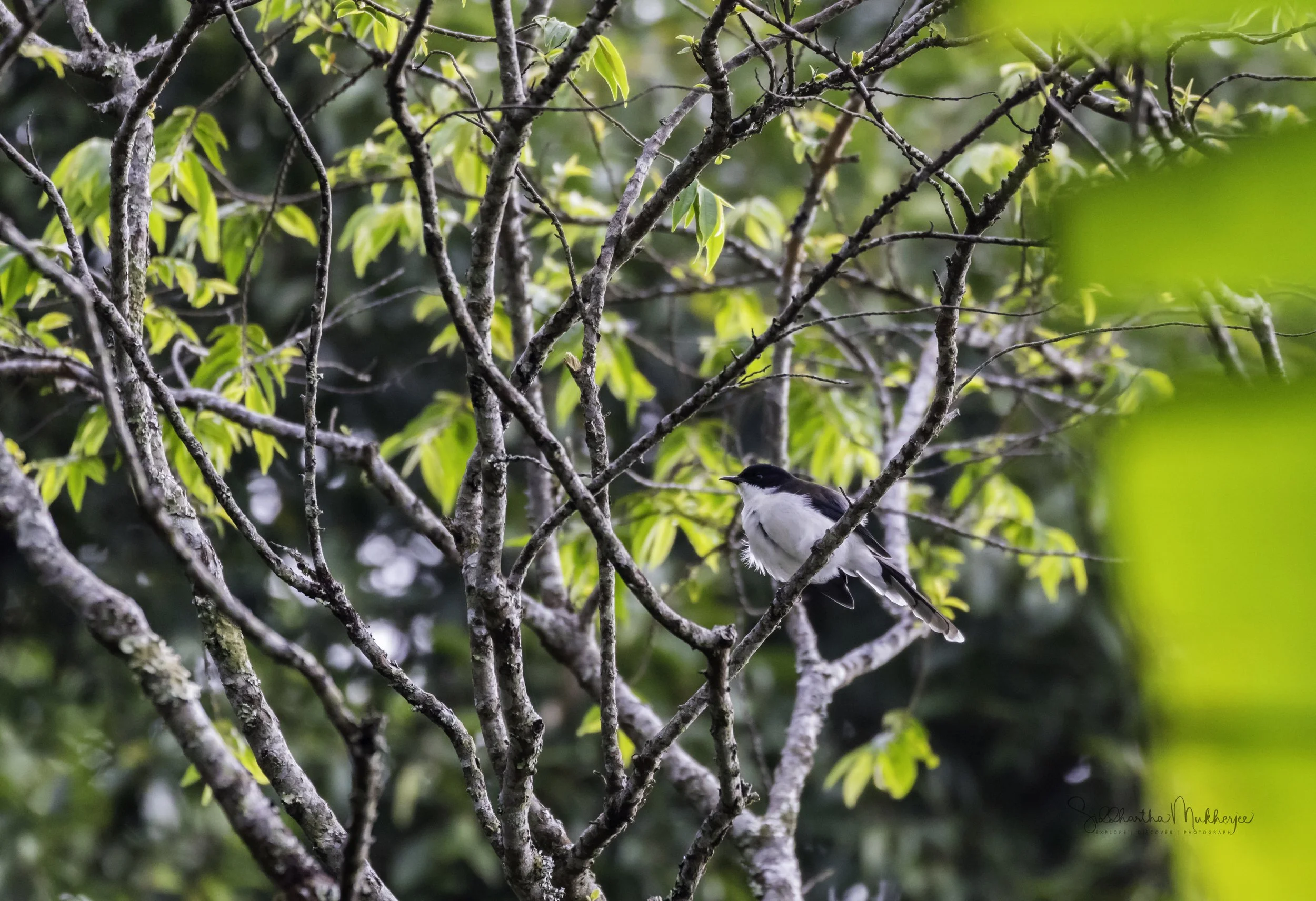
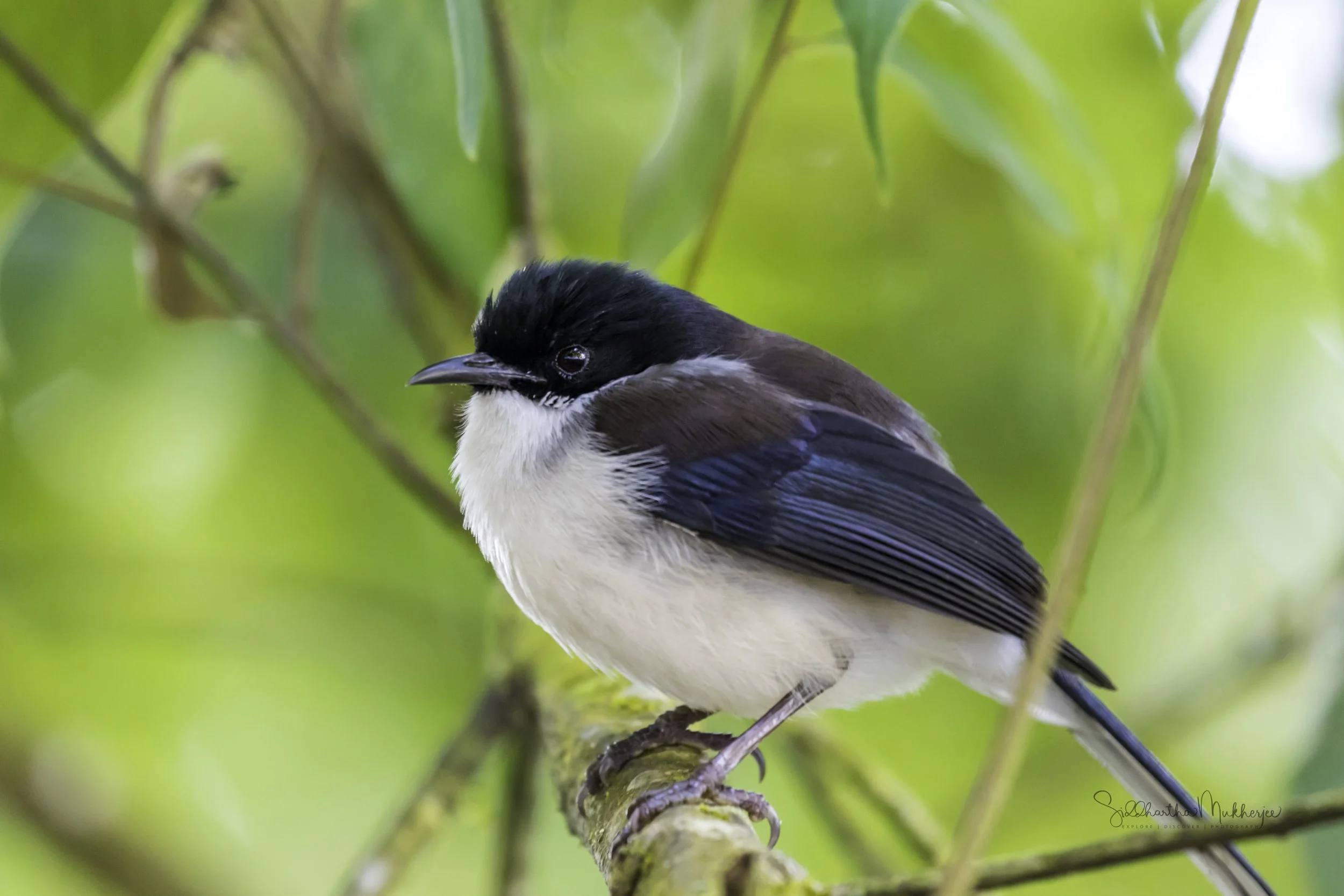
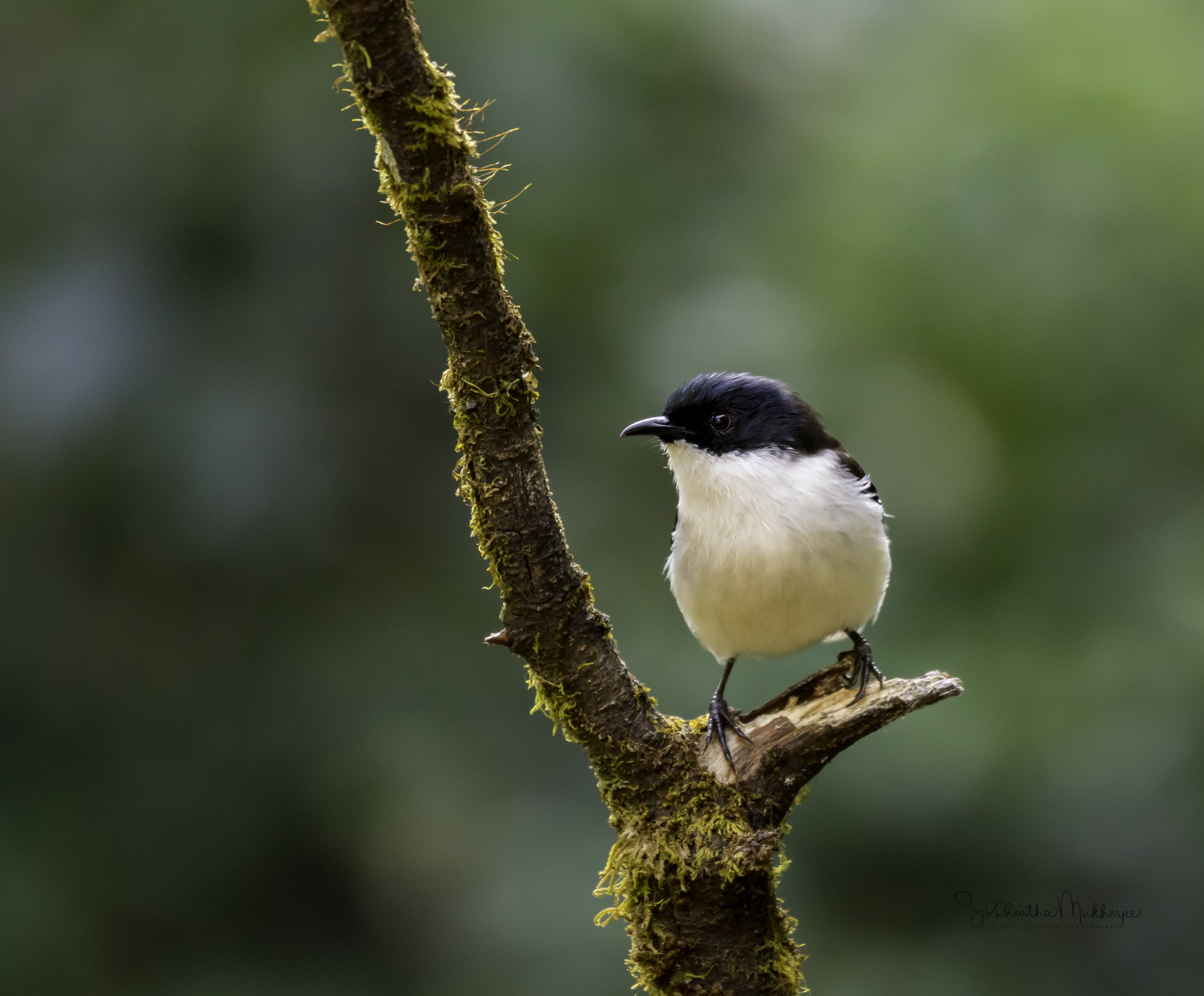
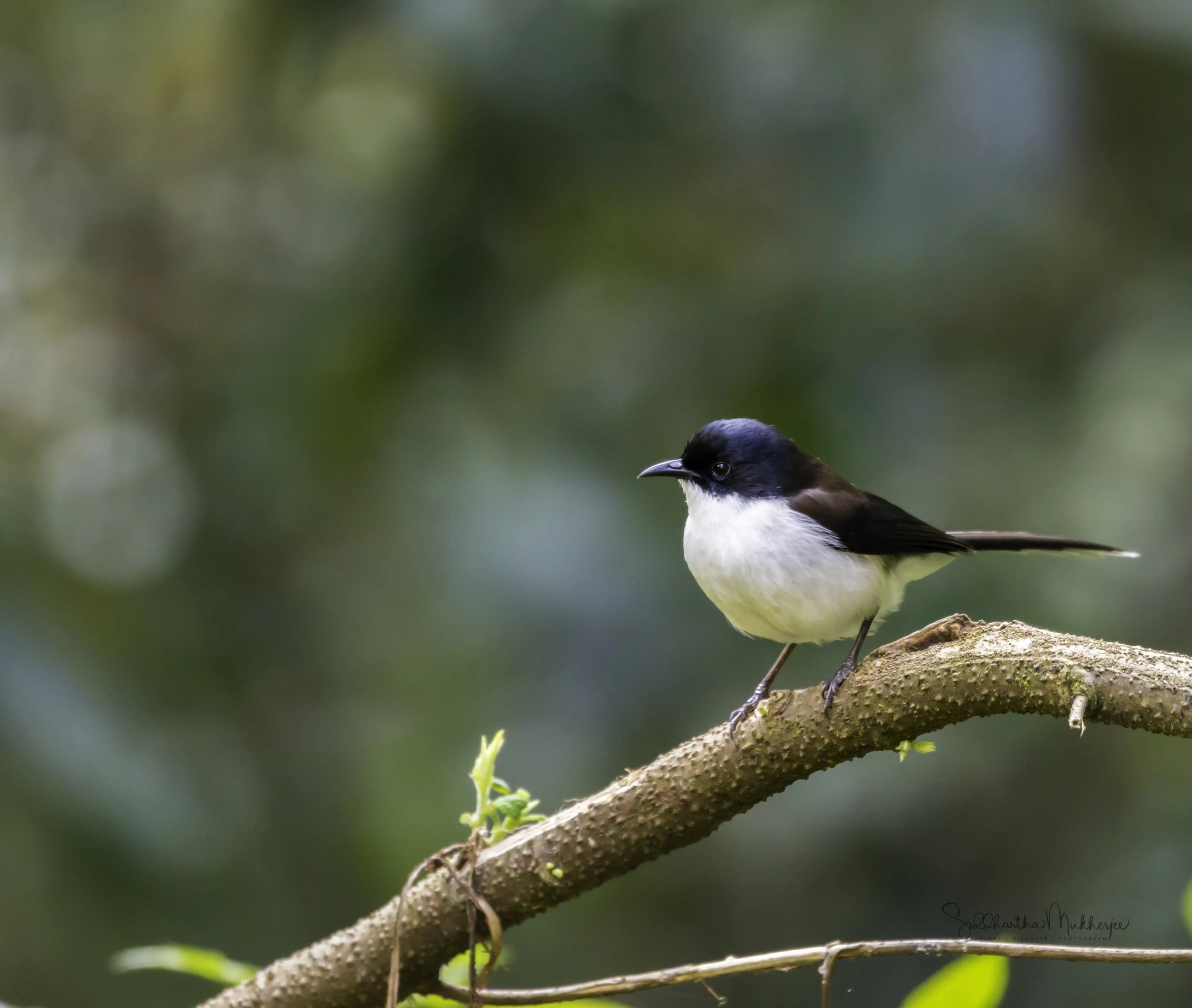
Suddenly, the grey monotony of the mist is broken by a striking silhouette slicing down from the canopy. A medium-sized, slender & elegant montane acrobat alights on a mossy branch, its long tail balancing its sharp, shrike-like posture. This is the Dark-backed Sibia (Heterophasia melanoleuca). I have written multiple blogs about these Birds on the Doi which talks extensively of the four mountains in North Thailand and the abundant wild and bird life inhabiting them.
About 685 kilometers to the north of Bangkok lies the former seat of the ancient Lanna Kingdom and is considered one of the most scenic provinces in the country given its mountain ranges, valleys, flora and fauna. A land of misty mountains and colourful hill tribes, a playground for seasoned travellers, and a delight for adventurers. Despite its relatively small size and blissful calm, Chiang Mai truly has it all, a city that is still firmly Thai in its atmosphere and attitude. It is the second-largest changwat (province) of Thailand. Bordered by Chiang Rai to the northeast, Lampang and Lamphun to the south, Tak to the southwest, Mae Hong Son to the west and the Shan State of Myanmar to the north. Located in a verdant valley on the banks of the Ping River, Chiang Mai was founded in 1296 as the capital of the ancient Lanna Kingdom. Today it is a place where past and the present seamlessly merge with modern buildings standing side by side with venerable temples. Of all the places I have visited in Thailand, Chiang Mai with its forests and mountains and the historic city of Ayutthaya are by far my favourites.
The word Chiang itself is from North Thai, or Lanna, meaning town or city and Mai means new making Chiang Mai the New City as it was founded later than Chiang Rai, the earlier capital of King Meng Rai. The districts in the province are called amphoe, and sub-districts are called tambon. Another twist is the use of Nakhon (or Nakorn or Nakhorn), derived from the Sanskrit word Nagara, also means city, though strictly speaking it refers to a capital city such as Nakorn Sri Ayutthaya (more on Ayutthaya later). Indeed to emphasise its former status you may sometimes see Chiang Mai referred to as Nakhon Ping. Other common names of geographical features include mae (river) and doi which is north Thai for mountain - for example Doi Inthanon and Mae Ping.
The four Dois we spent our time on were Doi Inthanon, Doi Ang Khang, Doi Luang and Doi SanJu.
Doi Luang & Doi SanJu in close proximity to the Doi Pha Hom Pok National Park, it is the second highest mountain in Thailand and a part of the Dan Lao Mountain range, northwest of Chiang Mai, sharing the border with Myanmar. Doi SanJu, can be easily accessed from Fang town. The mountain forest and no traffic make it easy to view birds. The entire area is very quiet, secluded and home to rare species like Mrs. Humes Pheasant, Long–tailed Sibia, Himalayan Cutia, Black–throated Tit, Black–eared Shrike Babbler, Whiskered Yuhina, Crimson–breasted Woodpecker, Fire–tailed Sunbird to name a few.
We didn’t have the good fortune to see all the species on all the mountains, that would have been impossible, but we did rack up quite a number of species - about 95 of them. This gallery is of one of the most beautiful of them all - the Mrs. Gould’s Sunbird.
‡‡‡‡‡
For a print of this beautiful bird click on the button below to read my process and order a limited edition canvas.
‡‡‡‡‡
Dark-backed Sibia
The Dark-backed Sibia (Heterophasia melanoleuca) is a bird species in the family Leiothrichidae. In former times it was included with the Black-headed Sibia, (Heterophasia desgodinsi). Together with most other sibias, it is some times separated in the genus Malacias. It is found in China, Myanmar and Thailand. Its natural habitat is subtropical or tropical moist montane forests.
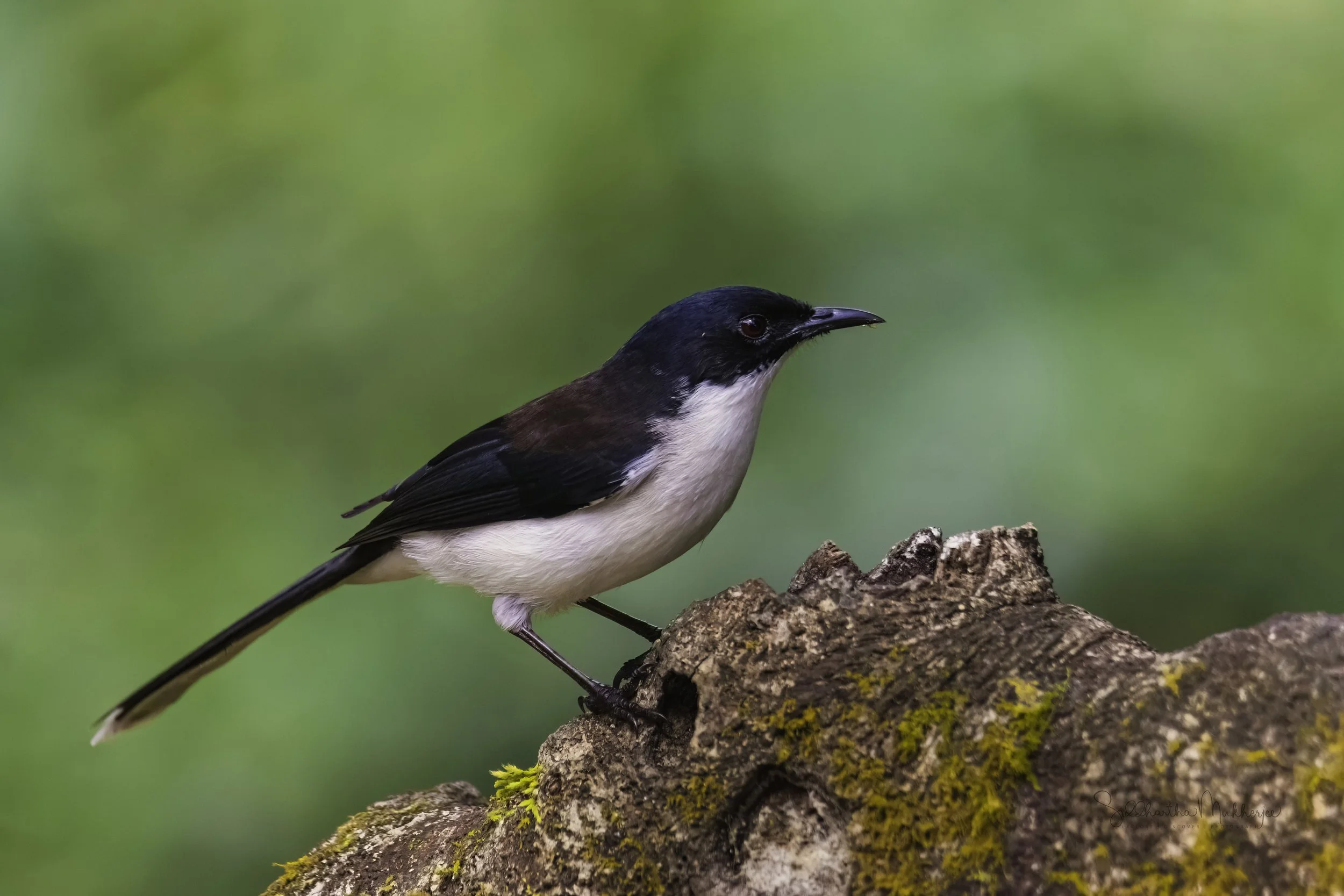
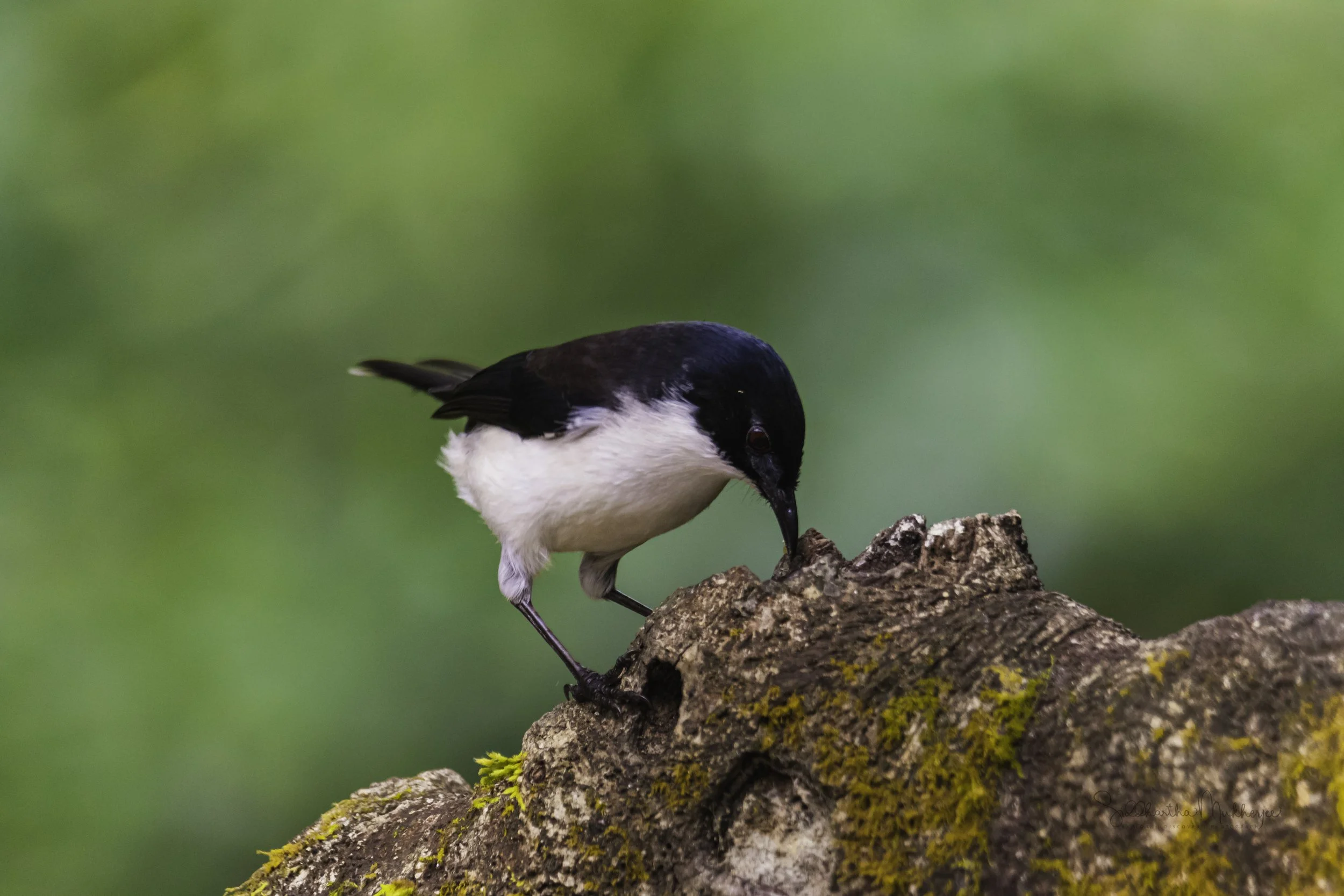
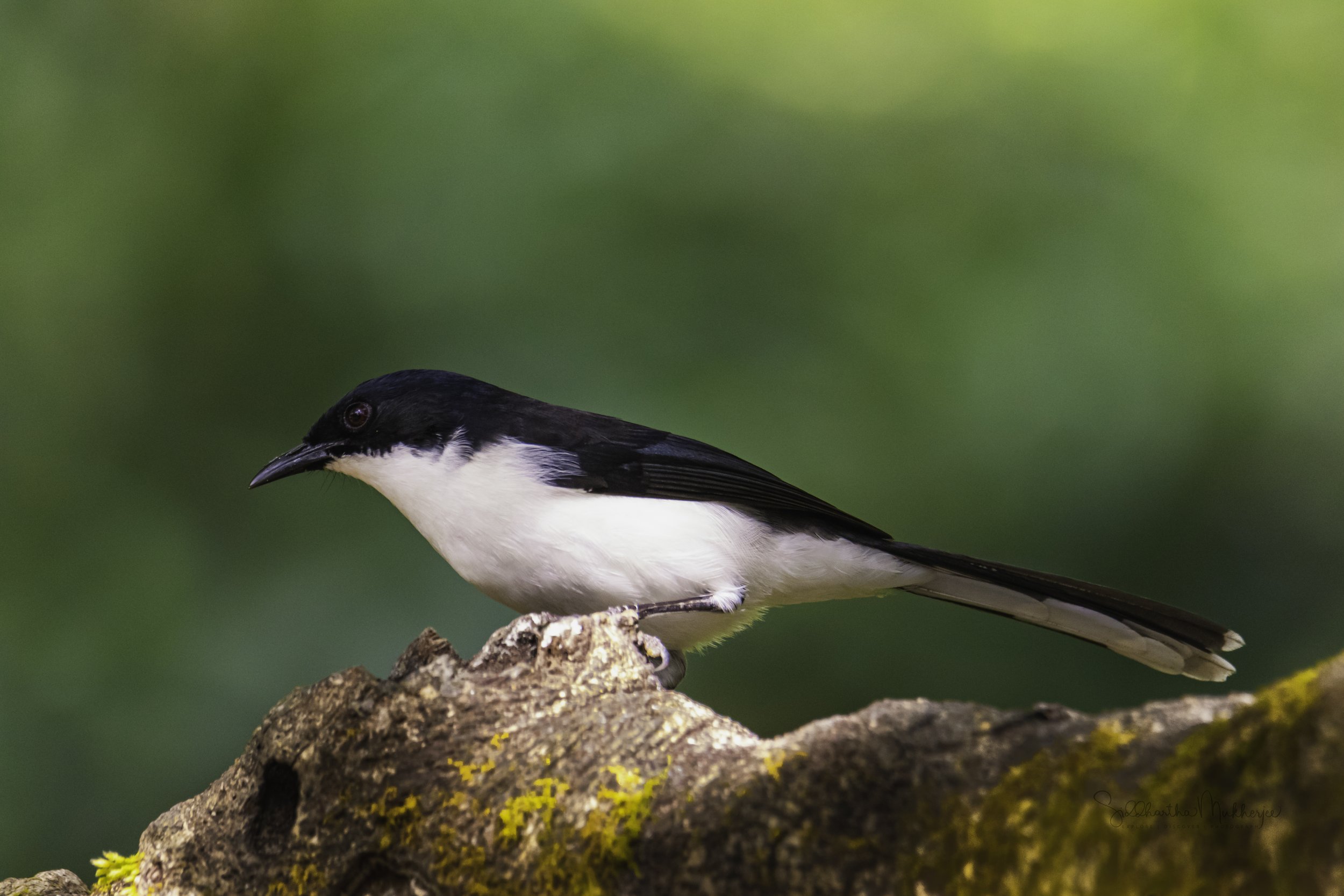
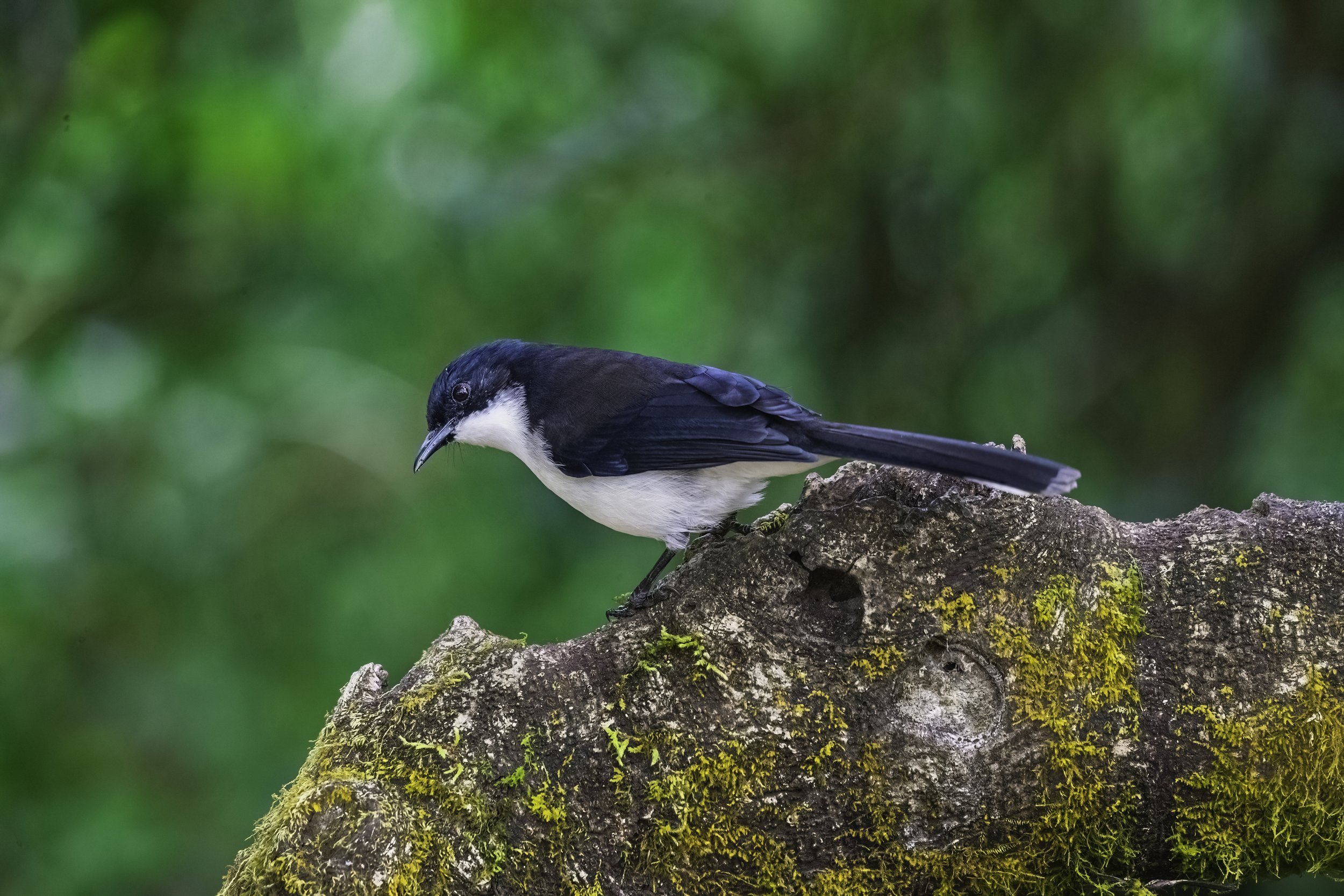
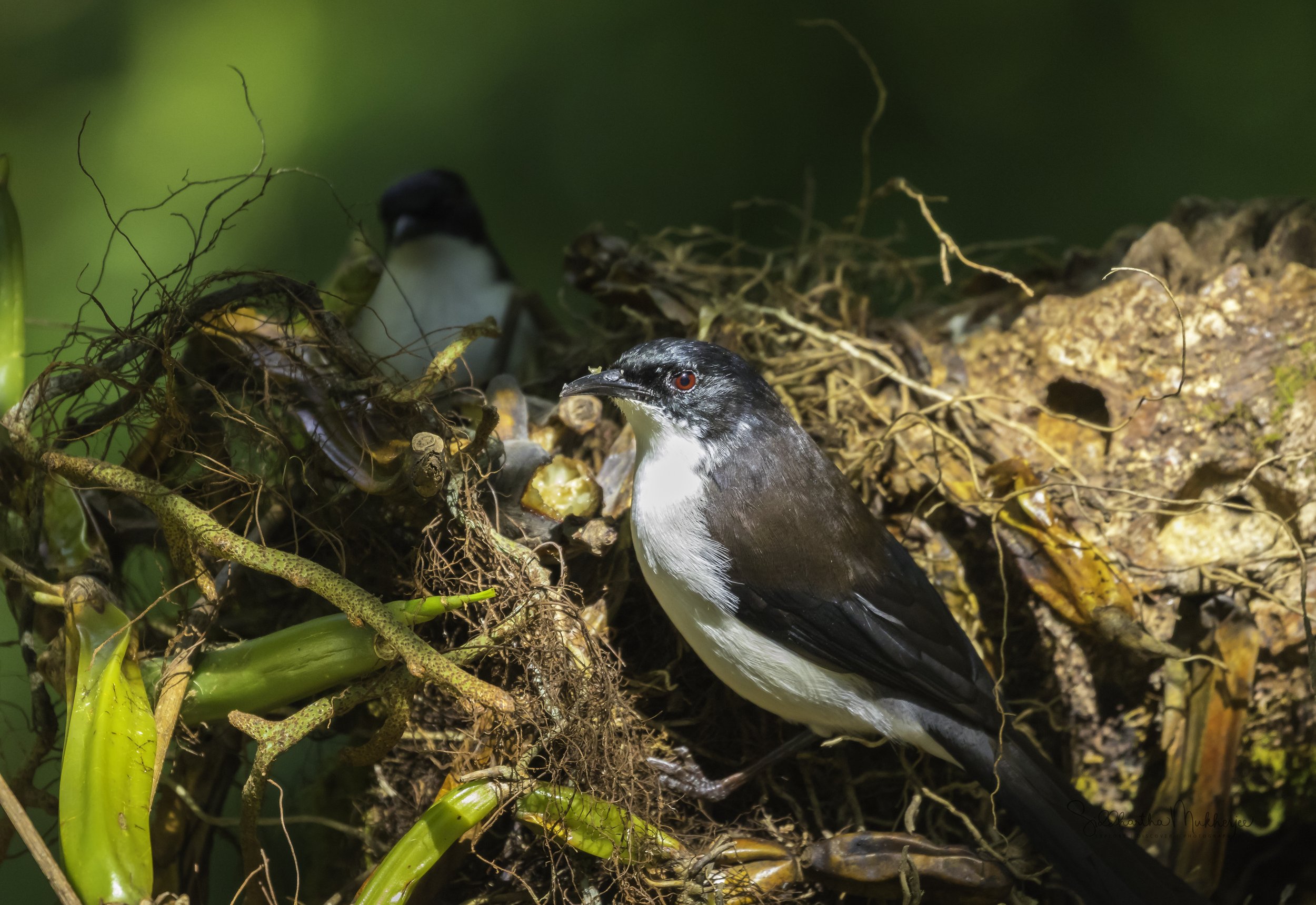
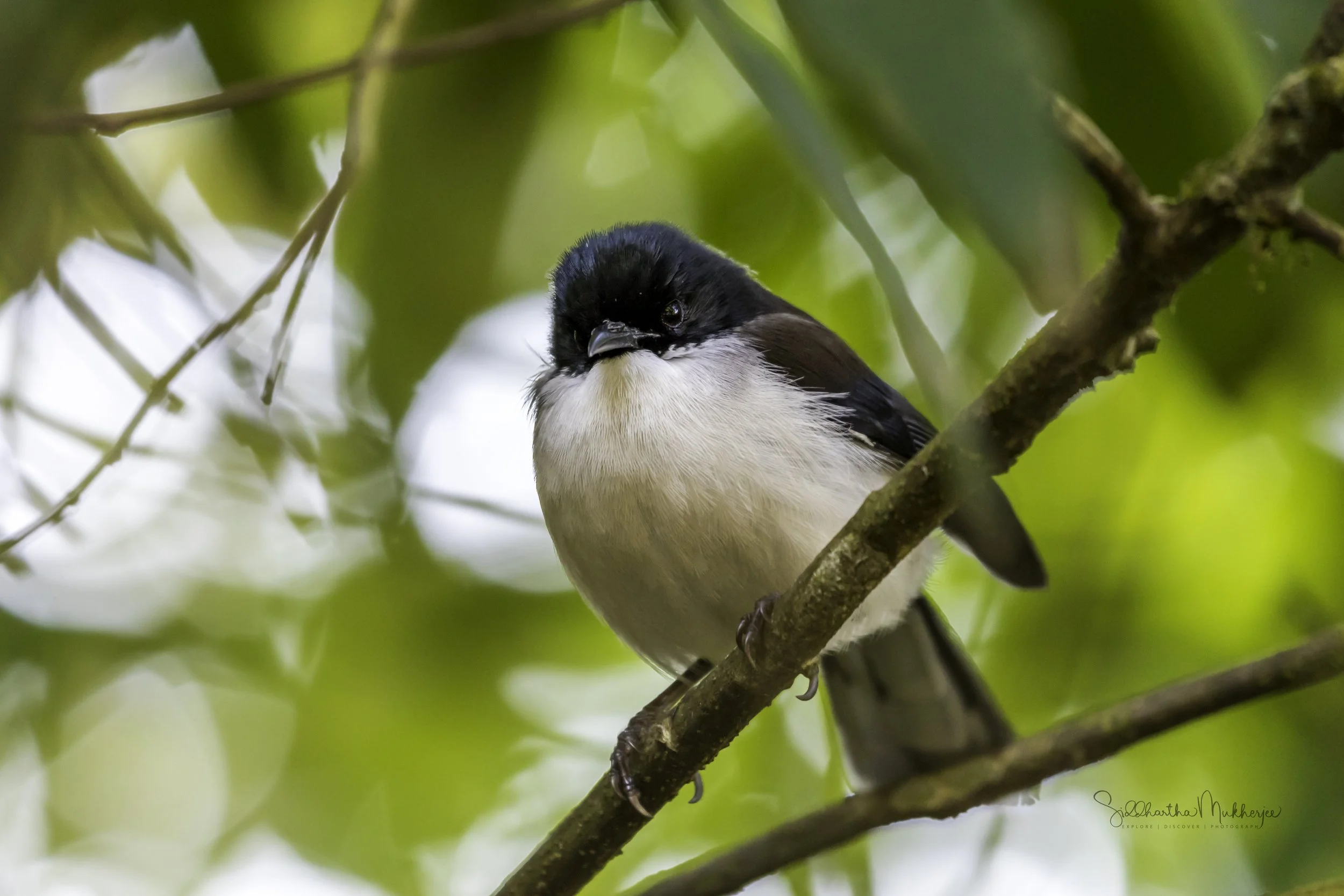
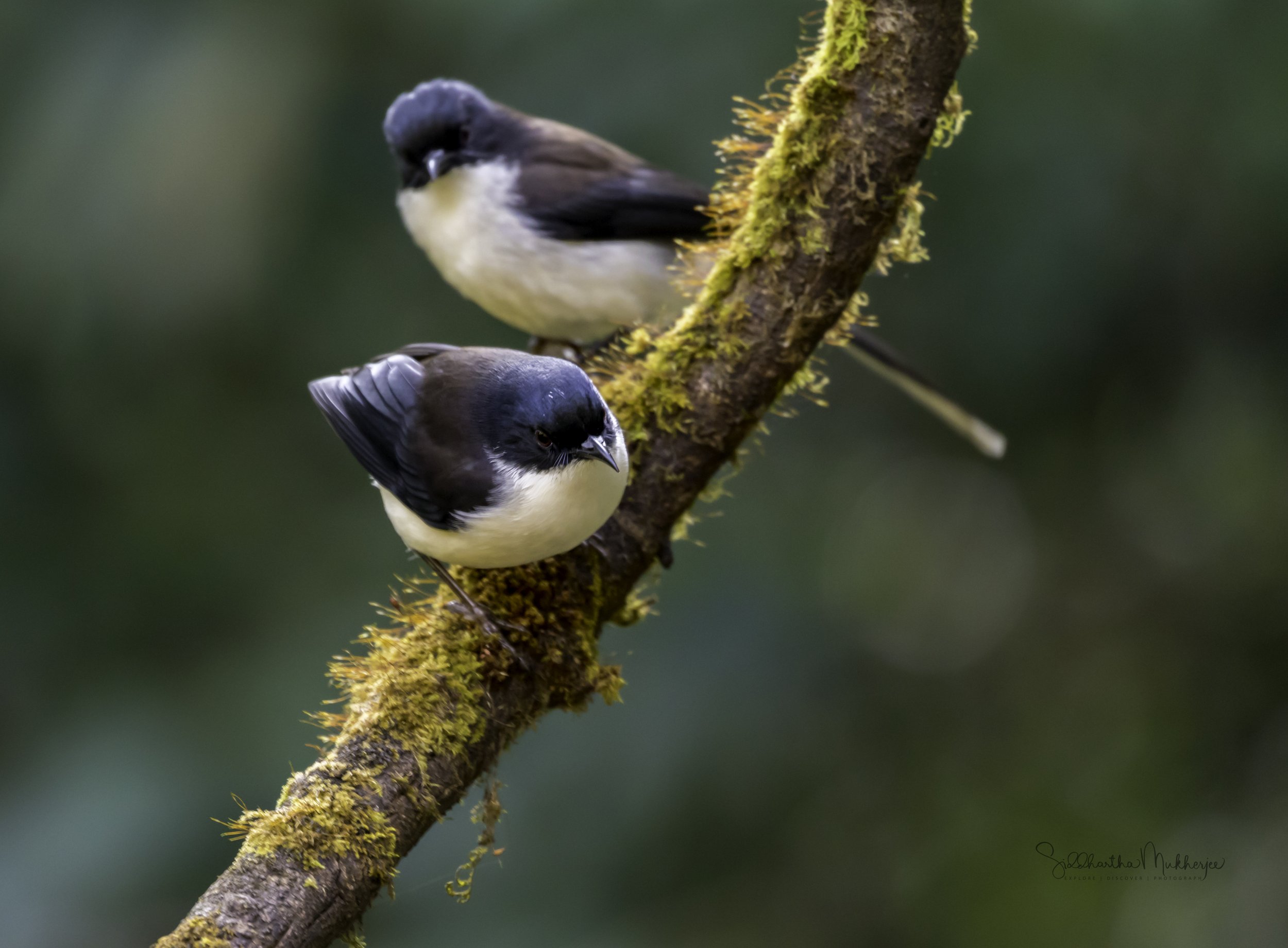
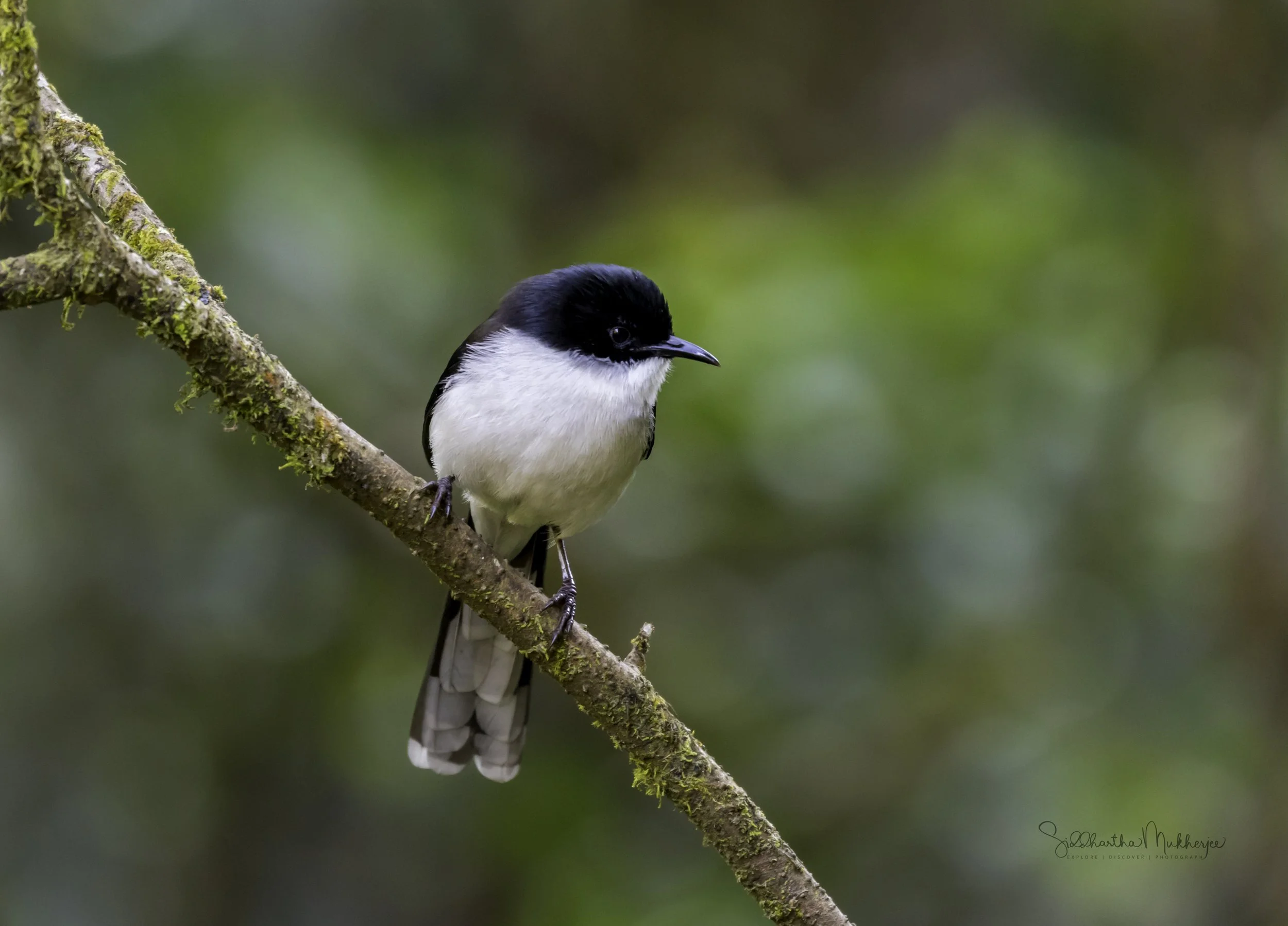
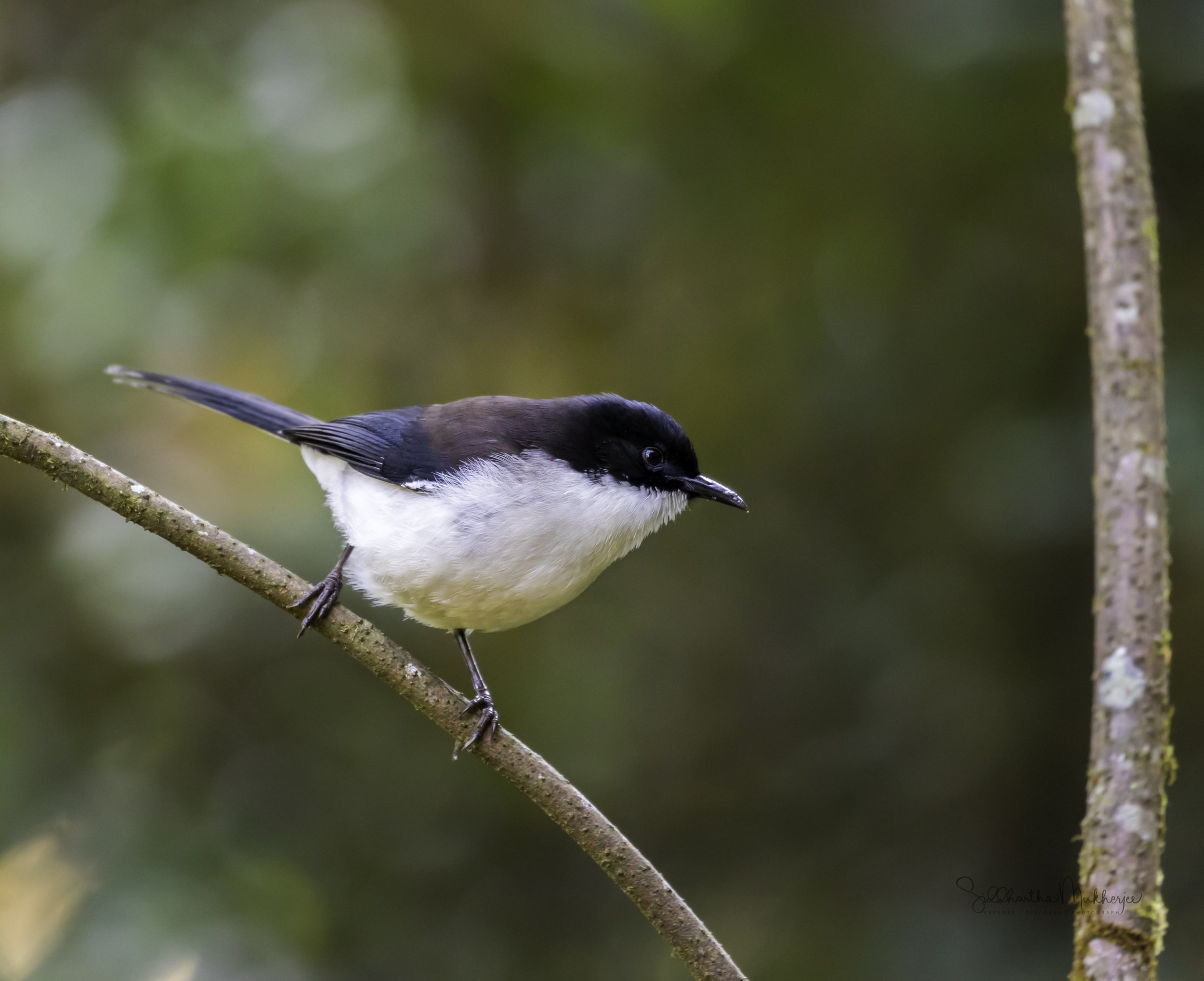
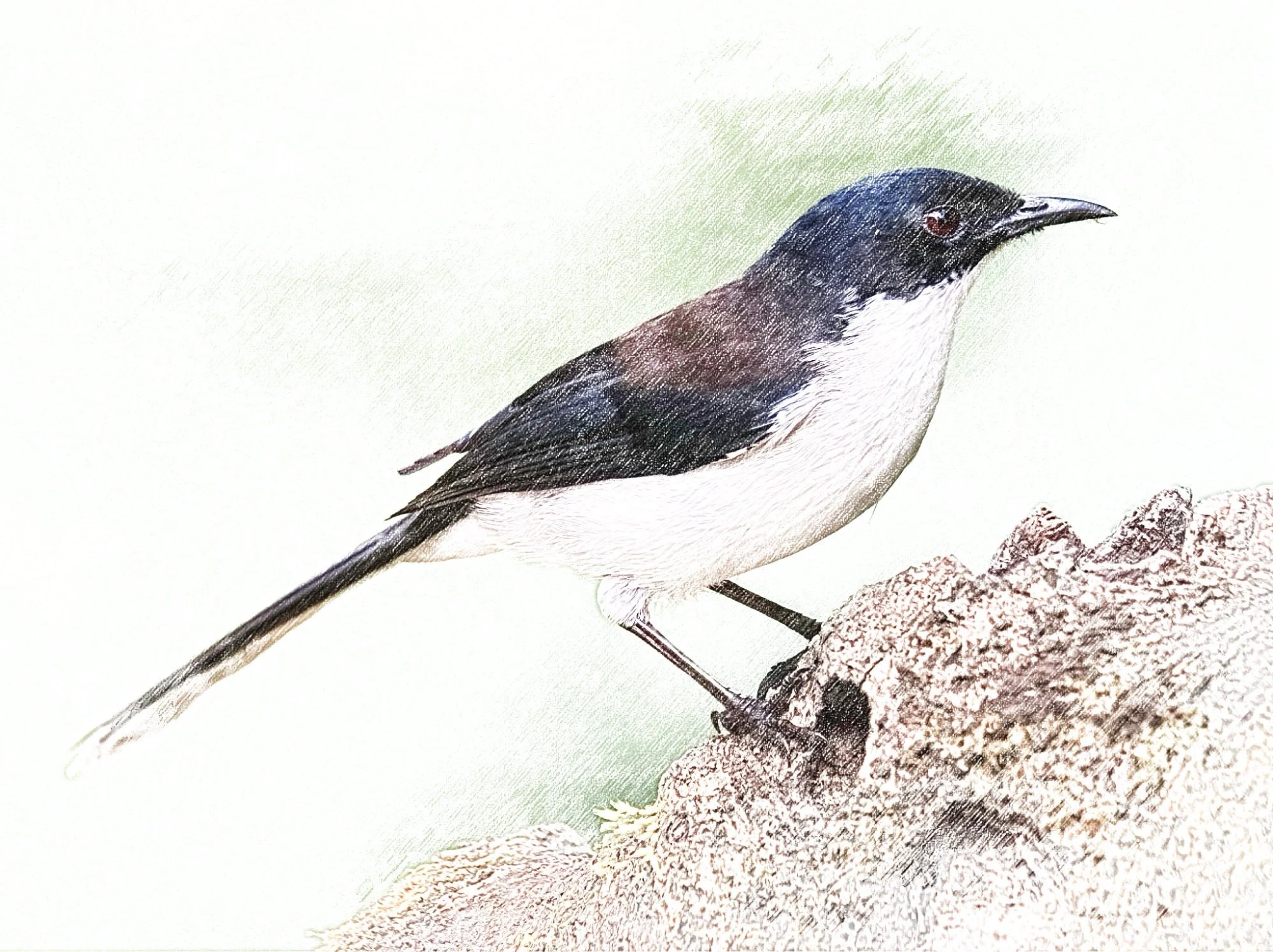
The Dark-backed Sibia is a masterclass in monochrome elegance, presenting an aesthetic that resembles a cross between a tiny, elongated magpie and a shrike. It typically stretches between 21 to 23 centimetres from its bill to the tip of its tail. And it is a lightweight, highly agile tree-dweller weighing between 23 and 39 grams. It possesses a slender, narrow, jet-black bill that is sharply pointed and slightly decurved, adapted perfectly for probing flowers and curling bark. It also features striking eyes with an iris that flashes dark reddish-brown, deep red, or occasionally pinkish-red.
The head is draped in a glossy, jet-black hood that covers the crown, lores, cheeks, ear-coverts & nape. The malar line shows fine black-and-white spotting under close inspection. This deep black gives way to a rich, warm coffee-brown mantle and upper back, which contrasts with its wings and tail. The upper wings are mostly blackish-brown with deep blue-black glossy fringes. When it takes flight across the mist-shrouded valleys of Doi Luang, pale, silvery-white panels on the inner flight feathers flash brilliantly against the dark forest background. The tail is long, dark brown, and subtly tipped with narrow white bands. In stark contrast to its dark upperparts, the bird's entire underside—from the throat down to the undertail coverts—is an immaculate, seamless snowy or creamy white. While the birds photographed at Doi SanJu and Doi Luang represent the classic Indochinese subspecies Heterophasia melanoleuca radcliffei, the species complex has an extensive footprint across the montane regions of Southeast Asia.
The Dark-backed Sibia is a resident of high-altitude zones across Northern Thailand, Myanmar, and Southwestern China (primarily Yunnan province). It is a quintessential resident of the continuous mountain chains that form the borderlands between Chiang Mai and the southern Shan State of Myanmar.
In India, the exact taxonomic classification of Heterophasia melanoleuca requires careful attention. Historically, the Black-headed Sibia (Heterophasia desgodinsi) was grouped as a subspecies of the Dark-backed Sibia. While true Heterophasia melanoleuca is dominant in Thailand and Myanmar, its closest sister species and regional counterparts inhabit the lush, wet hills of Northeast India:
Mizoram and Manipur: Occasional sightings of the closely related Black-headed/Dark-backed complex occur along the chin hills and eastern border forests.
Arunachal Pradesh: This region is dominated by related species like the Beautiful Sibia (Heterophasia pulchella) and the Black-eared morphs (Heterophasia pulchella nigroaurita).
The Himalayas: The temperate forests of West Bengal (Darjeeling), Sikkim, Nepal, and Bhutan are instead the stronghold of the Rufous Sibia (Heterophasia capistrata).
To distinguish the Dark-backed Sibia from its relatives across India and Southeast Asia, birdwatchers evaluate its stark white underparts and coffee-brown back.
| Species | Primary Range | Distinctive Physical Features | Key Diagnostic Differences |
|---|---|---|---|
| Dark-backed Sibia (Heterophasia melanoleuca) | Thailand, Myanmar, S. China | Coffee-brown back, jet-black crown, pure white underparts. | Lacks the grey chest tones of desgodinsi; completely white below. |
| Black-headed Sibia (Heterophasia desgodinsi) | China, Laos, Vietnam | Black crown sharply separated from a pale grey/brown mantle; grey-washed breast. | Upper chin is white; breast and flanks are suffused with distinct pale grey. |
| Rufous Sibia (Heterophasia capistrata) | India, Nepal, Bhutan | Rufous-orange body, black cap, blue-grey wings, and a prominent crest. | Completely different color scheme; dominated by bright orange/rufous tones |
| Beautiful Sibia (Heterophasia pulchella) | NE India, SW China, Myanmar | Silky blue-grey plumage with a weak black face mask. | Lacks brown or white entirely; uniform blue-grey look. |
| Gray Sibia (Heterophasia gracilis) | NE India, Myanmar | Grey body with a brown cast on the back, dark head, silver wing panels. | Underparts are pale grey to dull white, lacking the clean snowy contrast of melanoleuca. |
| Long-tailed Sibia (Heterophasia picaoides) | SE Asia, Sumatra | Very long tail, uniform slate-grey body, white wing patch, small head. | Drab grey overall; completely lacks contrasting dark-and-white patterns. |
The Dark-backed Sibia is a specialist of the subtropical and tropical moist montane forests. It thrives in altitudinal bands ranging from 1,000 to 2,565 metres above sea level. In the environs of Doi Pha Hom Pok, the bird spends the majority of its life in the upper and middle storeys of broadleaf evergreen hill forests. It shows a strong affinity for Old-growth oak and chestnut forests laden with mosses, lichens, and orchids; stands of native hill pines (Pinus kesiya) intermingled with broadleaved valleys; primary forest edges where fruiting bushes grow along slopes and ridges.
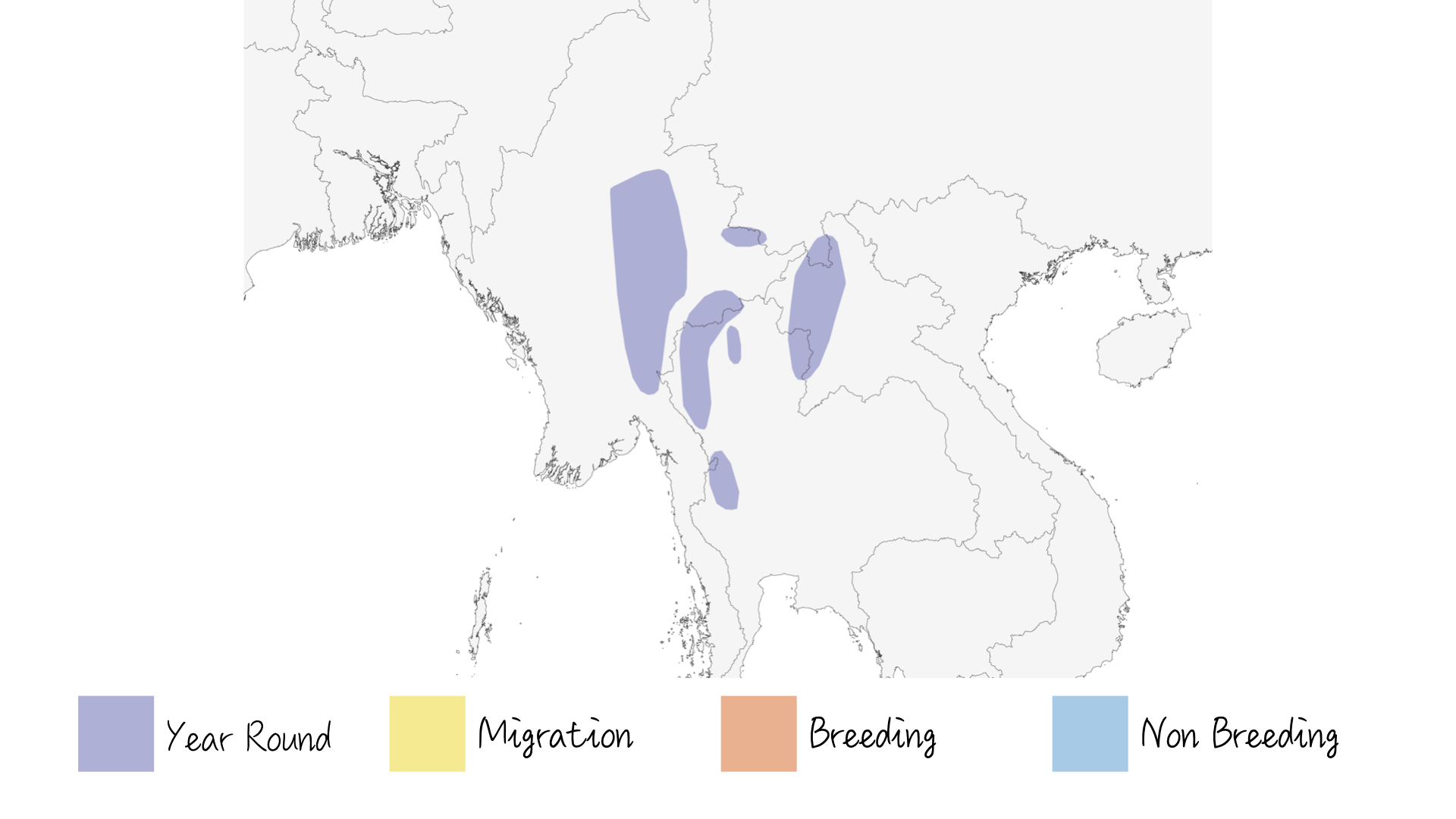
On the steep slopes of Doi Luang and Doi SanJu, the Dark-backed Sibia experiences micro-habitat overlaps with several species. While it occupies the high canopy to forage, it frequently forms loose, multi-species feeding flocks with the Silver-eared Laughingthrush (Trochalopteron melanostigma) and the Spectacled Barwing (Actinodura ramsayi), which work the middle and lower storeys.
Critically, it occasionally shares territory with the Long-tailed Sibia (Heterophasia picaoides) & the Rufous-backed Sibia (Minla anchiroptera). In these shared zones, the Dark-backed Sibia maintains its niche by foraging along primary forest branches, whereas the Long-tailed Sibia tends to prefer more open, secondary scrub edges and taller emergent pines.
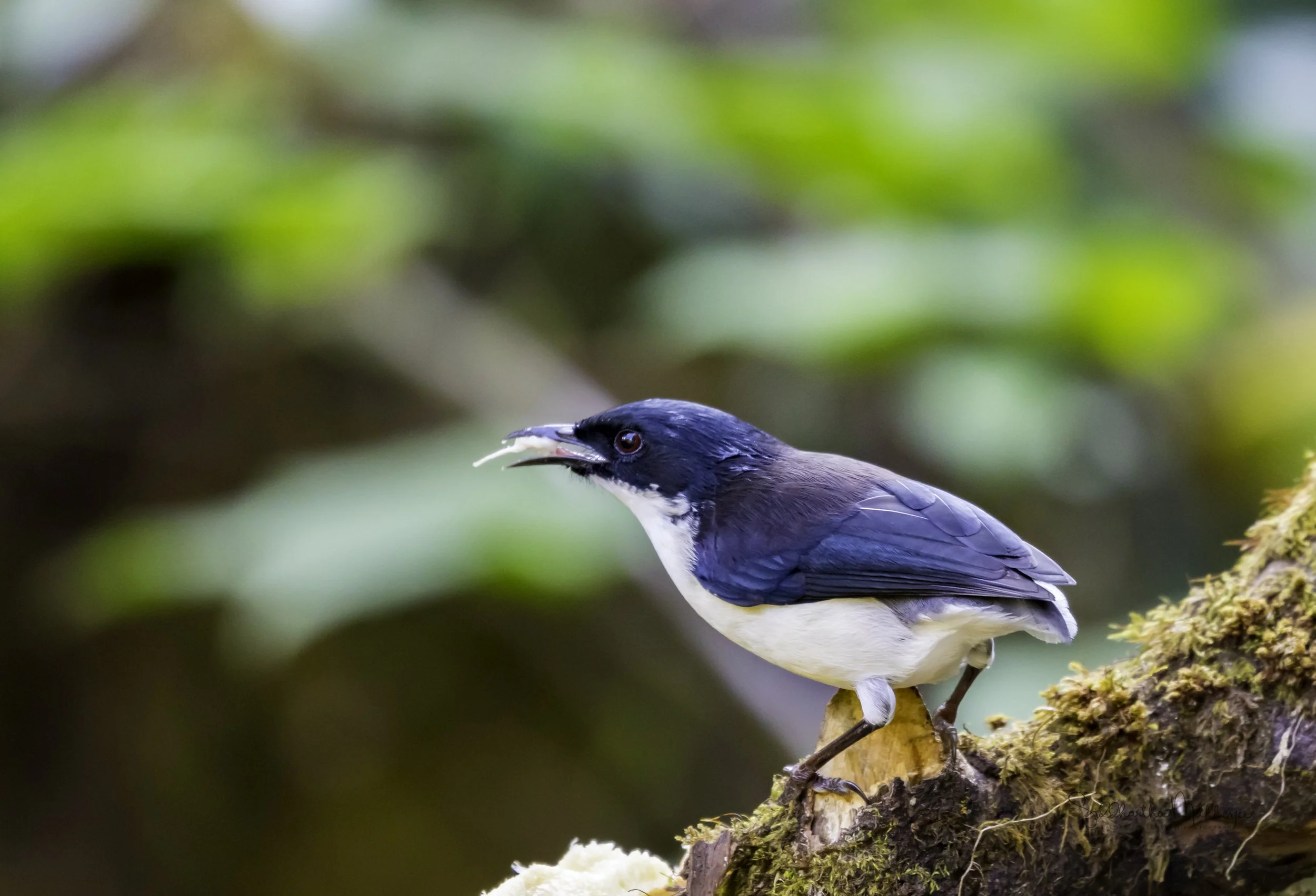
To watch a Dark-backed Sibia in the wild is to witness a bird in constant motion. They are energetic and agile foragers, moving through the canopy with jerky, acrobatic leaps, sometimes hanging upside down from terminal leaf clusters to inspect the undersides of leaves. The species is omnivorous, varying its diet depending on seasonal availability:
Insects and Larvae: Probes mossy bark and epiphytes for beetles, caterpillars, and grubs.
Nectar: Regularly visits flowering trees like wild cherries and rhododendrons, acting as an important regional pollinator.
Berries and Wild Figs: Gathers in small groups around fruiting bushes on steep forest paths.
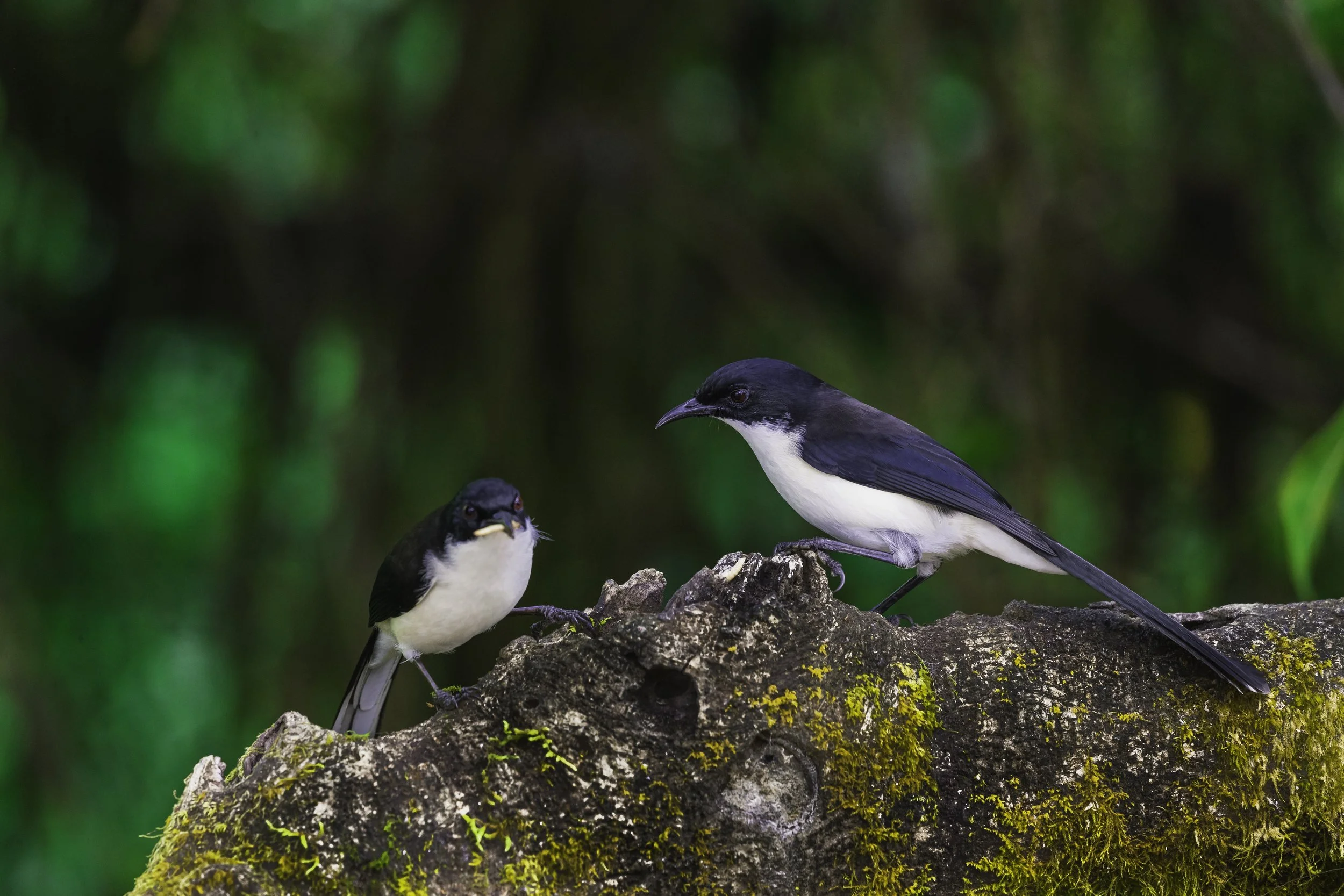
Unlike some babblers that skulk silently in the undergrowth, Dark-backed Sibias are highly social and vocal. They travel in pairs during the breeding season (February to June) and congregate into rowdy flocks of 6 to 15 birds during the winter months. The vocal behavior of the Dark-backed Sibia is a defining feature of the northern Thai mountains. Its song is a striking, loud, metallic trilled whistle that rises sharply before trailing off into a series of descending notes, transcribed as “hrrrr'rrr'r'r'i-u”. When a flock travels through the mist, they maintain contact via harsh, dry, rattling notes given in rapid succession (“trr-trr-trr-trr”). This vocalization stands in contrast to the Beautiful Sibia, which produces thin, querulous twitters and drawn-out squeaks, or the Rufous Sibia, whose song is a more structured series of melodic phrases delivered on a nearly identical pitch.
Currently, the Dark-backed Sibia is classified as Least Concern on the IUCN Red List due to its relatively wide regional range. However, its reliance on primary montane evergreen forests makes it highly vulnerable to localized habitat loss, fragmentation, and climate shifts.
Unusual Behavioral Shifts
As logging, agriculture, and road construction encroach upon the edges of Doi Pha Hom Pok National Park, scientists and birdwatchers have noted several behavioral modifications in the species:
Descent to Lower Storeys: Naturally canopy-loving birds, Dark-backed Sibias are increasingly forced to descend closer to the forest floor and undergrowth to forage on secondary fruiting shrubs when old-growth canopies are disrupted.
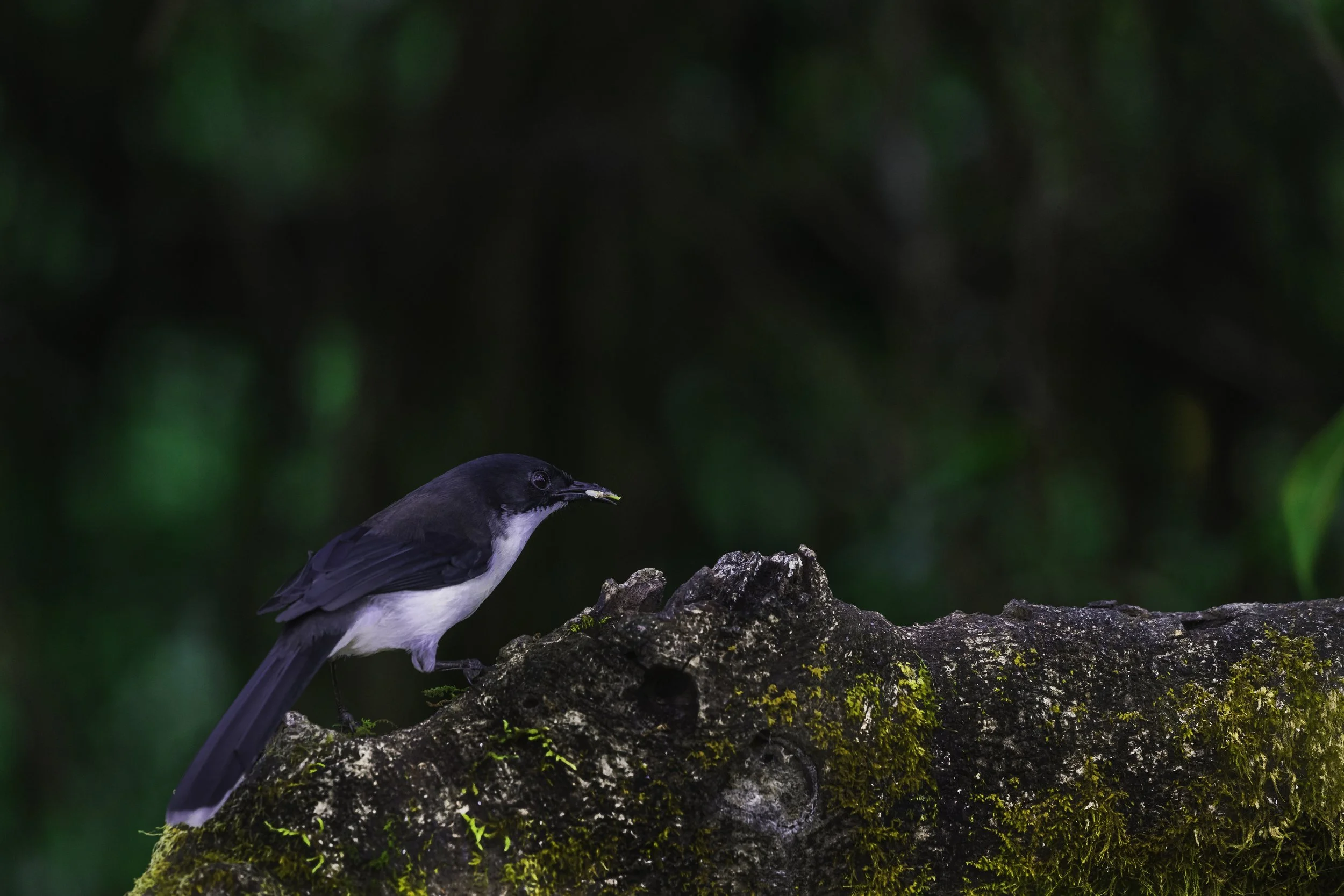
Exploitation of Human Borders: Along the military and police checkpoints of Doi San Ju, the birds have adapted to human activity. Flocks frequently drop down to artificial feeding stations established by bird photographers, showing an unusual tolerance for humans to access easy food sources like mealworms and fruit.
Changes in Nesting Materials: During the breeding season, pairs build a compact cup nest out of moss, pine needles, and leaves. In areas near human paths or settlements, they have begun integrating modern debris—such as bits of string, plastic fiber, and discarded paper—into the outer walls of their nests, lining the interiors with fungi stalks and animal hair.
The snapshot of the Dark-backed Sibia at Doi San Ju captures more than a beautiful bird on a misty mountain; it represents a resilient montane specialist navigating a changing Asian landscape. Protecting the primary evergreen canopies of sanctuaries like Doi Pha Hom Pok remains critical to ensuring its metallic trills continue to echo across the peaks.
‡‡‡‡‡

Related Posts


Truly long-tailed, even for a sibia, this bird appears rather dainty and small-headed in comparison with most of its relatives. Gray overall, darker on the wings and tail, it mostly lacks the contrasting patterns of other sibias, with only a small white patch near the wingtip. It forages in flocks in open hill forests, edges, and adjacent scrubby second growth. Despite its striking appearance, it is often heard before it’s seen.
#wildartworks, #Canon, #PromediagearTR424L, #Bird, #Birdinginthewild, #BirdWatching, #Wildlife, #WildBirds, #naturephotography, #your_best_birds, #planetbirds, #earthcapture, #photo_pond, #earthpix, #naturyst, #conservationphotography, #wildlifeonearth, #bbcearth, #natgeowild, #natgeoindia, #BukitFraser, #FrasersHill, #Malaysia, #longtailedsibia, #sibia,