
Black Drongo
Dicrurus macrocercus
A creature of the open across Telangana & India
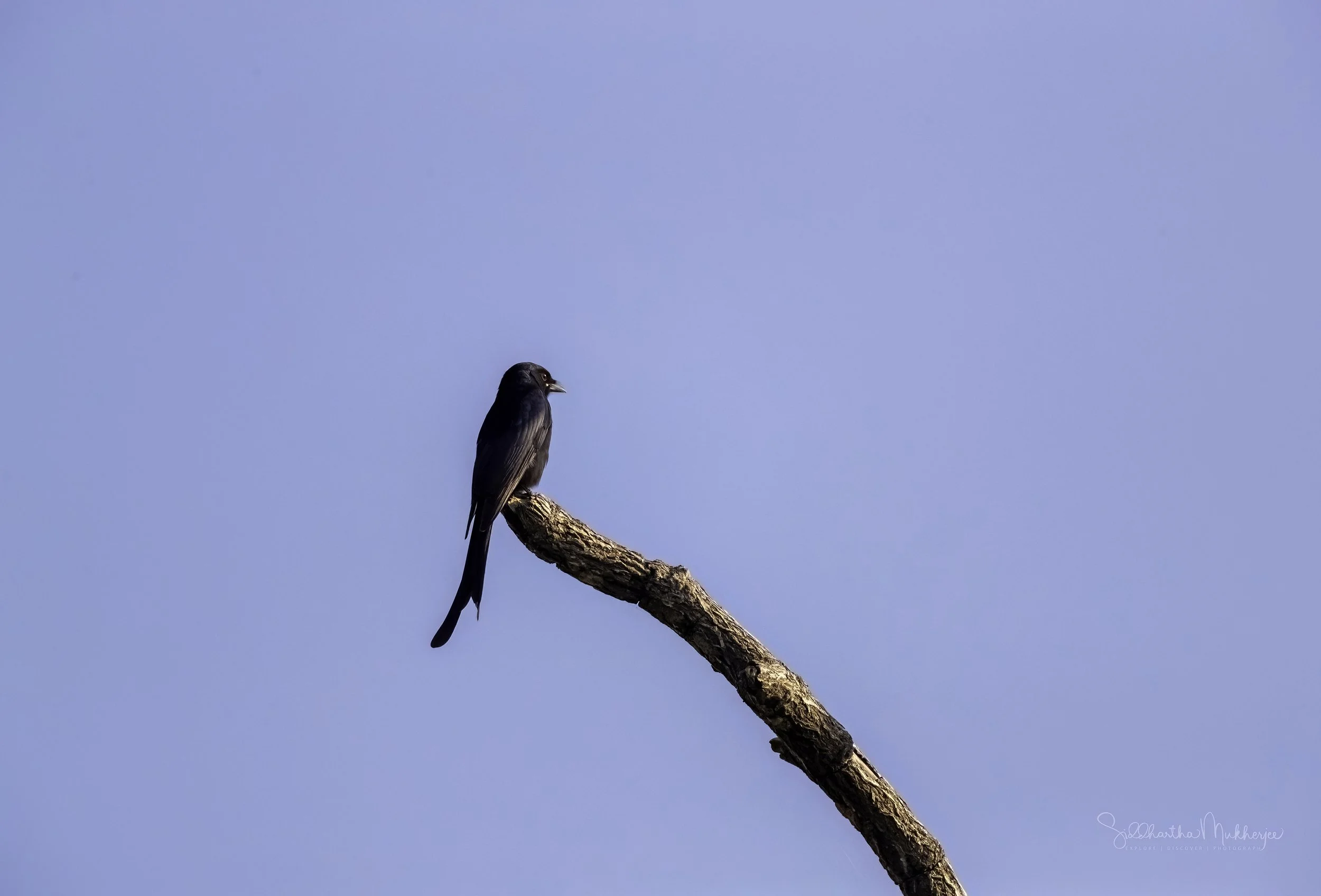
The first thing you notice in the open fields of Telangana isn't the bird itself, but its silhouette—a sharp, fork-tailed sentry perched atop a rusted barbed-wire fence or the back of a grazing buffalo. This is the Black Drongo (Dicrurus macrocercus), a bird so bold and ubiquitous it has earned the nickname “King Crow”. It is a common resident breeder found throughout the open habitats of Telangana and the wider Indian subcontinent. These birds are highly adaptable and are primarily seen in areas that provide a combination of high vantage points for hunting and clear, open spaces. The Black Drongo avoids dense forests, preferring "open country" where it can easily spot and chase aerial insect prey.
Telangana's landscape is dotted with ideal habitats, from the urban oases of Ameenpur Lake, Osman Sagar, HImayat Sagar, Kistareddypet Lake near Hyderabad to the sprawling Singur Dam, the Sri Ram Sagar Reservoir and the Dindi Reservoir. Renowned for its extensive natural resources, breathtaking scenery, and rich cultural legacy Telangana is the eleventh largest state in India situated on the south-central stretch of the Indian peninsula on the high Deccan Plateau. It is the twelfth-most populated state in India with a geographical area of 112,077 km² of which 21,214 km² is forest cover. The dry deciduous forests ecoregion of the central Deccan Plateau covers much of the state, including Hyderabad. The characteristic vegetation is woodlands of Hardwickia binata and Albizia amara. Over 80% of the original forest cover has been cleared for agriculture, timber harvesting, or cattle grazing, but large blocks of forest can be found in the Amrabad Tiger Reserve and elsewhere. The more humid Eastern Highlands moist deciduous forests cover the Eastern Ghats in the eastern part of the state. The Central Deccan forests have an upper canopy at 15–25 meters, and an understory at 10–15 meters, with little undergrowth.
The dry sub-humid zone or Dichanthium-cenchrus-lasitrrus type of grasslands are prevalent here and cover almost the entirety of peninsular India except the Nilgiris. One sees thorny bushes like the Acacia catechu or Khair as it is known in Hindi, Mimosa, Zizyphus (Ber) and sometimes the fleshy Euphorbia, along with low trees of Anogeissus letifolia or Axle Wood, Soymida febrifuga - the Indian Redwood - and other deciduous species. Sehima (grass) which is more prevalent on gravel is about 27% of the cover and Dichanthium(grass) which flourishes on level soil is almost 80% of the coverage.
Nallamala Hills & forest range
The Nallamala Hills and forest range is a significant geographical feature within the Eastern Ghats of southern India, located in Telangana and stretching into Andhra Pradesh. This ~430 km long range, parallel to the Coromandel Coast, features rugged hills and deep valleys and hosts one of the largest contiguous forest areas in the region, encompassing a significant portion of the Nagarjuna Sagar Srisailam Tiger Reserve. The rugged, sparsely populated hills are composed for the most part of jumbled quartzites and slates and exemplify the mountain scenery of the Eastern Ghats. The range is known for its rich biodiversity, eco-tourism opportunities, and important religious sites like the Srisailam temple. It is bounded by the Krishna River to the north and the Pennar River to the south. The region includes important religious sites like the Srisailam Temple, one of the twelve Jyotirlingas. The Nallamala region has faced threats from proposed uranium mining projects, which would jeopardize the Tiger Reserve and the Chenchu's traditional way of life. Organisations like HYTICOS and local tribes have actively campaigned against these projects to protect the delicate ecosystem.
In the Nallamalla Hills and forest range the predominant vegetation is dry deciduous forest, with species such as Terminalia (తెల్ల మద్ది, అర్జున, ఎర్రమద్ది), Hardwickia (ఏపీ, నరేపీ), and Pterocarpus (ఏగిస, పెద్దగి and ఎర్ర చందనం). The forest also has a variety of medicinal plants. The forest is home to various mammals like Tigers, Leopards, Sloth Bears, Wild Boar, Sambhar, Blackbucks, and Pangolins. A variety of birds, including rare and migratory species, inhabit the sanctuary. Read about some of the species here. It is also host to diverse reptile species, including the King Cobra and Indian Rock Python and the forest is known for unique spider species like the critically endangered Gooty Sapphire Ornamental Tarantula (Poecilotheria metallica). The Chenchus, a forest-dwelling tribe, are the indigenous inhabitants of the Nallamala forest. They traditionally live a semi-nomadic, hunter-gatherer lifestyle and have remained largely cut off from modern society. The Chenchus have a unique, symbiotic relationship with the forest and play a key role in its conservation.
Uma Maheshwaram is the northern gateway to Srisailam — one of the jyotirlingas, on a hill surrounded by high trees. The Uma Maheshwaram temple is dedicated to the Hindu god Shiva located in the Nallamala Forest around 100 km from Hyderabad on the Hyderabad-Srisailam highway, about 4 kms from the village of Rangapur, Achampet. Nearby hills shield the temple and the 500-metre stretch to PapaNasanam (a mysterious spring of unknown source from which water can be drawn continuously through the year) from sunlight for most of the day, maintaining a temperature lower than the surroundings during the entire year. The area abounds in flora and fauna like the beautiful and Vulnerable Yellow-throated Bulbul.
‡‡‡‡‡
For a print of the beautiful wildlife from my various sojourns click on the button below to read my process and order a limited edition canvas from the catalog.
Black Drongo
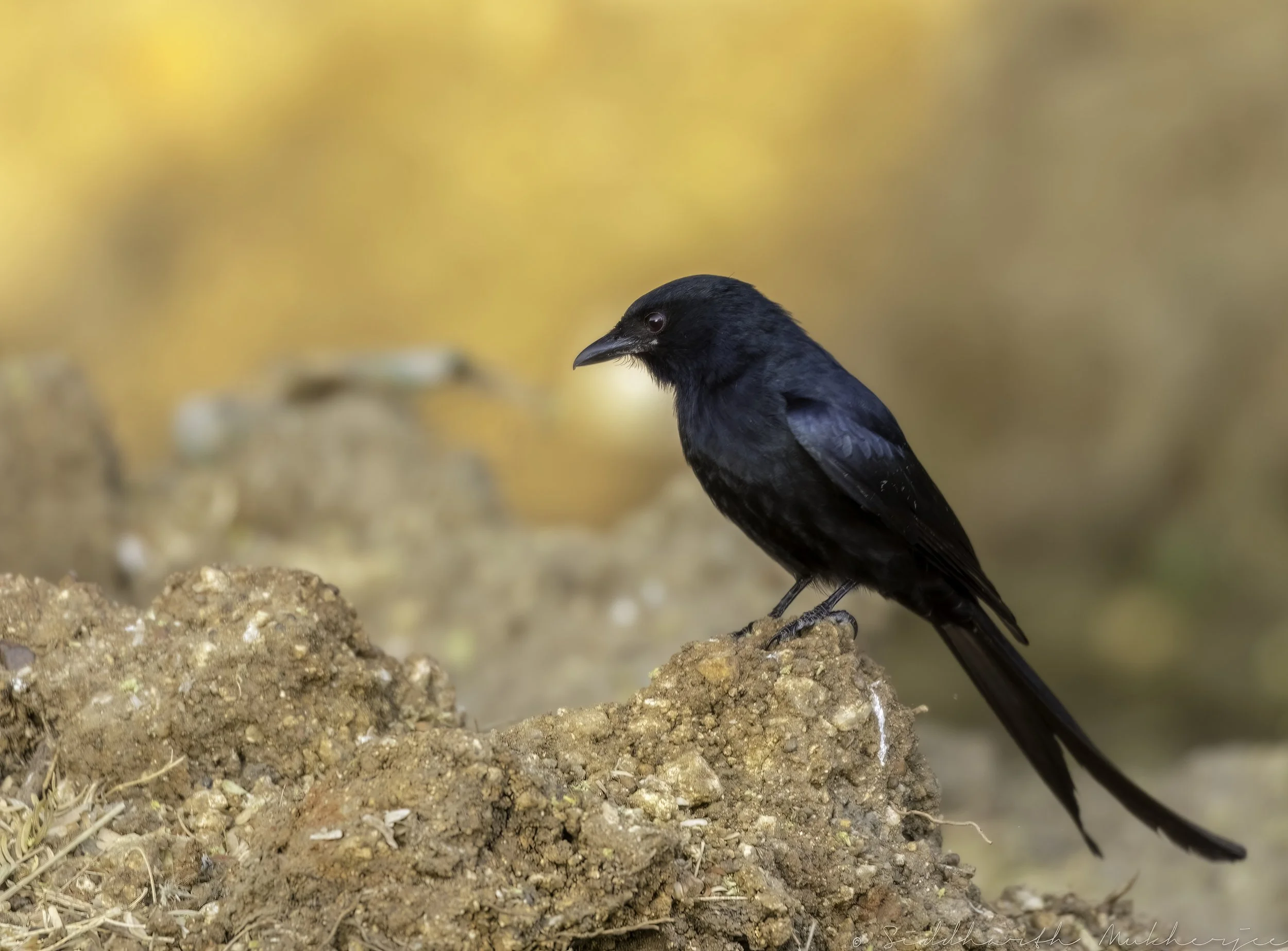
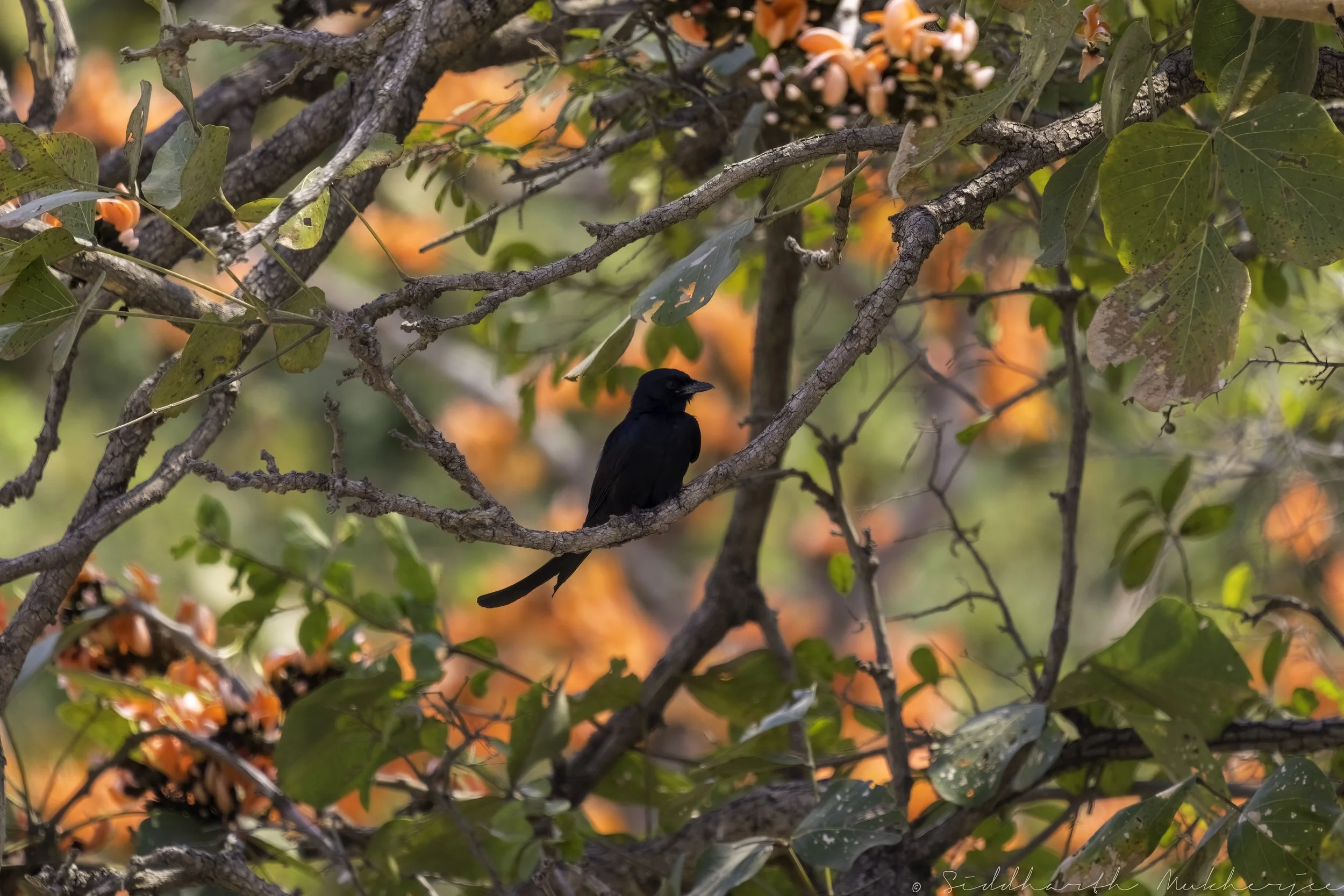
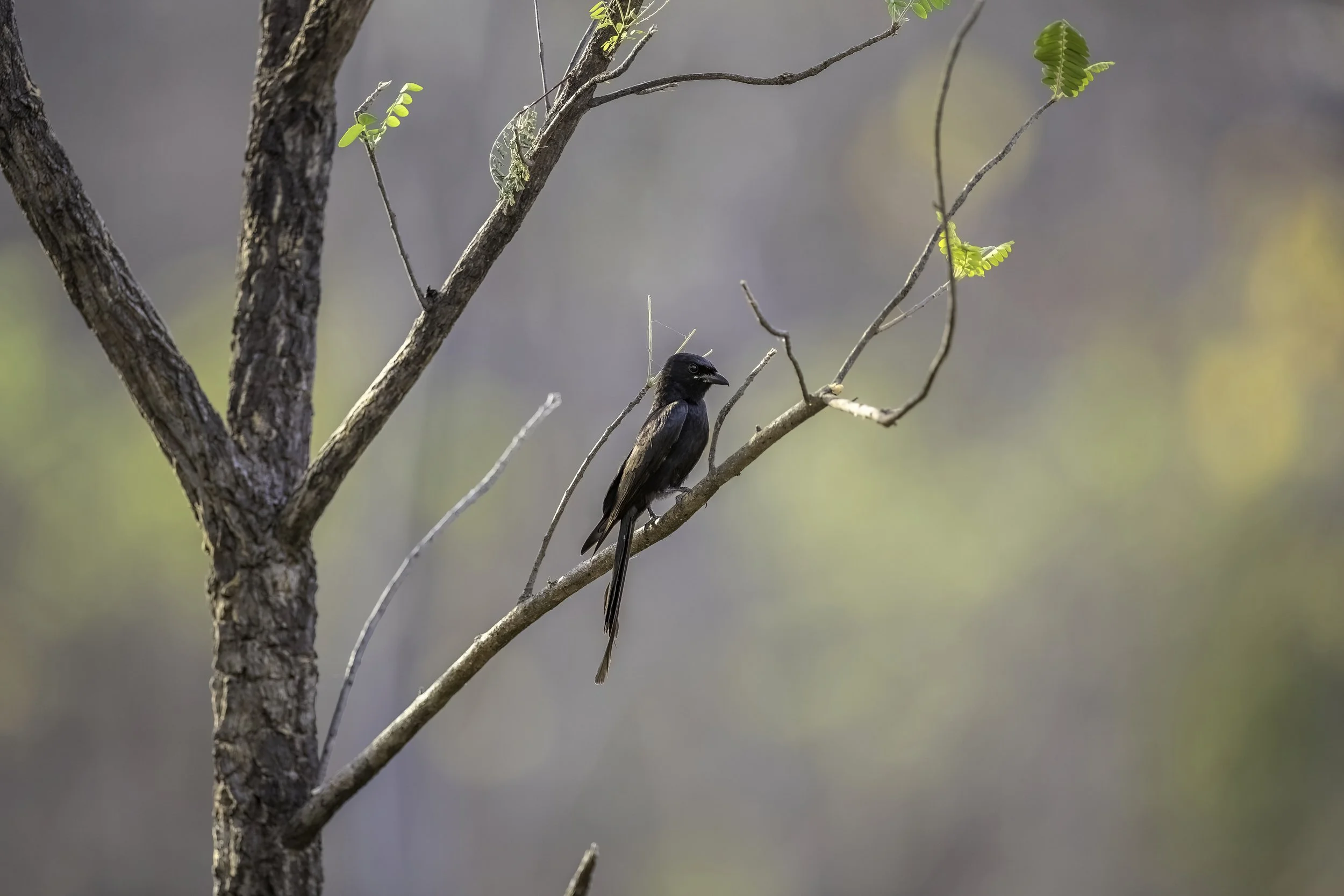
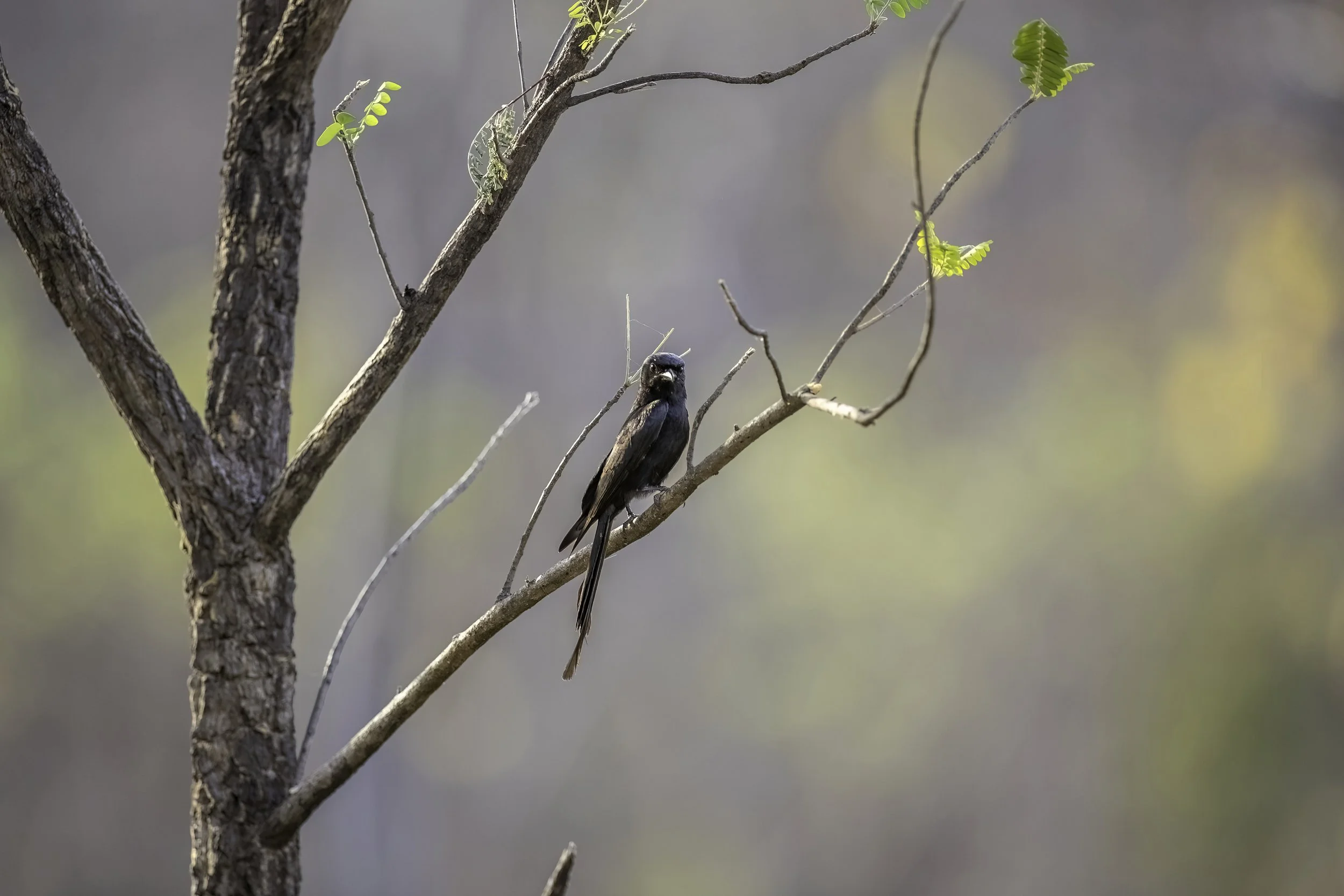
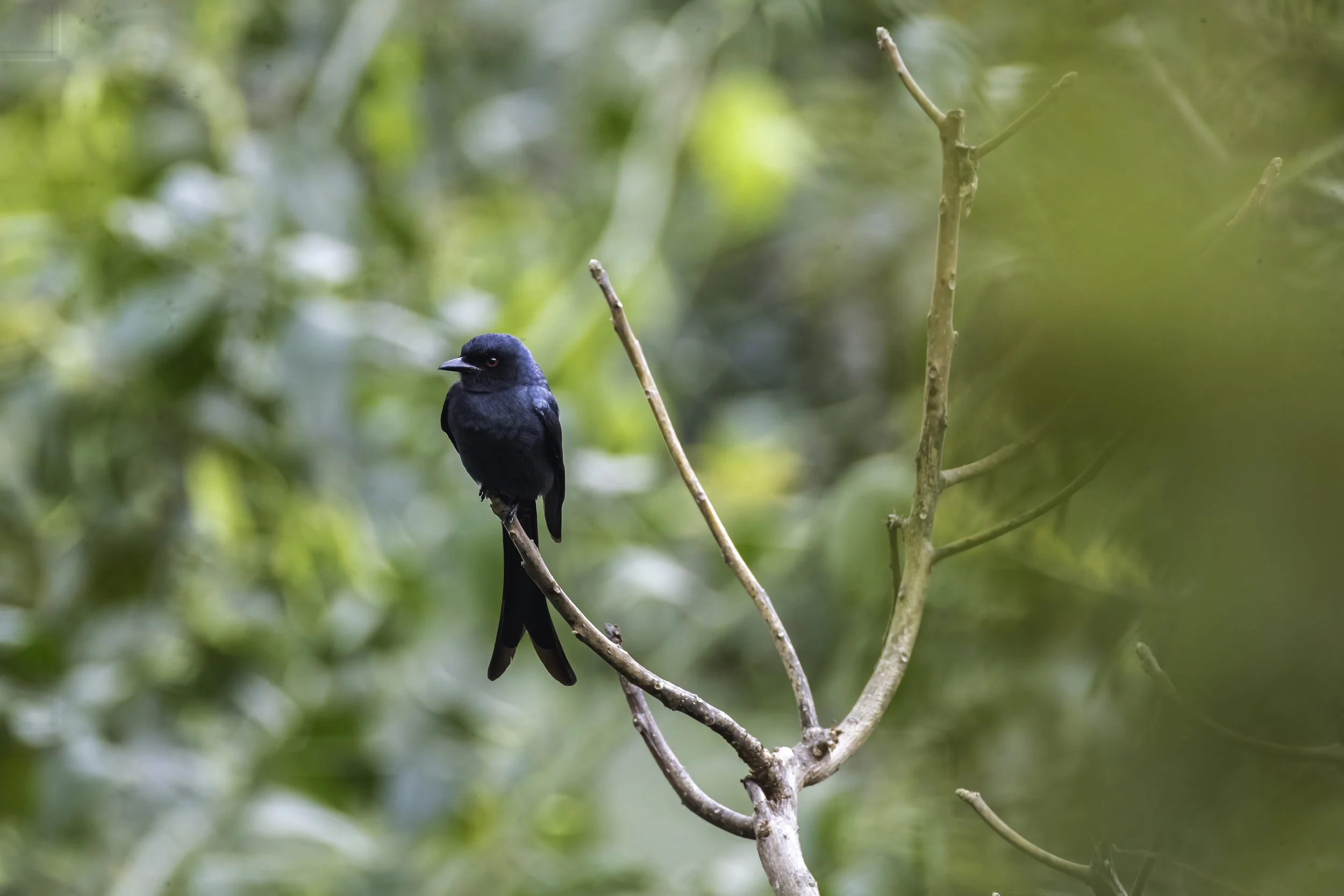
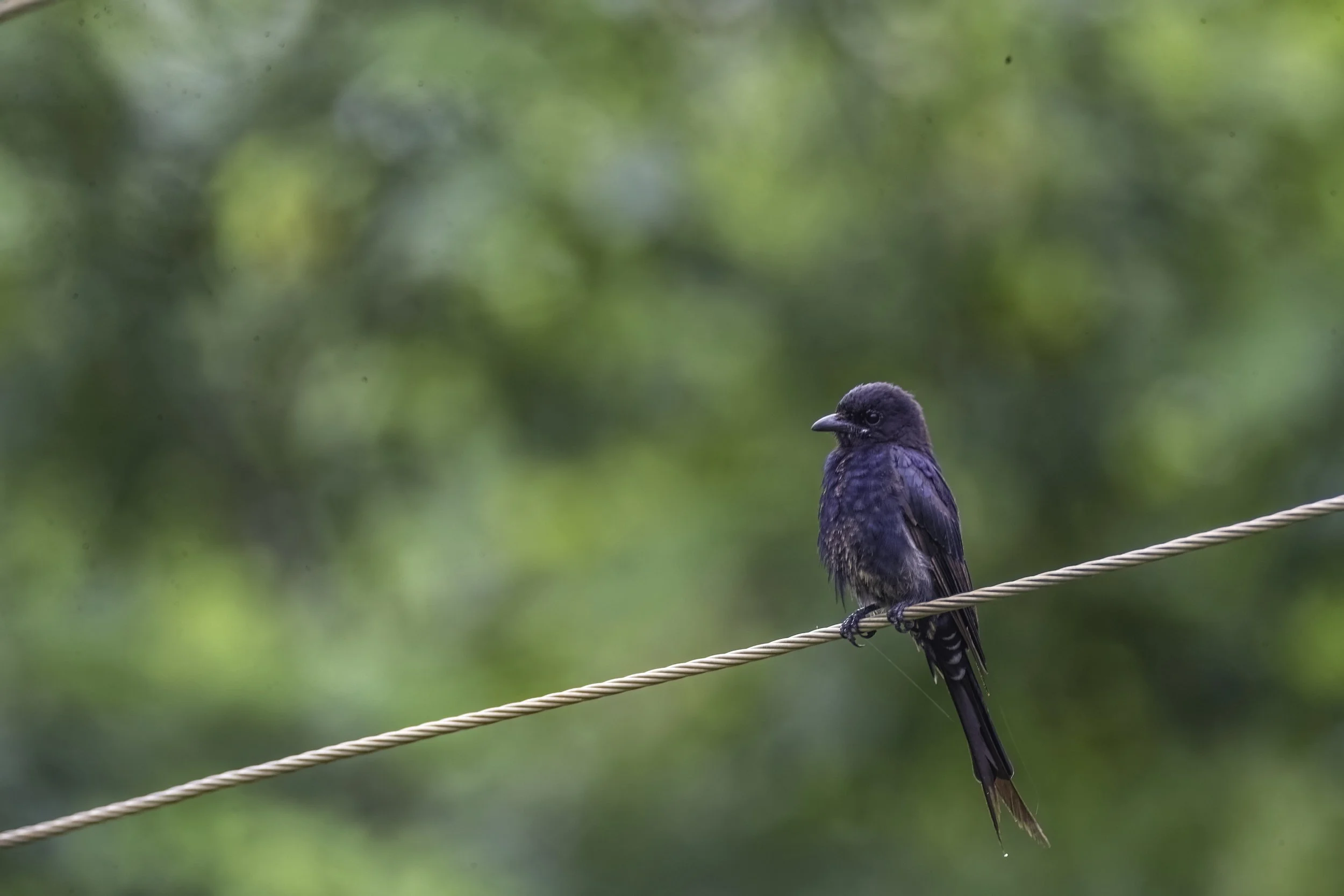
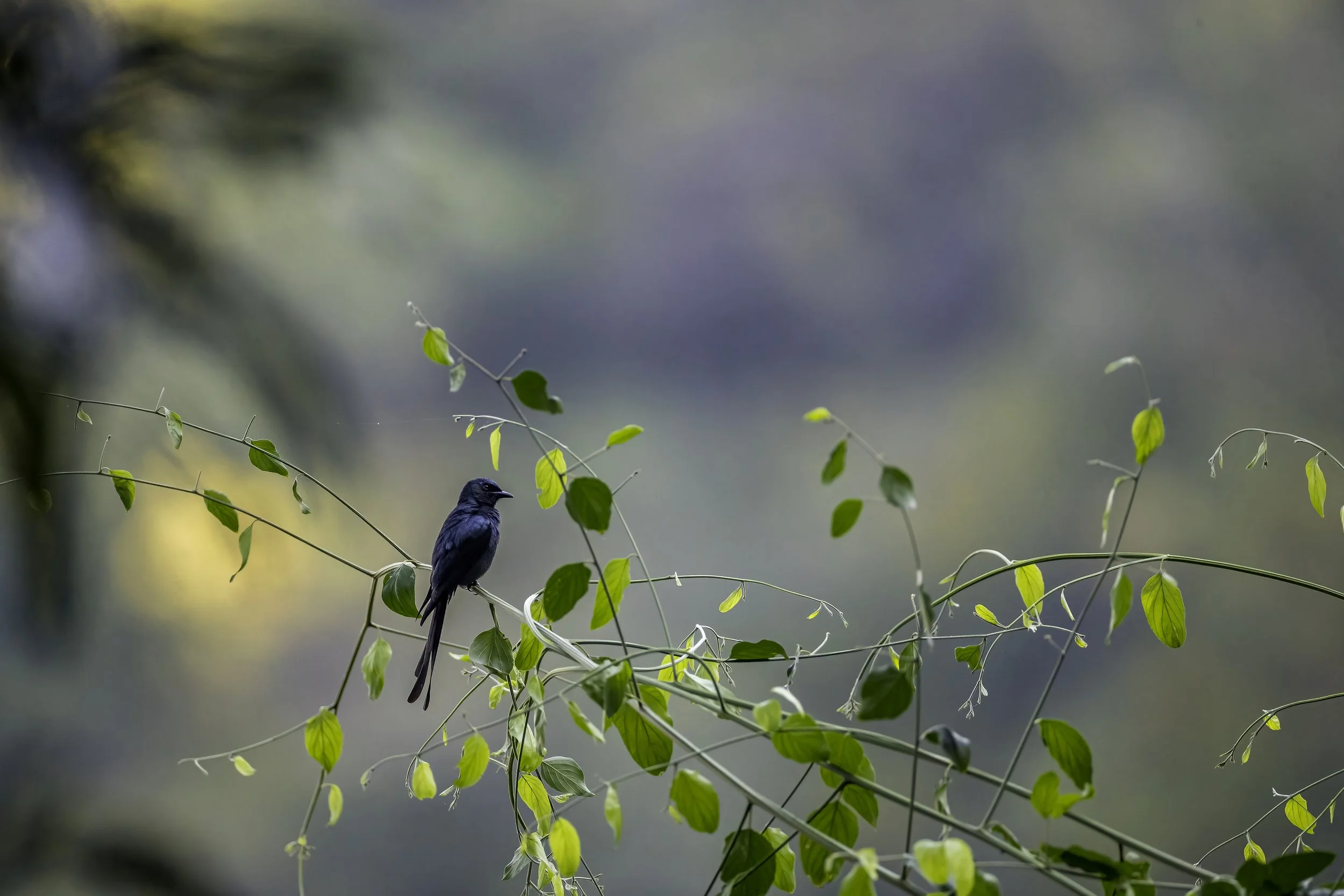
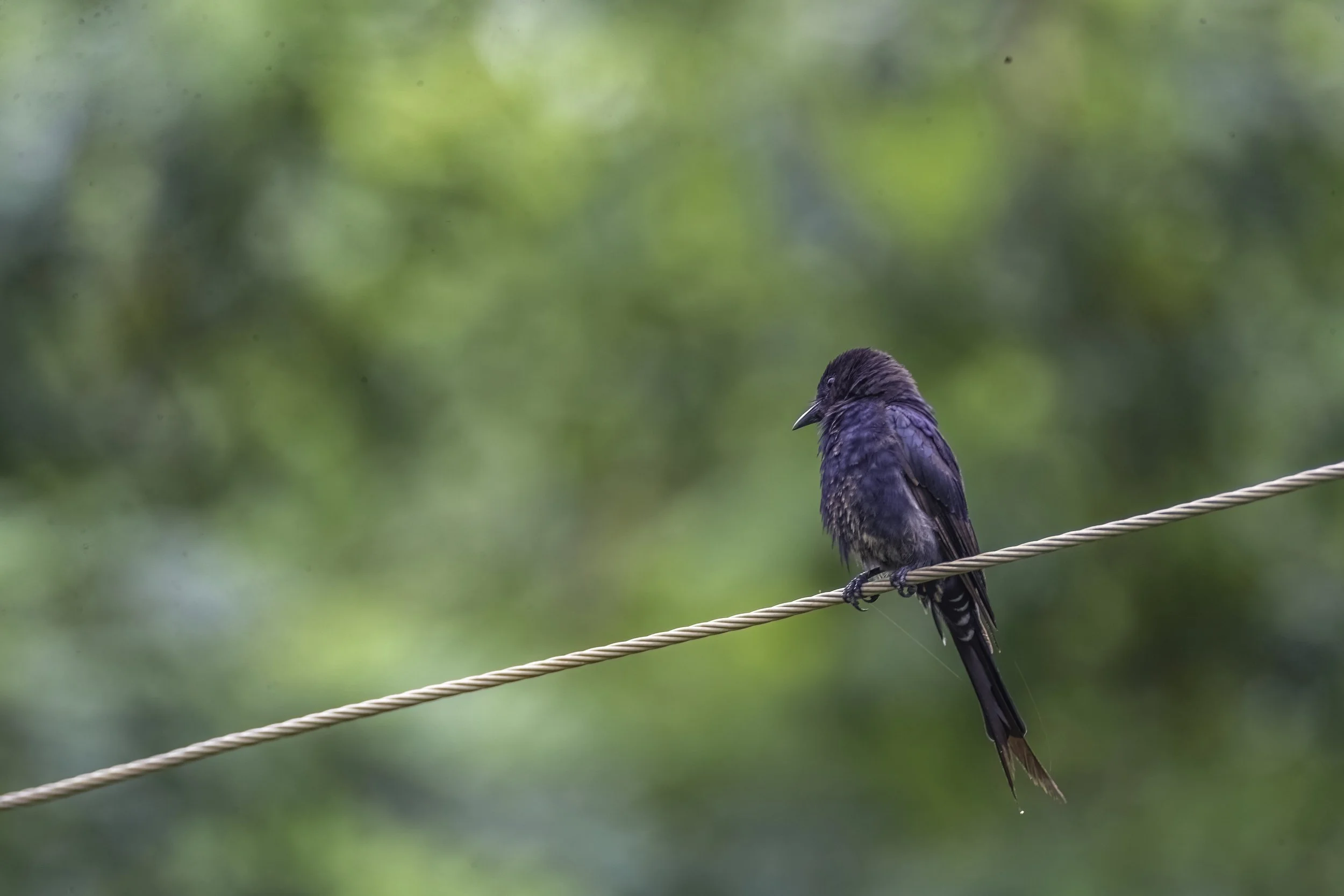
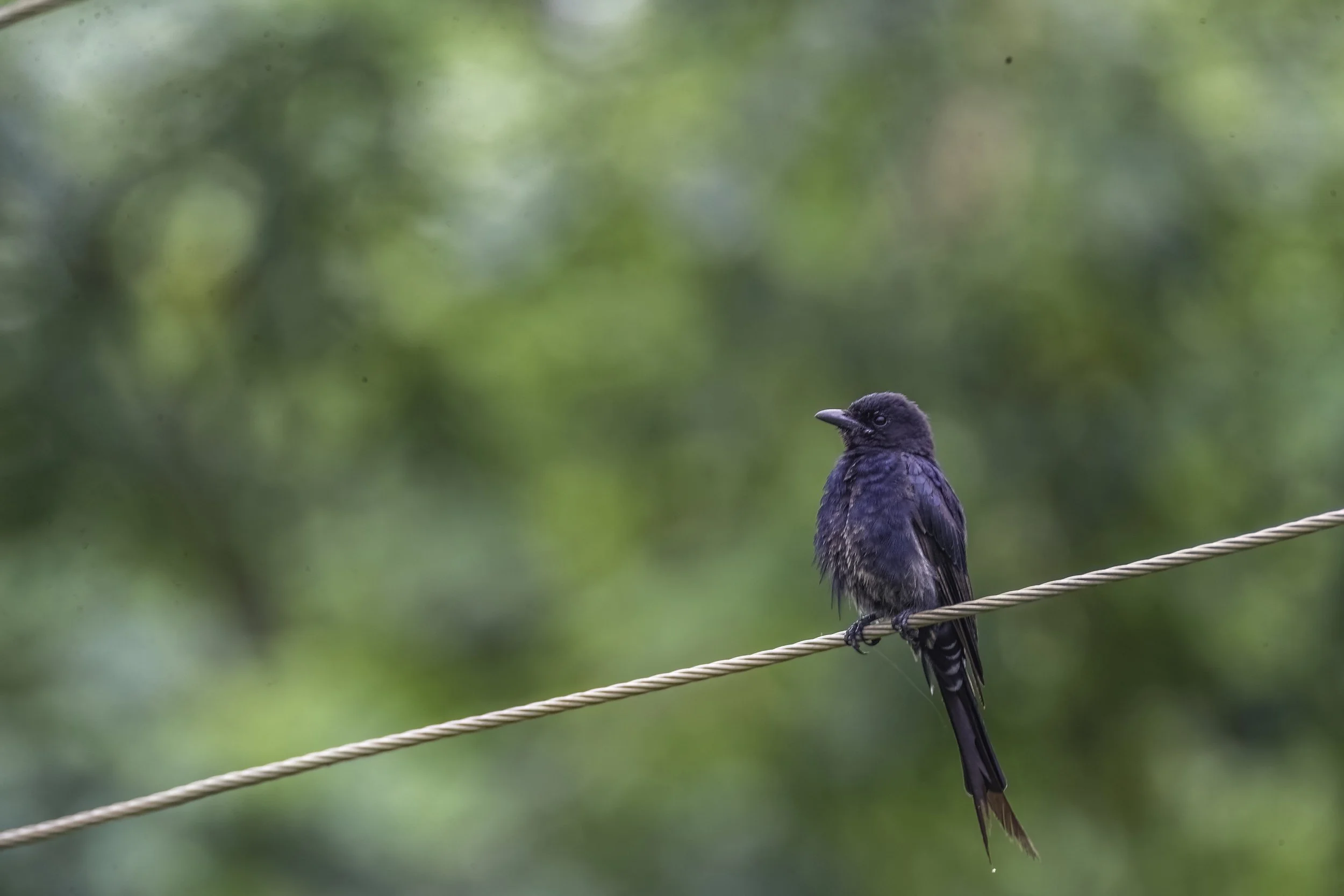
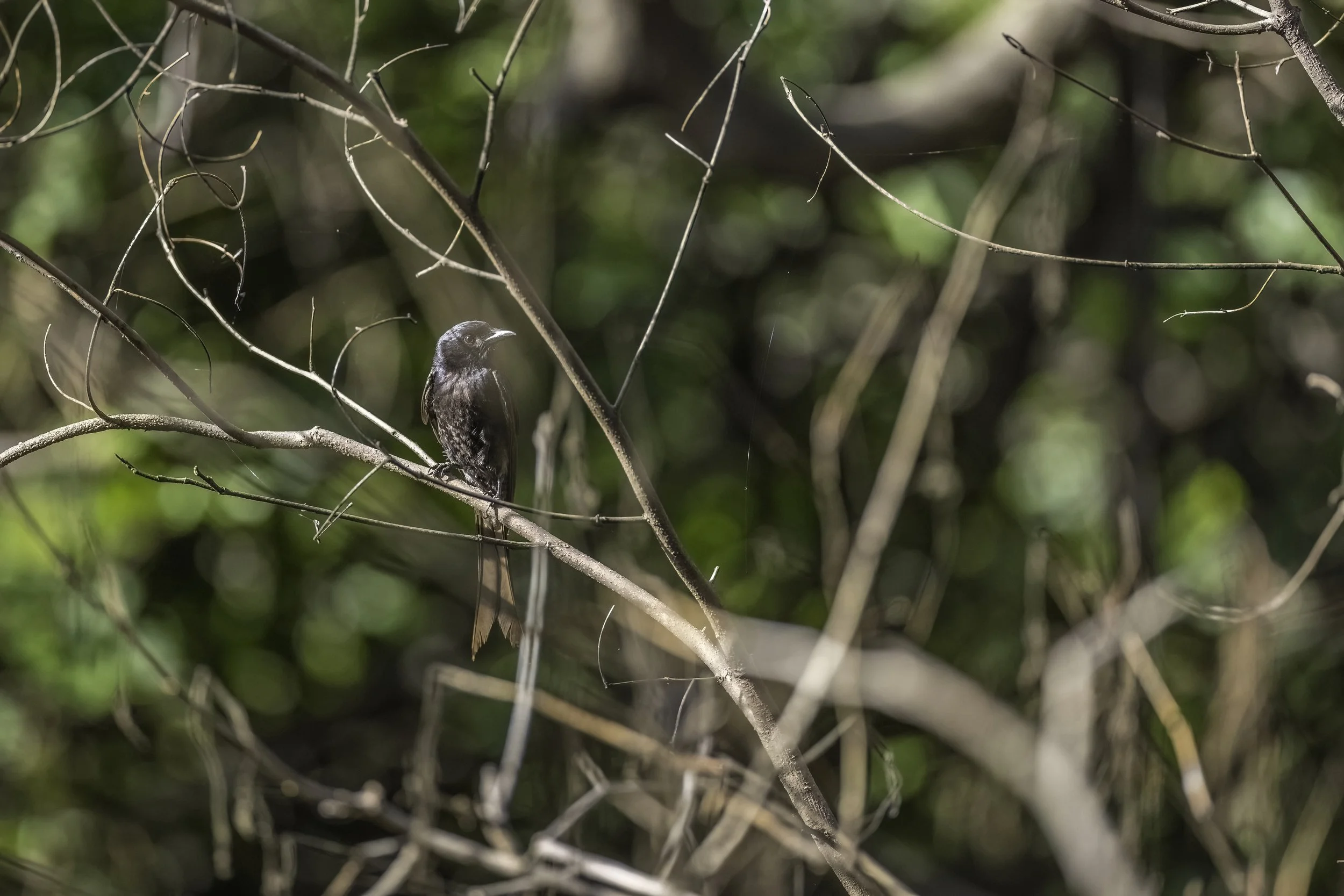
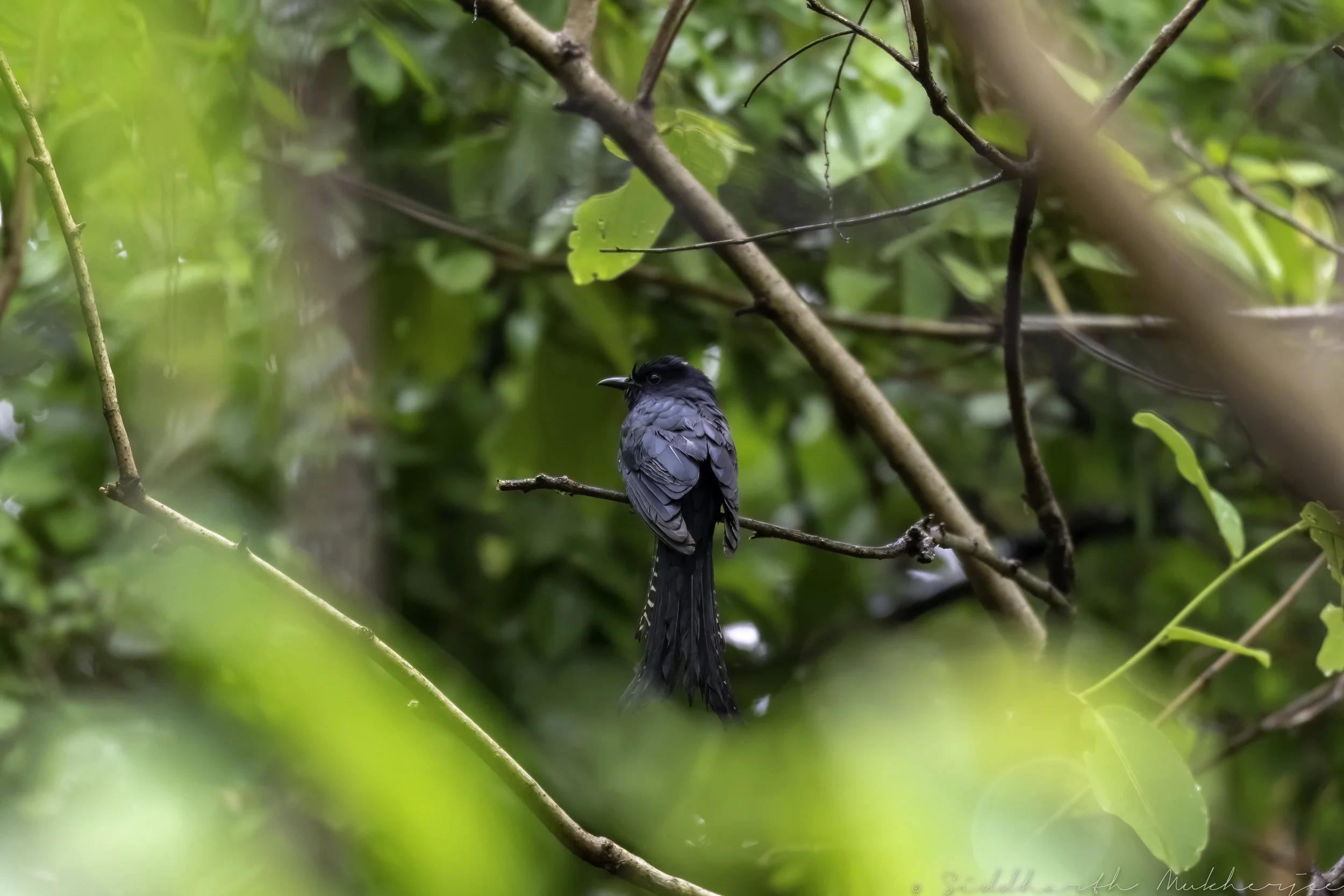
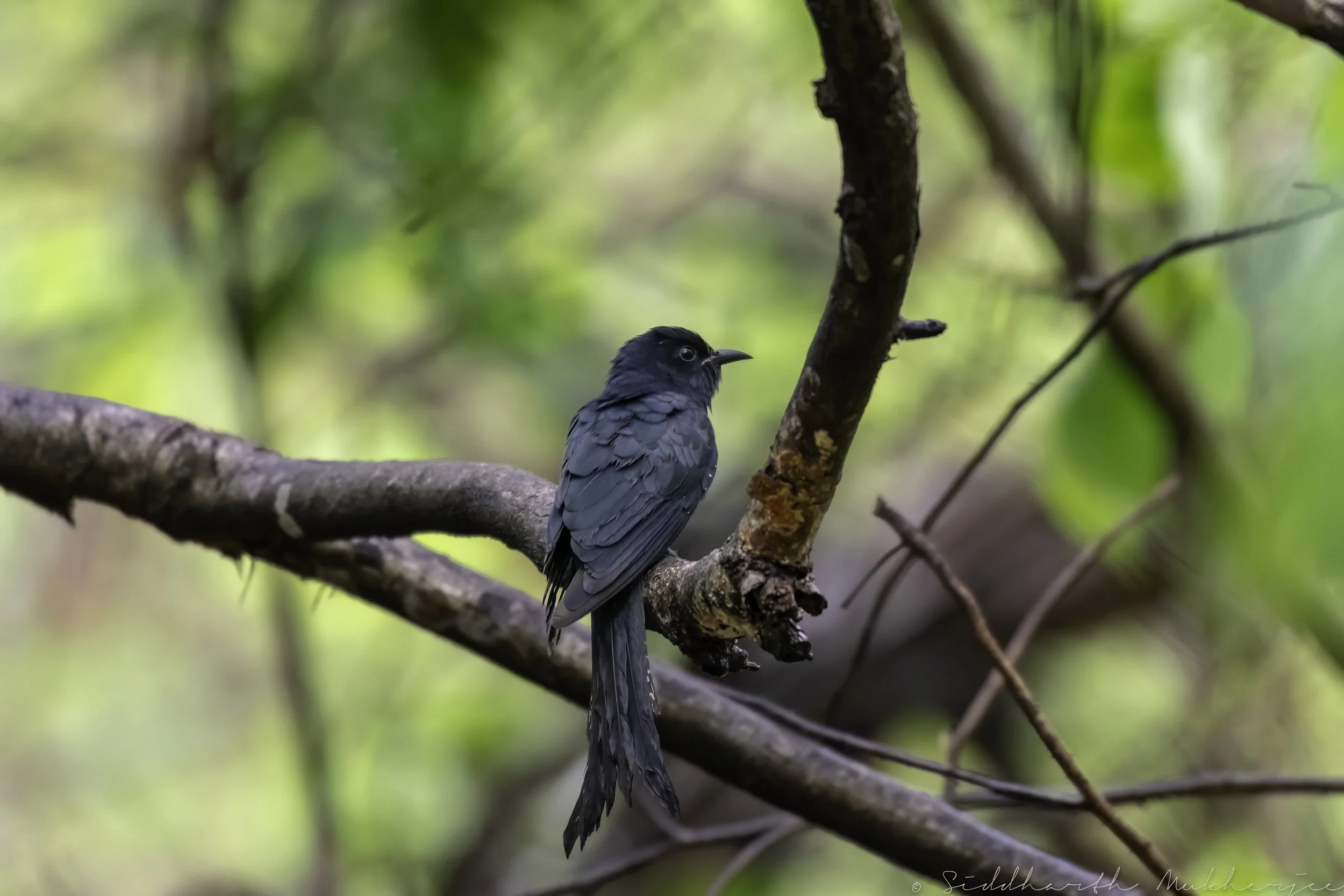
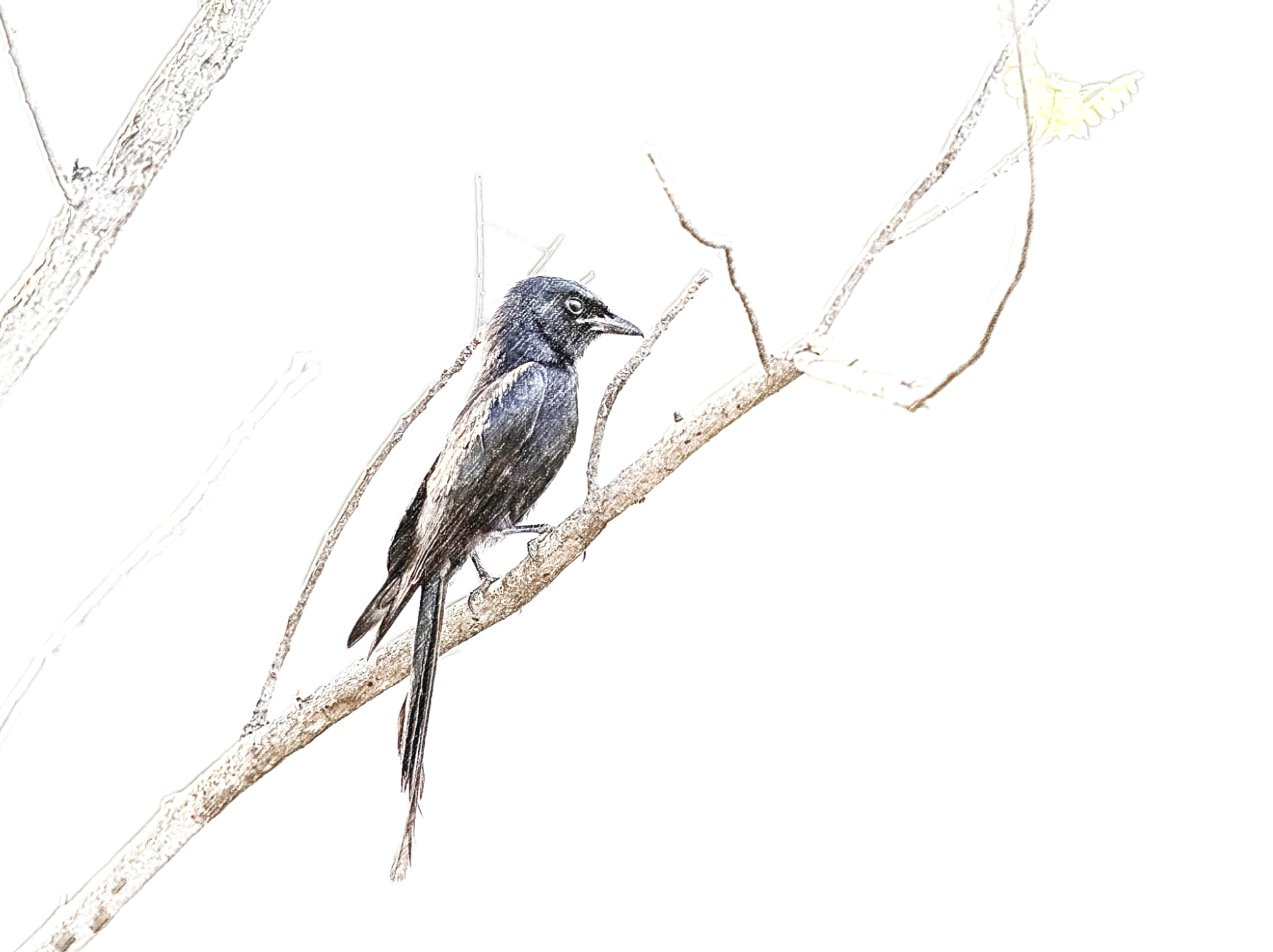
To look at a Black Drongo is to see a study in midnight. It is a medium-sized bird, roughly 28-30 centimetres in length and weighing about 39–59 grams, with a slim, aerodynamic frame. While it appears purely black from a distance, a closer look in the harsh Indian sun reveals a brilliant blue or steel-grey metallic sheen across its plumage. Its most defining feature is the deeply forked tail, which acts as a high-performance rudder during its acrobatic aerial hunts. Its eyes are a startling, deep ruby red, providing a fierce contrast to its dark feathers. A tiny white spot at the corner of its gape (the rictus) is often the only break in its obsidian uniform.
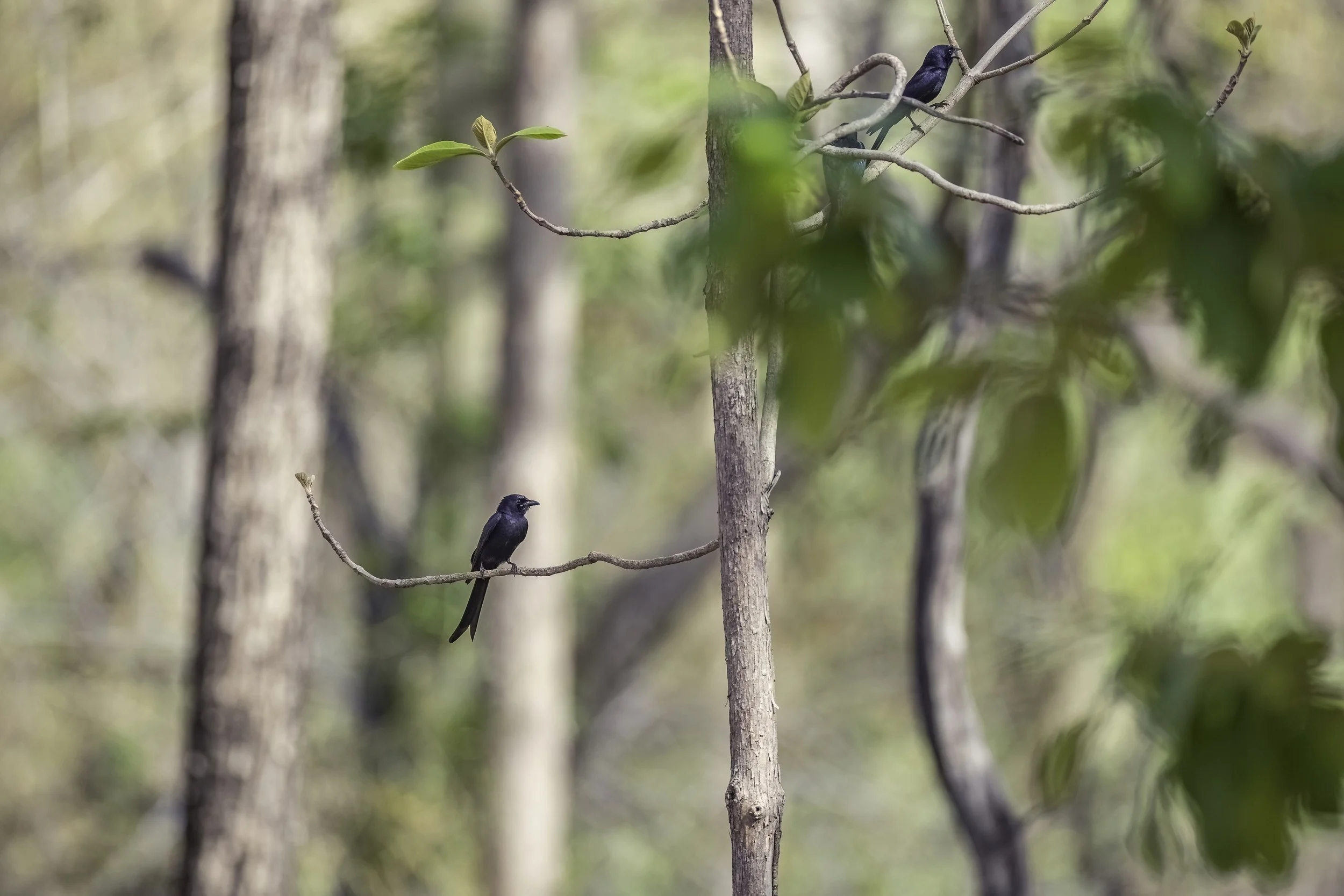
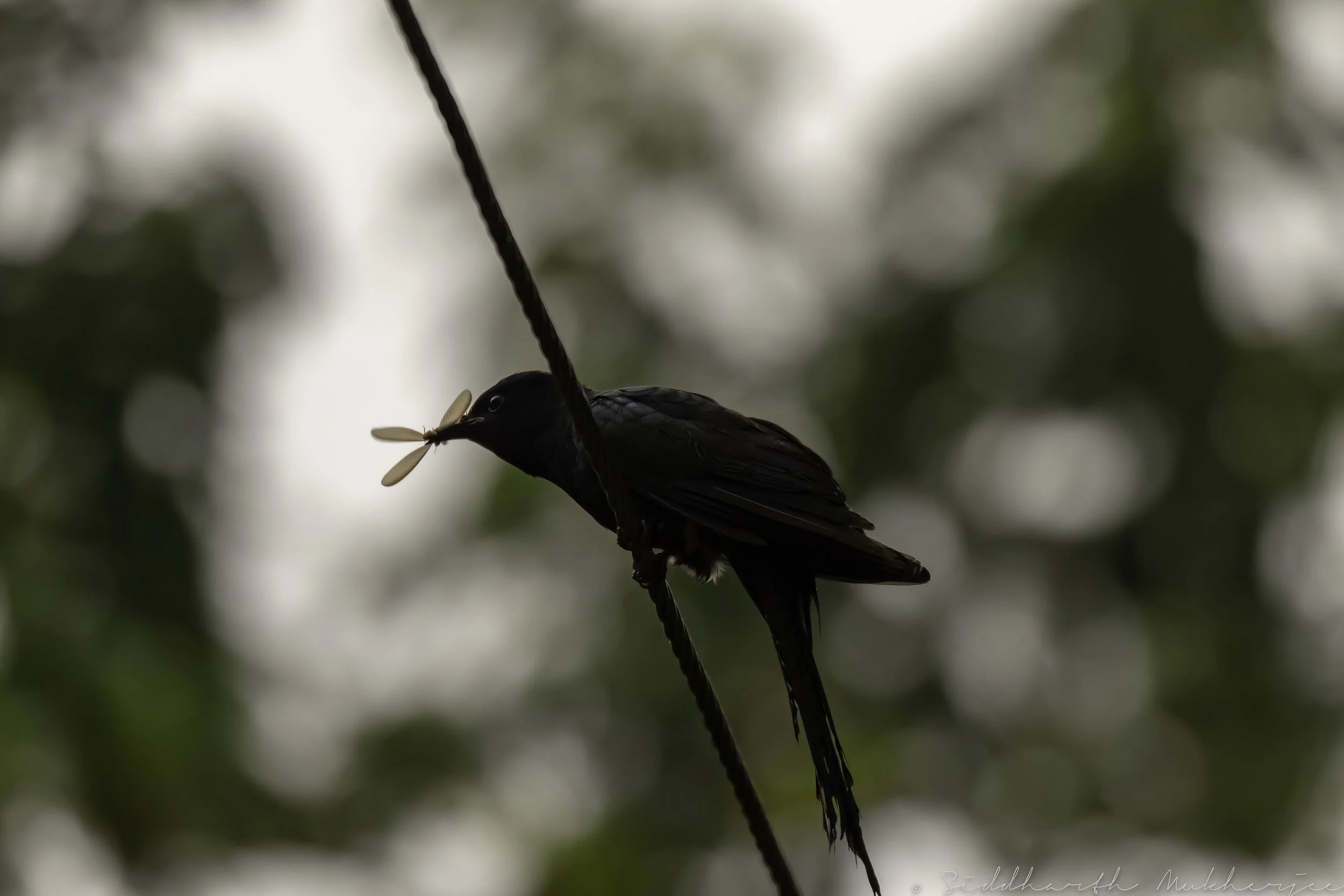
The Black Drongo is not a shy forest dweller; it is a creature of the "open." Across India, it is found from the foothills of the Himalayas to the tip of Kanyakumari. In Telangana, it is a quintessential part of the landscape. Whether you are driving through the scrub forests of Kinnerasani, trekking the rocky outcrops of Khajaguda, or walking the agricultural fringes of Medak, the Drongo is there. It thrives in habitats that offer wide-view perches: farmlands, light forests, and even urban parks. It is not endemic, but it is one of the most commonly seen birds in the subcontinent. You will frequently find them following cattle; as the heavy animals move through the grass, they flush out insects, which the Drongo snatches mid-air with clinical precision.
While the Indian subcontinent is home to several drongo species, the Black Drongo has a few "tells" that separate it from its relatives:
Ashy Drongo: Often confused with the Black Drongo, the Ashy is a slimmer, slate-grey bird with a much longer, more deeply forked tail, usually preferring more wooded areas.
Greater Racket-tailed Drongo: This cousin is much larger and unmistakable due to the two long, wire-like outer tail feathers ending in "rackets."
Bronzed Drongo: Smaller and more "glossy," this species stays deep within moist forests, unlike the sun-loving Black Drongo.
In past, it was often treated as conspecific with Dicrurus adsimilis, but it differs slightly in plumage and significantly in proportions and voice; possible close relationship between the two supported by DNA studies. Race albirictus intergrades with nominate in SE Pakistan and across C India (in narrow band roughly from Kutch E to S West Bengal) and with cathoecus in NW Myanmar; cathoecus and thai may intergrade in N Thailand. Seven subspecies are recognized.
Subspecies: Introduced (race harterti) in S Northern Marianas (on Rota I), from where colonized Guam.
Dicrurus macrocercus albirictus:Himalayas from E Afghanistan and N and E Pakistan E to W and extreme N Myanmar and SE Tibet, S to SE Pakistan (E from Indus Valley) and across C India (S to Gujarat, N Madhya Pradesh and West Bengal); formerly SE Iran; non-breeding also S to S India, C and S Myanmar and N Thailand.
Dicrurus macrocercus macrocercus:SE Pakistan and peninsular India S from Gujarat, Madhya Pradesh and West Bengal.
Dicrurus macrocercus minor:N and NW Sri Lanka (S, in W, to Puttalam), including Mannar I.
Dicrurus macrocercus cathoecus: C, E and S China (E from Qinghai, S from Jilin; including Hainan), Myanmar (except W and N), N Thailand and N Indochina; non-breeding S to SW and S Myanmar, S Malay Peninsula (Singapore) and S Indochina.
Dicrurus macrocercus thai: S Myanmar (Tenasserim), C and E Thailand, probably E Cambodia, and S Indochina.
Dicrurus macrocercus harterti: Taiwan.
Dicrurus macrocercus javanus: Java and Bali.
The experience of seeing one is often punctuated by its fearless personality. It is famously aggressive, frequently diving at much larger hawks or crows that venture too near its nesting site. This "bravery" is why smaller birds, like orioles and doves, often build their nests in the same tree as a Drongo—they use the "King Crow" as a free security guard.
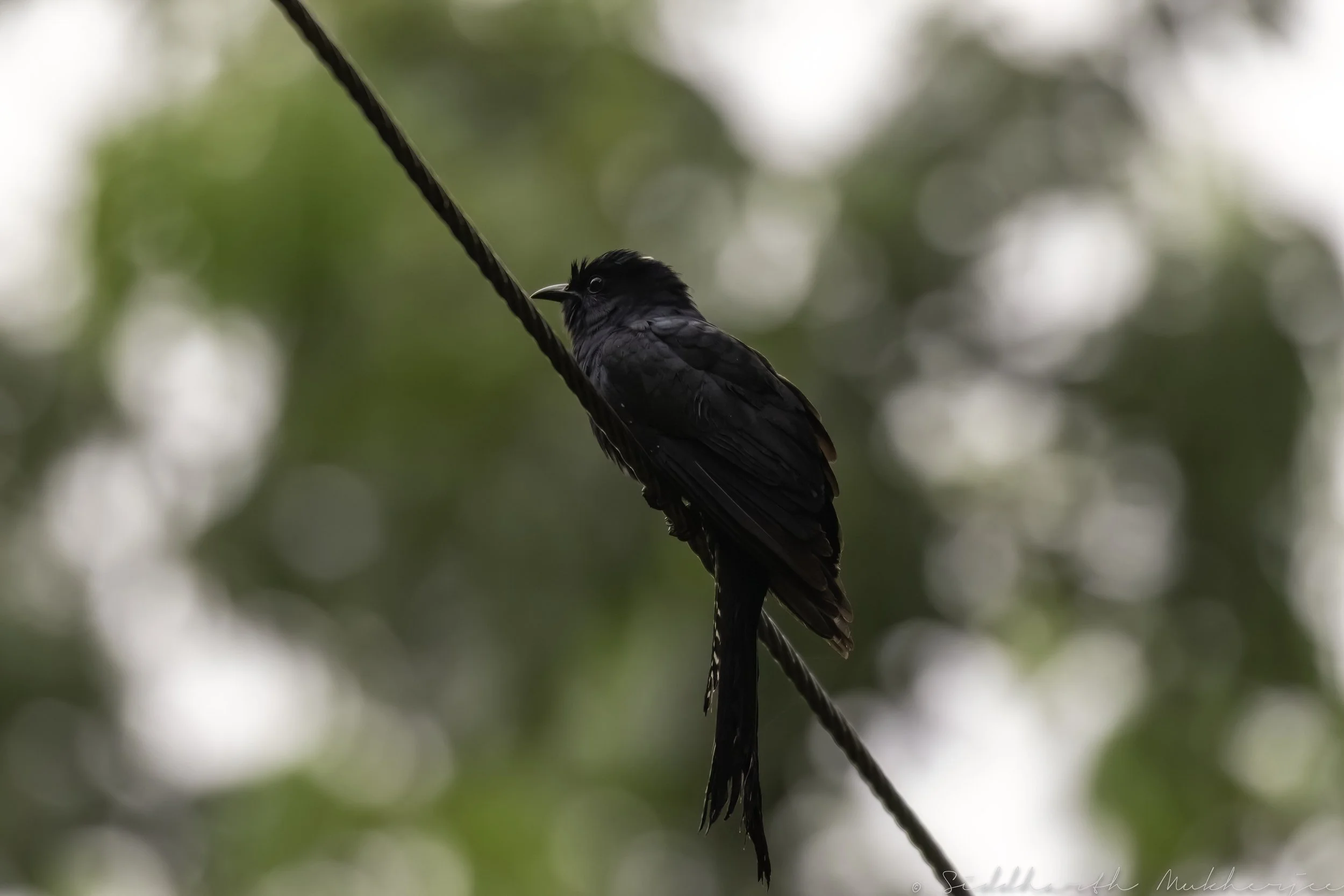
Photographing a Black Drongo is a lesson in patience and technical skill. Capturing a "black bird on a bright day" is notoriously difficult; without careful exposure, you end up with a featureless black blob or a washed-out background.
When you finally dial in the settings, the rewards are immense. Through the viewfinder, you see the bird’s character: the way it tilts its head to track a dragonfly, the bristly feathers around its beak, and that defiant red glint in its eye. There is a specific thrill in freezing its flight—a chaotic, high-speed dive that showcases the fork-tail in full spread. In the quiet farmlands of Telangana, where the heat haze ripples over the soil, the Black Drongo remains the ultimate subject: a common bird with an uncommon spirit.
‡‡‡‡‡

Related Posts

A passerine bird native to South & SE Asia inhabiting shrubland, grassland and wetland habitats. An odd-looking babbler which looks and behaves like a prinia on steroids. Brown above and white below with rufous wingtips with a unique red eyering. Scrambles about in reed beds, scrub, field edges, and grassy meadows in small flocks and pairs. Scales stems like a parrotbill and hangs acrobatically like a tit or leaf warbler. Strident, melodic song has a somewhat hoarse, nasal quality. Calls include repeated descending whistles, energetic chattering, and dry chittering.
#wildartworks, #Canon, #Bird, #Birdinginthewild, #BirdWatching, #Wildlife, #WildBirds, #naturephotography, #your_best_birds, #planetbirds, #earthcapture, #photo_pond, #earthpix, #naturyst, #conservationphotography, #yesbbcearth, #wildlifeonearth, #bbcearth, #natgeowild, #natgeoindia, #india, #telanganabirds, #ananthagiri, #ananthagiriforestrange, #vikarabad, #YellowEyedBabbler, #Babbler, @wildtelangana, #Damagundam, #chincholi,