
Brown Fish Owl
Ketupa zeylonensis
Ananthagiri Forest Range, Vikarabad
Ananthagiri Hills, located about 80 km from Hyderabad in Telangana's Vikarabad district, serves as a vital water source for the region and one of the state's densest forest patches. These moist deciduous forests and rocky streams offer a prime opportunity to encounter the Brown Fish Owl (Ketupa zeylonensis), a large, bulky predator of the water’s edge and are home to a multitude of birds including the endemic and very difficult to spot White-naped Woodpecker also called the Black-shouldered Woodpecker and the Black-rumped Flameback/ Lesser Golden-backed Woodpecker among many more.
Located in the central stretch of the Deccan Plateau, Telangana has sub-tropical climate and the terrain consists mostly of hills, mountain ranges, and thick dense forests covering an area of 27,292 km² (10,538 sq mi). The annual rainfall ranges between 1,100 mm to 1,200 mm and the annual temperature varies from 15 C to 45 C. The State is drained by a number of rivers which include Godavari and Krishna.
Telangana is endowed with rich diversity of flora and fauna. It has dense teak forests on the northern part along the banks of river Godavari. As per the Champion & Seth Classification of Forest Types (1968), the forests in Telangana belong to three Forest Type groups, which are further divided into 12 Forest Types. The State Government has taken up a massive greening programme, 'Telangana Ku Harita Haram' in the State to plant and protect 230 crore seedlings over a period of 4 years. This initiative aims at achieving the twin objectives of increasing the forest cover and reduce pressure on the existing forest resources, through massive community participation by Vana Samrakshna Samithis (VSS) and Eco-Development Committees (EDCs) in Protected Areas and Watershed Development Committees in the Watershed areas. Recorded Forest Area (RFA) in the State is 26,904 km² of which 20,353 km² is Reserved Forest, 5,939 km² is Protected Forest and 612 km² is Unclassed Forests. In Telangana, during the period 1st January 2015 to 5th February 2019, a total of 9,420 hectares of forest land was diverted for non-forestry purposes under the Forest Conservation Act, 1980 (MoEF & CC, 2019). As per the information received from the State during that last two years, 12,730 ha of plantations including avenue plantations in the State.
Three National Parks and nine Wildlife Sanctuaries constitute the Protected Area network of the State covering 5.08% of its geographical area.
Ananthagiri Forest Range
Ananthagiri Hills is located in the Vikarabad district of Telangana. It is one of two major reserve forest blocks of the Vikarabad Forest Range the other one being the Damagundam Forest Reserve and each of these forest blocks is spread over a 10 km² area. While the limits of Damagundam begin from Manneguda, a small town about 60 kms from Hyderabad, Ananthagiri block begins where the limits of Vikarabad end near the railway tracks. The Ananthagiri hills and their dense forests host many wild species like the Nilgai, Sambhar, Black Buck, Chital, Chowsingha, Chinkara, Wild Goats and many more. The streams from these hills flows into Osman Sagar, also known as the Gandipet lake, and Himayat Sagar. It is one of the denser forests in Telangana and is the birthplace (about 5 kilometers from the town of Vikarabad) of the Musi river, also known as the Muchkunda River, which flows through the capital city, Hyderabad. The Musi River after originating in these Ananthagiri Hills, about 90 kilometers to the west of Hyderabad and flowing due east for almost all of its course joins the Krishna River at Wadapally in the Nalgonda district after covering a total distance of about 240 km. Also in these forests is the Sri Anantha Padmanabha Swamy Temple, a Hindu temple dedicated to the Lord Vishnu.
According to the Skanda Purana it is believed this temple was installed by Rishi Markandeya in the Dvapara Yuga. Attracted by the peaceful atmosphere of the Ananthagiri Hills Rishi Markandeya came here for yoga sadhana. It is believed that the Rishi, on the strength of his spiritual powers, would visit Kasi daily for a bath in the sacred Ganges through a cave. One day he was not able to visit Kasi because the Dwadasi was in the early hours of the morning. Because of this miss the Lord Vishnu appeared, gave Darshan, in a dream and arranged for the Ganges to flow so the Rishi could take his bath daily without having to travel.
About 400 years back the Nizams of Hyderabad used these forests as their hunting grounds. It is said that the lord Vishnu in the form of Sri Anantha Padmanabha Swamy appeared in a dream and asked the then Nizam, Mir Osman Ali Khan, to build a temple for him. About 20 kilometers from the temple lies the Nagasamudram Lake or Kotipally Reservoir, a masonry dam.
It is one of the earliest habitat areas with ancient caves, medieval fort structures and temples that illustrate the antiquity of this area.
I love these forests as they are home to innumerable bird species, some of which I have photographed and many more which I am yet to photograph. I only hope the so called “bird and nature lovers” who come here to photograph and achieve social media fame adhere to ethical birding practices and refrain from using calls, especially owl calls, and bait. Over the years I have seen the behaviour of the wildlife change in these forests. Birds like the Jungle Nightjar were easily visible without having to venture deep into the dense brush but now the overload of visitors has pushed these birds deep into the undergrowth. I think, in a way, it is good for the birds because it requires time and patience to slowly approach them which the modern bird lover/ photographer and nature enthusiast lacks.
Read about the other lovely species I have photographed in the Ananthagiri Forests.
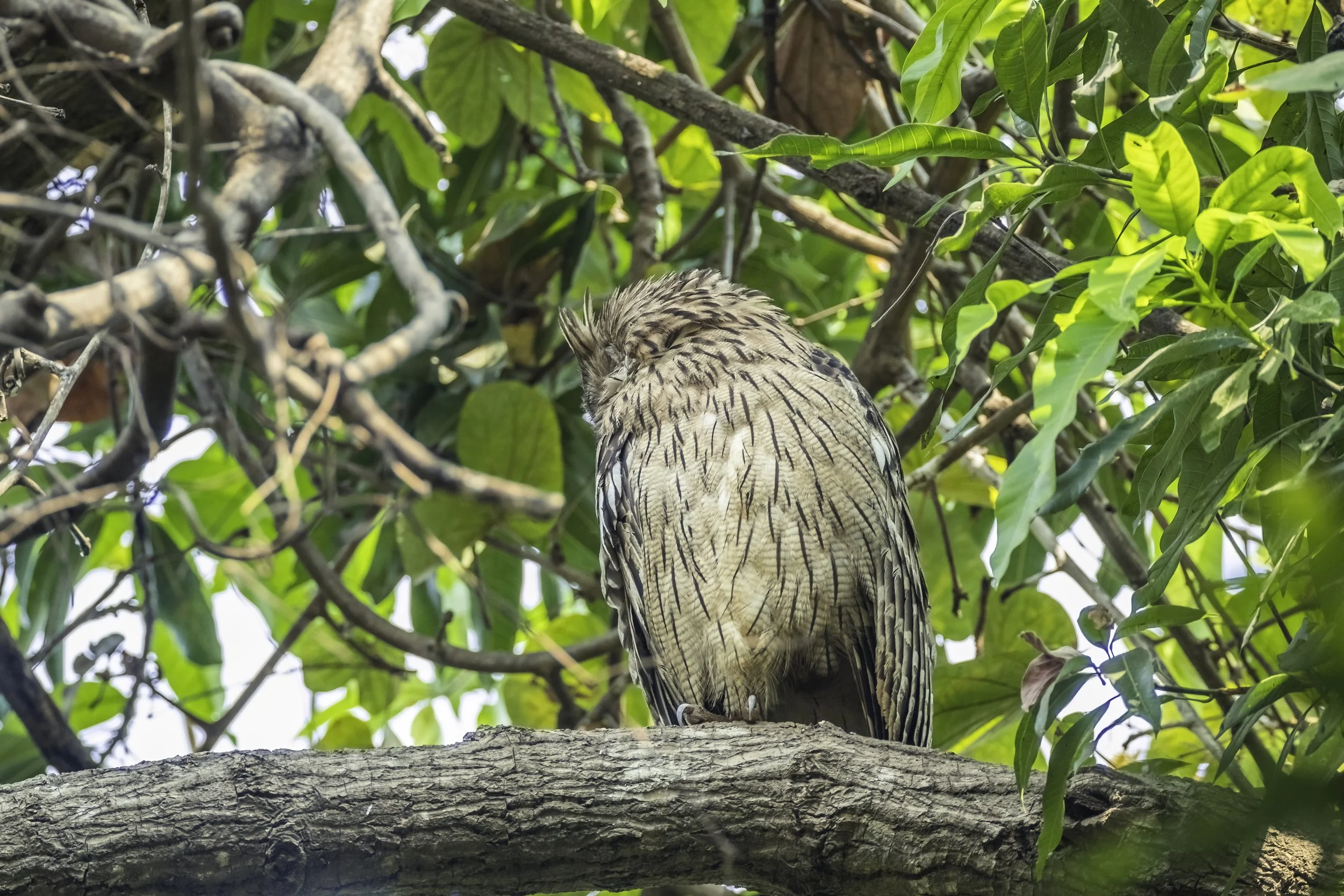
Brown Fish Owl
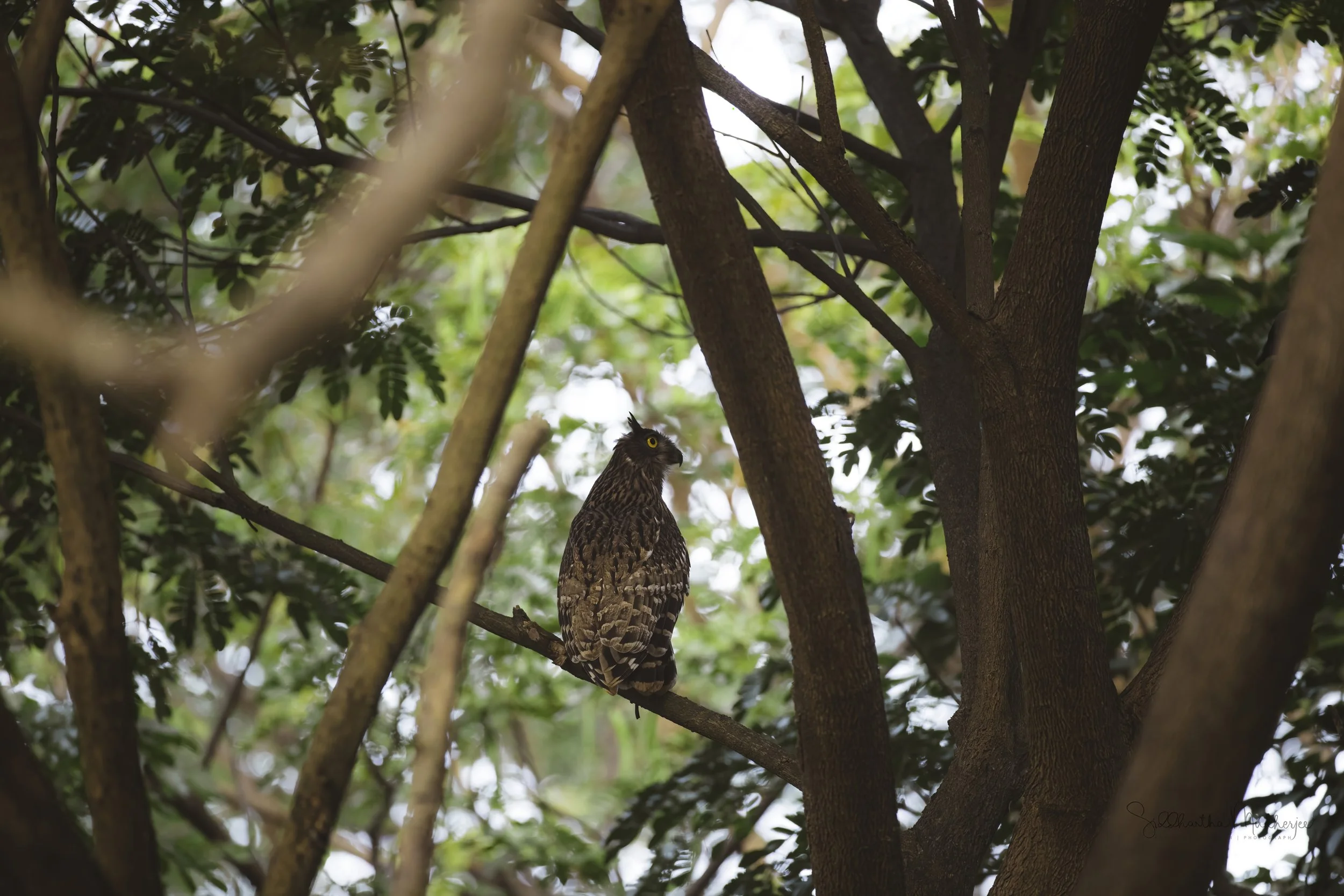
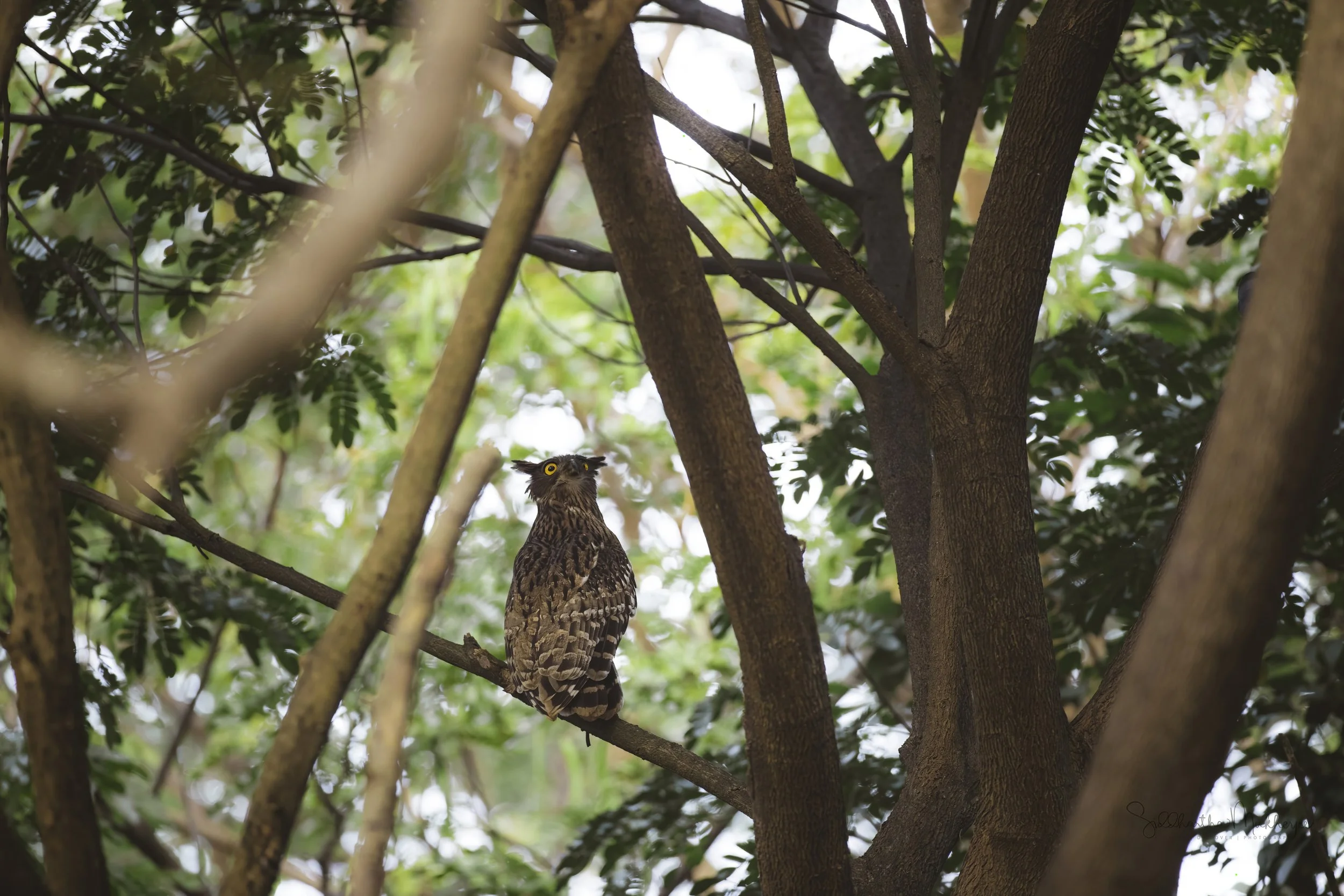
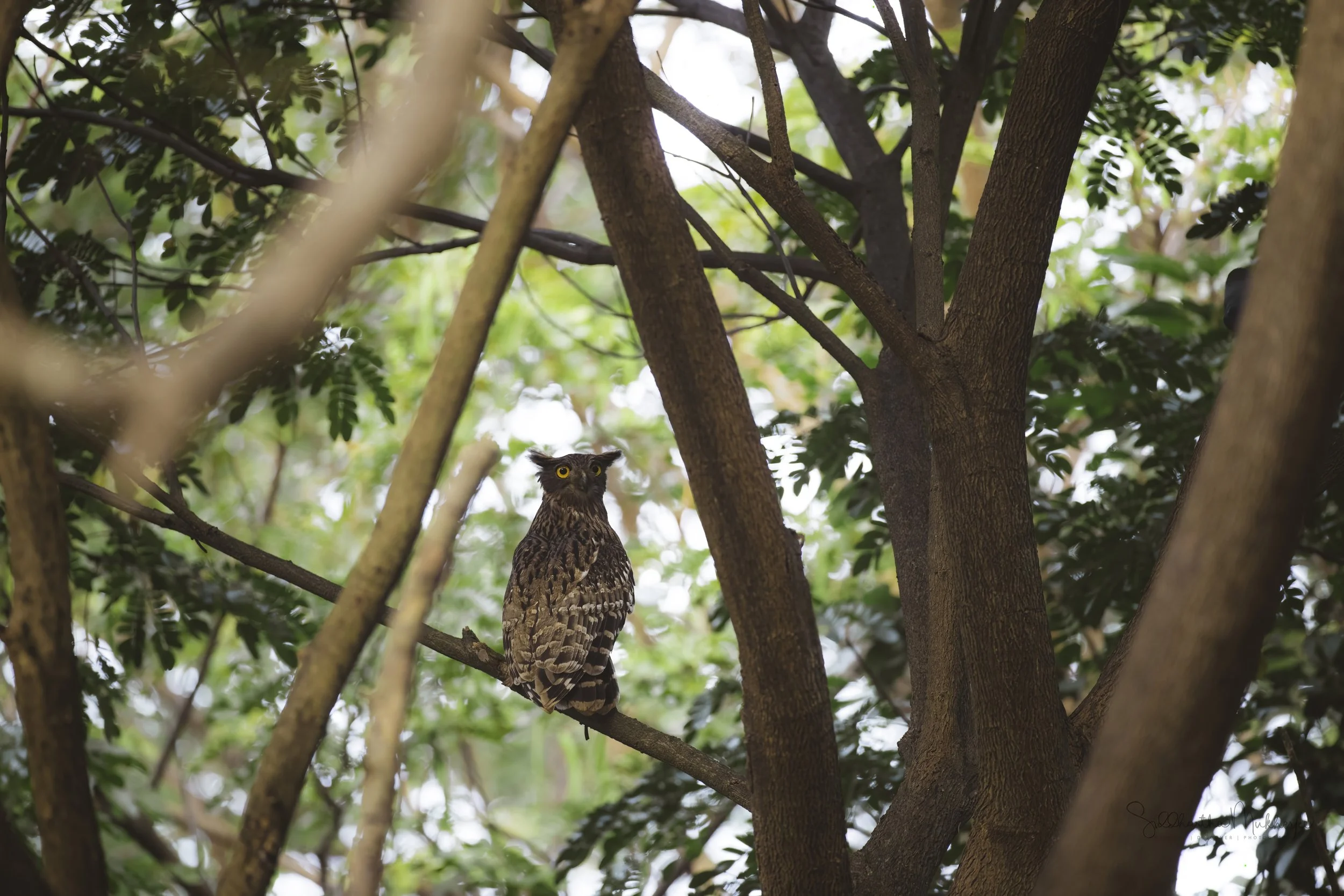
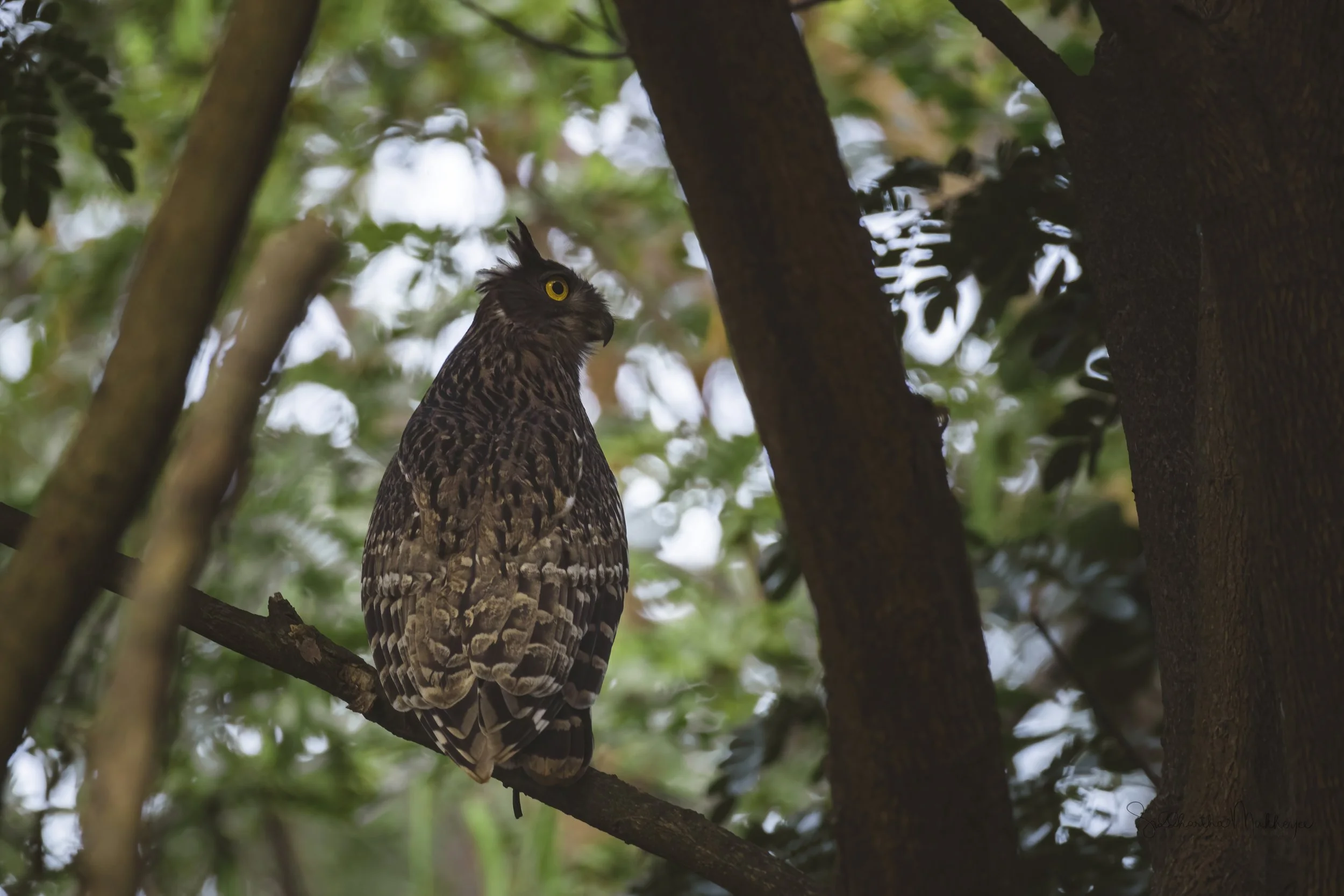
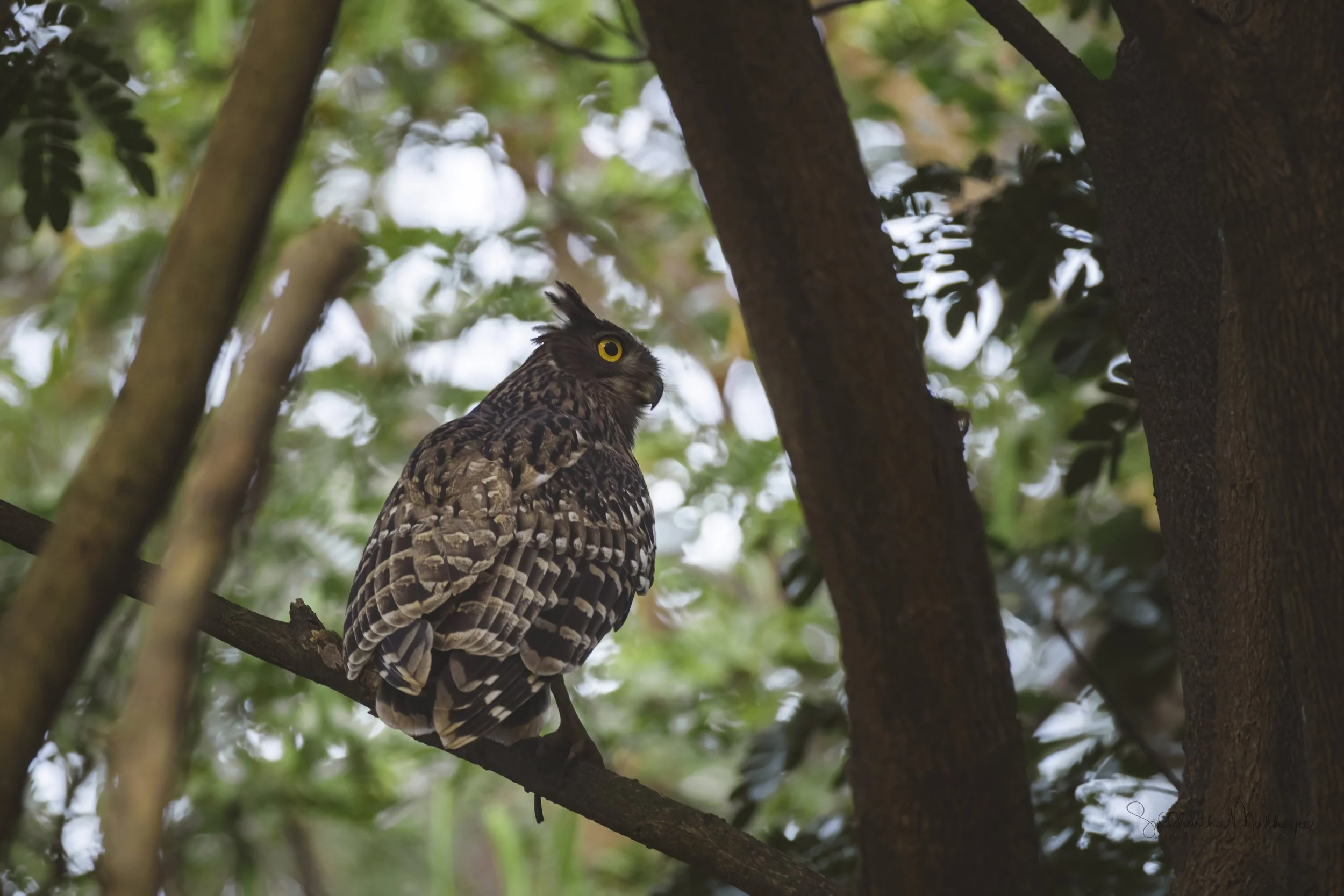
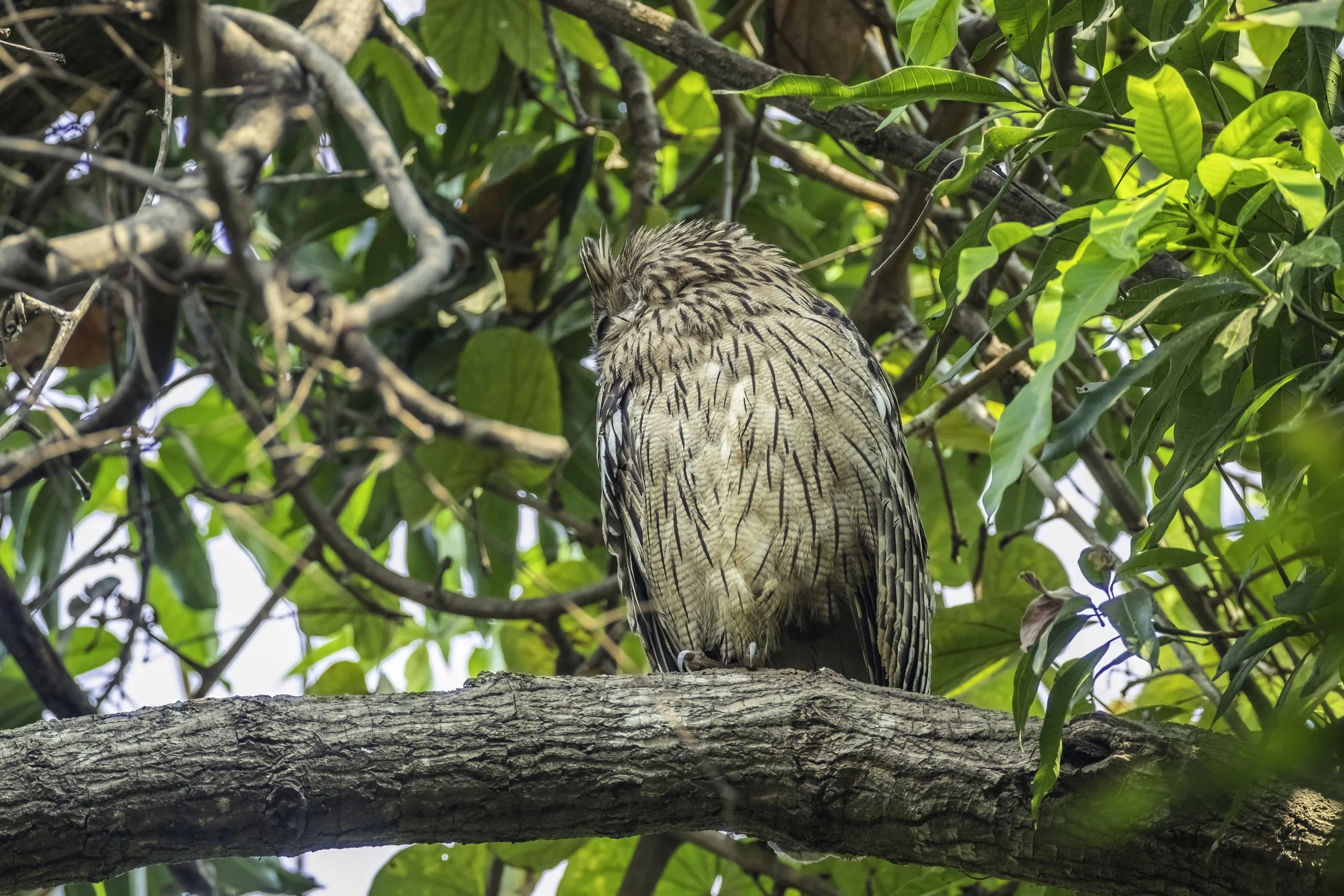
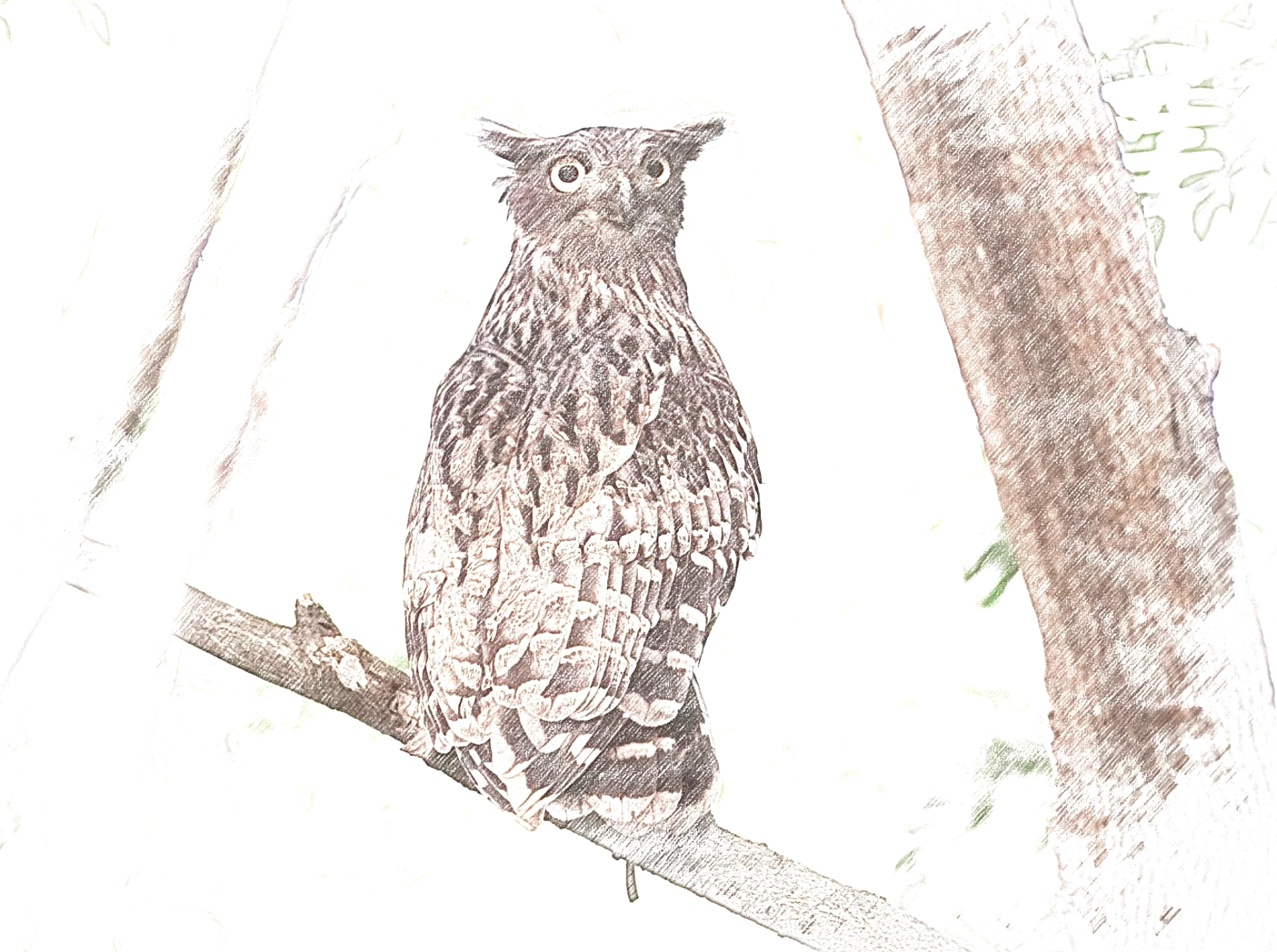
The Brown Fish Owl (Ketupa zeylonensis) is a fish owl species in the family known as typical owls, Strigidae. It is native from Turkey to South and Southeast Asia. Due its wide distribution it is listed as Least Concern on the IUCN Red List. Of the four living species of fish owl, it is the most widely distributed, most common and best-studied. It occupies a range of over 7,000 kms. It is a huge bulky brown owl with a finely streaked breast, a plain face, and bright yellow eyes. Also note its dirty white “bib” and the heavy brow that gives it a moody demeanor. A large, flat-headed owl, with noticeable ear-tufts usually held horizontally, it inhabits waterside wooded areas from lowlands up into the mountains and feeds by dropping down into and wading around in creeks, lakes, and pools. It often gives deep echoing hoots, as well as various shrieks and higher-pitched hoots.
The Brown Fish Owl is a powerful raptor with a "moody" or "sinister" demeanor, characterized by its heavy brow and dark bill set between its eyes. It measures 48–61 cm with a wingspan of 125–140 cm. Typically weighs between 1.1 to 2.5 kg, with females being significantly larger and heavier than males. Its upperparts are rufous brown with heavy black or dark brown streaks, while the underparts are buffy-white with thin rufous cross-lines and long dark shaft-streaks. A prominent white "bib" on the throat can be puffed out conspicuously.
Four subspecies are generally recognised, differing mainly in size and saturation:
Ketupa zeylonensis leschenaultii: The race found in most of India (including Telangana). It has a medium hue with lighter markings than the nominate race.
Ketupa zeylonensis zeylonensis: Found in Sri Lanka; the smallest and darkest race.
Ketupa zeylonensis semenowi: Occurs from Turkey to NW India; significantly paler with a tawny hue.
Ketupa zeylonensis orientalis: Found in SE Asia; darker with more black on the upperparts.
The Brown Fish Owl has a vast range of over 7,000 km, stretching from Turkey and the Middle East through South Asia to SE China and Vietnam. In India, it is a widespread resident of lowland forests and foothills up to 1,500m. It is almost always found near water—streams, lakes, mangroves, or even rice fields. In Anantagiri, they frequent the well-vegetated ravines and rocky streams near the Sri Anantha Padmanabha Swami Temple trails.
They are non-migratory, year-round residents. Though primarily nocturnal, they are semi-diurnal and often active on cloudy days. They lack the sound-muffling wing fringes of other owls, making their flight noisier. Their diet is primarily aquatic prey like fish, frogs, and freshwater crabs. They also take rodents, birds, reptiles (including snakes and monitor lizards), and even carrion. They hunt from a perch overlooking water, gliding down to grab fish from the surface with long, unfeathered legs and rough toe pads designed for gripping slippery prey.
While most owls are "silent hunters" of the air, the Brown Fish Owl is an "angler." Unlike the Great Horned Owl, the Brown Fish Owl has unfeathered (naked) legs and toes. This is an evolutionary adaptation to prevent feathers from getting waterlogged while fishing. The soles of its feet are covered in spicules—sharp, bony scales—that act like sandpaper to grip slippery fish. It lacks the well-defined, stiff-feathered "facial disc" found in Barn Owls. Because it relies less on acoustic triangulation and more on visual detection of surface ripples, its facial structure is more relaxed and less concave.
In the shaded ravines of Anantagiri, this owl is notably crepuscular. While other owls wait for total darkness, the Brown Fish Owl often begins hunting in the late afternoon. Photographers often find them perched on low-hanging branches over the Musi River’s headwaters as early as 4:00 PM. They are known to be frequent bathers. After a successful night of hunting, they often descend to shallow rocky pools to clean their plumage, offering rare opportunities for "action shots" in the water.
In the seasonally dry landscape of Telangana, these owls are highly opportunistic. During the dry summer months when streams recede, their diet shifts heavily toward freshwater crabs and large beetles. They have also been recorded hunting Indian Pond Herons and small mammals. Their pellets (regurgitated indigestible material) are often found at the base of large Mango or Ficus trees near water and contain high concentrations of crushed crab shells and fish scales.
In Anantagiri, they favor hollows in old-growth trees or high, inaccessible rock ledges within the ravines for their nests. They typically lay 1–2 round, white eggs. The incubation period lasts about 38 days. Both parents guard the nest, and the young stay with the adults for several months, learning the complex skill of snatching prey from moving water.
The Brown Fish Owl’s repertoire is distinct from the more common Spotted Owlet or Indian Eagle-Owl.
The Territorial Call: A deep, resonant hup-hup-hu or boooo-boooo.
The Alarm: If disturbed by a photographer or a predator, they emit a harsh, shrieking hiss or a loud clicking of the beak.
Field Identification Tips
Visuals: Look for the bright golden-yellow eyes and prominent, horizontally oriented ear tufts that appear "scraggly".
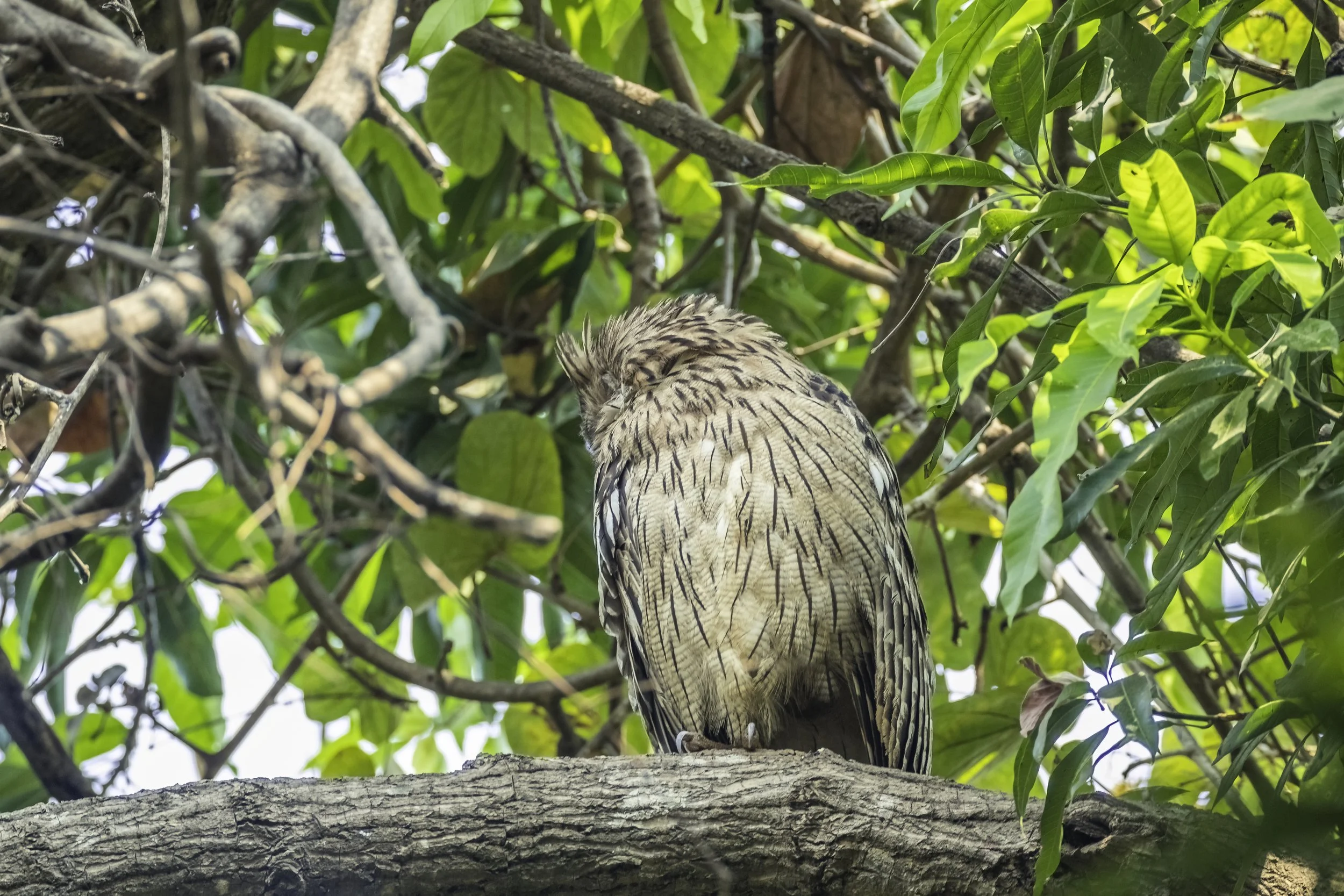
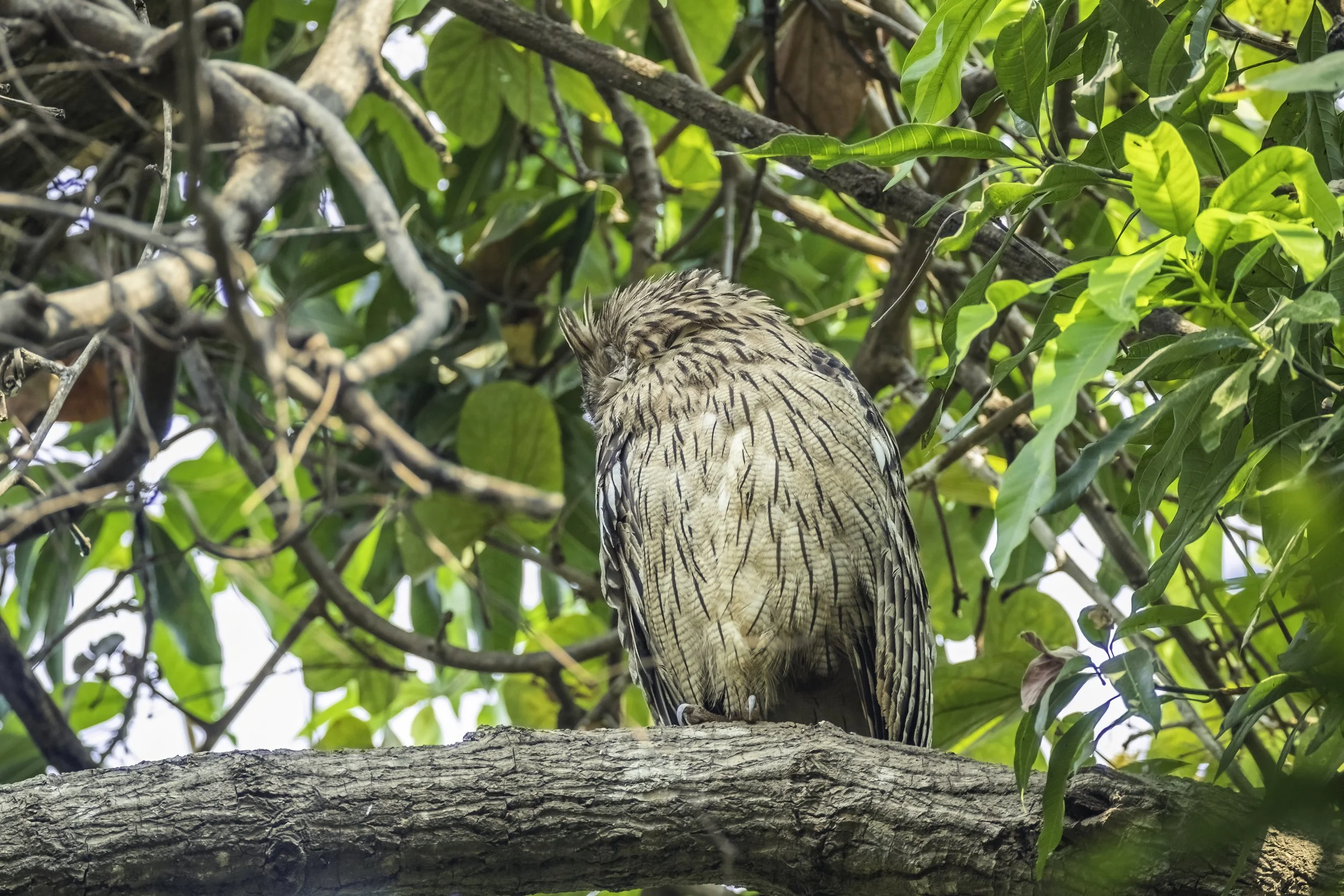
Roosting: During the day, they roost in leafy trees (like mango or fig) or stands of bamboo. You can often find them by listening for small birds "mobbing" them while they rest.
Calls: Listen for a deep, trisyllabic "tu-whoo-hu" or a hollow, ventriloquial "boom-boom".
The breeding season in India is typically November to March. They do not build their own nests, instead using natural tree cavities, rock ledges, or abandoned nests of other large birds. The species is listed as Least Concern on the IUCN Red List but despite its wide distribution, it faces threats from habitat loss, water pollution, and human disturbance. In some regions of India, they are also victims of superstitious practices.
Photography Strategy at Anantagiri
The "River Walk": Focus on the stretch of forest where the Musi River originates. The combination of water and dense canopy makes this their primary "dining room."
Low Angles: Because they often perch on low rocks or overhanging branches to scan the water, a low-angle tripod or beanbag is essential for eye-level shots.
Low Light Gear: Given their preference for deep ravines and twilight hours, a lens with a wide aperture (f/2.8 or f/4) and a camera body with strong ISO performance is critical.
‡‡‡‡‡
For a print of the beautiful birds from my various sojourns click on the button below to read my process and order a limited edition canvas.
‡‡‡‡‡

Related Posts
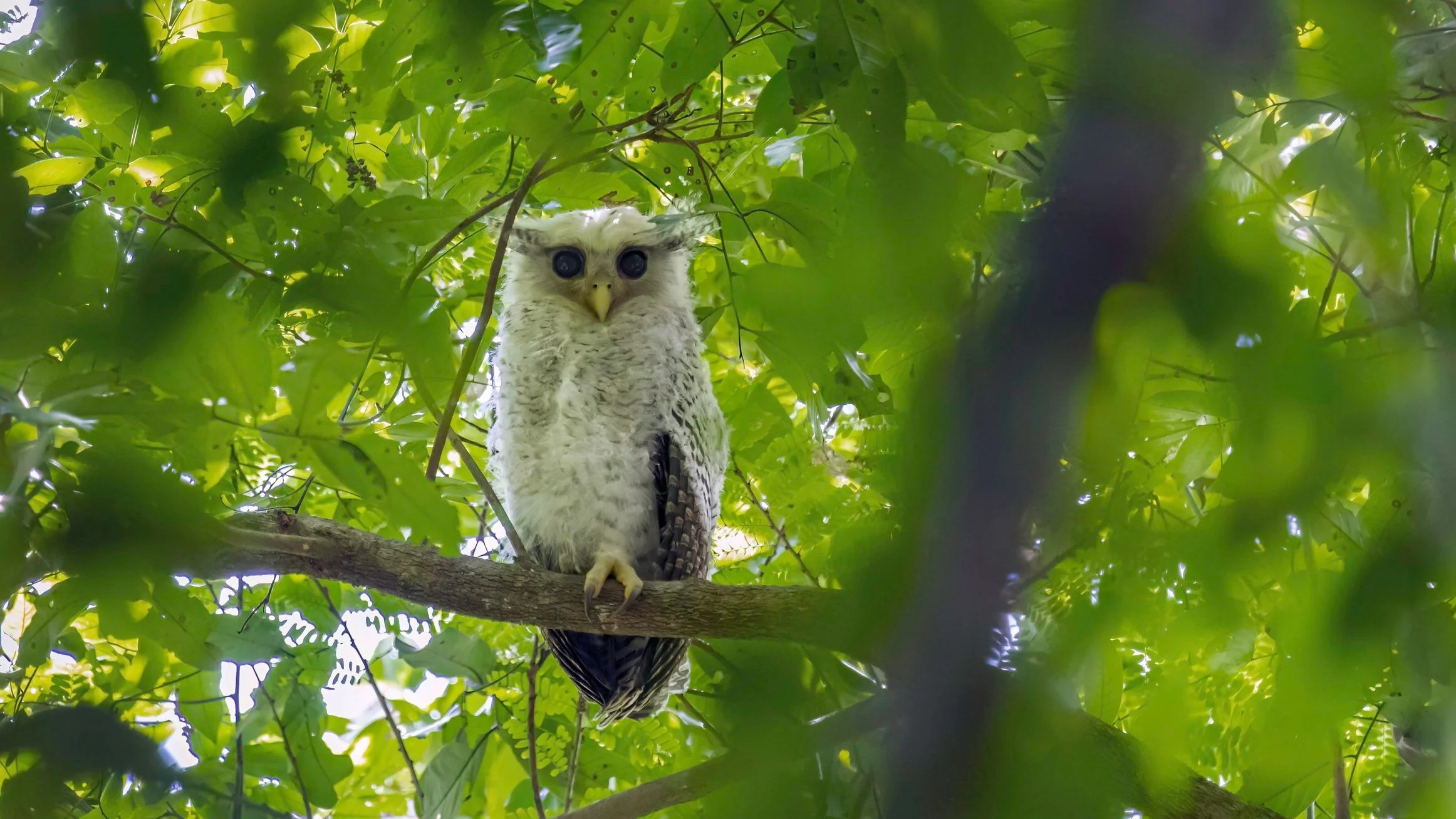

The Indian or Bengal eagle-owl (Bubo bengalensis), also widely known as the Rock eagle-owl, is a large horned owl species native to hilly and rocky scrub forests in the Indian Subcontinent. It is splashed with brown and grey, and has a white throat patch with black small stripes. It is usually seen in pairs and has a deep resonant booming call that may be heard at dawn and dusk.
#wildartworks, #Canon, #Canon1DxMkii, #PromediagearTR424L, #DeityD3Pro, #EF600f4LISIII, #Wildlife, #naturephotography, #earthcapture, #photo_pond, #earthpix, #naturyst, #Telangana, #YenkathalaGrasslands, #Enkathala, #EnkathalaGrasslands, #Mominpet, #wildtelangana, @wildtelangana, @save_yenkathala, #ramnathgudpalle, #indianeagleowl, #bengaleagleowl, #rockeagleowl, #eagleowl, #owl, #raptor