
The Intimacy of the Gaze
Shinrin-yoku - The art of Forest Bathing
Amrabad Tiger Reserve
The air in the Amrabad Tiger Reserve is a thick, textured veil—a medicinal, honeyed infusion of crushed Teak leaves and the dry, papery whisper of Bamboo groves. To enter this landscape is to accept an olfactory invitation to Shinrin-yoku, the Japanese art of "forest bathing." This is not a mere hike or a safari with a checklist of sightings; it is a profound sensory immersion where the goal is to let the atmospheric essence of the woods filter through your skin, dissolving the frantic boundaries of the modern self.
While most traverse these rugged Nallamala tracks with a singular, feverish obsession—the head-on encounter with a Tiger or Leopard—the true practitioner of Shinrin-yoku understands that the "soul" of the forest is found in the collective, quiet gaze of the entire ecosystem. Enthusiasts often spend hours tailing and most times chasing a single predator, desperate for that front-facing snarl or the piercing amber gaze of a big cat. While staring into the eyes of a 200-kilogram predator is undeniably primal—an experience that makes the heart hammer against the ribs—this fixation often blinds us to the quiet, soulful gaze of the rest of the ecosystem.
Located in the central stretch of the Deccan Plateau, Telangana has sub-tropical climate and the terrain consists mostly of hills, mountain ranges, and thick dense forests covering an area of 27,292 km². The annual rainfall ranges between 1,100 mm to 1,200 mm and the annual temperature varies from 15°C to 45°C. The State is drained by a number of rivers which include the Godavari and the Krishna.
Telangana is endowed with rich diversity of flora and fauna. It has dense teak forests on the northern part along the banks of river Godavari and to the south along the banks of the Krishna. As per the Champion & Seth Classification of Forest Types (1968), the forests in Telangana belong to three Forest Type groups, which are further divided into 12 Forest Types. Recorded Forest Area (RFA) in the State is 26,904 km² of which 20,353 km² is Reserved Forest, 5,939 km² is Protected Forest and 612 km² is Unclassed Forests.
Three National Parks and nine Wildlife Sanctuaries constitute the Protected Area network of the State covering 5.08% of its geographical area and our focus area today is within the north western fringe of the Nallamalla forest - the Amrabad Tiger Reserve. The Amrabad Tiger Reserve is India's second-largest tiger reserve by core area (2,611 km²). Known for its rugged terrain, deep gorges, and dry deciduous forests, it hosts Bengal tigers, leopards, and over 300 bird species. The river Krishna flows through it, supporting rich biodiversity and the indigenous Chenchu tribes. The Chenchu have a symbiotic, non-exploitative relationship with their environment, often considering the tiger a brother and a god. In the heart of the Amrabad Tiger Reserve, their lives are a living echo of an ancient past, where every rustle of a leaf is a language and every ancient tree is a silent guardian. For a Chenchu, the forest is not a resource to be exploited, but a family to be revered; they believe that without them the forest would not survive, and without the forest, they would surely perish.
The Intimacy of the Gaze
As the golden light of dawn filters through the canopy, the forest begins to breathe in a visible mist. To sit in a stationary vehicle with the engine killed is to allow the stillness to wash over you, replacing the mechanical roar of the world with the rhythmic pulse of the earth. In this cathedral of silence, the "supporting cast" emerges from the shadows of the apex predators. High on a gnarled branch, an Oriental Honey Buzzard shakes the dew from its wings. If you wait—if you truly practice the patience that forest bathing demands—the bird does not fly. Instead, it tilts its head, and for a heartbeat, you experience the "soul-look."
Its piercing amber eyes lock onto yours in a moment of inquisitive intelligence. In that locked gaze, the hierarchy of the world vanishes; you are no longer a tourist or a photographer, but a recognized presence, a witness to a life that exists entirely for itself. This is the intimacy of the wild—a fleeting bridge between species that occurs only when the human intruder becomes a silent part of the landscape.
The Sentinels of the Sun and Moon
This intimacy deepens as the sun rises and the heat of the day settles. A Crested Serpent Eagle sits like an ancient, feathered sentinel on a high bough. In the rush to find stripes or spots, many drive past, but the true lover understands that this raptor’s steady, unblinking stare holds the history of the ridge. When you lock eyes with such a bird, there is a startling sense of mutual investigation. You are witnessing a mind that operates on a different frequency of time.
This spirit of curiosity is not limited to the raptors. Nearby, a pair of Rufous Treepies, dressed in their striking ochre and silver-grey, may descend. If you remain motionless, they ignore your presence and engage in their rhythmic feeding behavior, tossing seeds or probing bark just a few feet away. To be so close that you can see the light catch the mahogany of their feathers is a reward of stillness. In the midday heat, the forest offers smaller, hidden treasures: a tiny Indian Scops Owl might blink open its eyes from a tree hollow—a sleepy, gold-rimmed stare that acknowledges your presence without the vibration of alarm. As the sun dips, the dark, liquid eyes of a Mottled Wood Owl reflect the rising moon, offering a glimpse into the velvet-dark intelligence of the night. These beautiful, fleeting glimpses look literally into your soul, yet they are so often ignored in the pursuit of the "big prize."
The Vigilance of the Preyed and the Predator
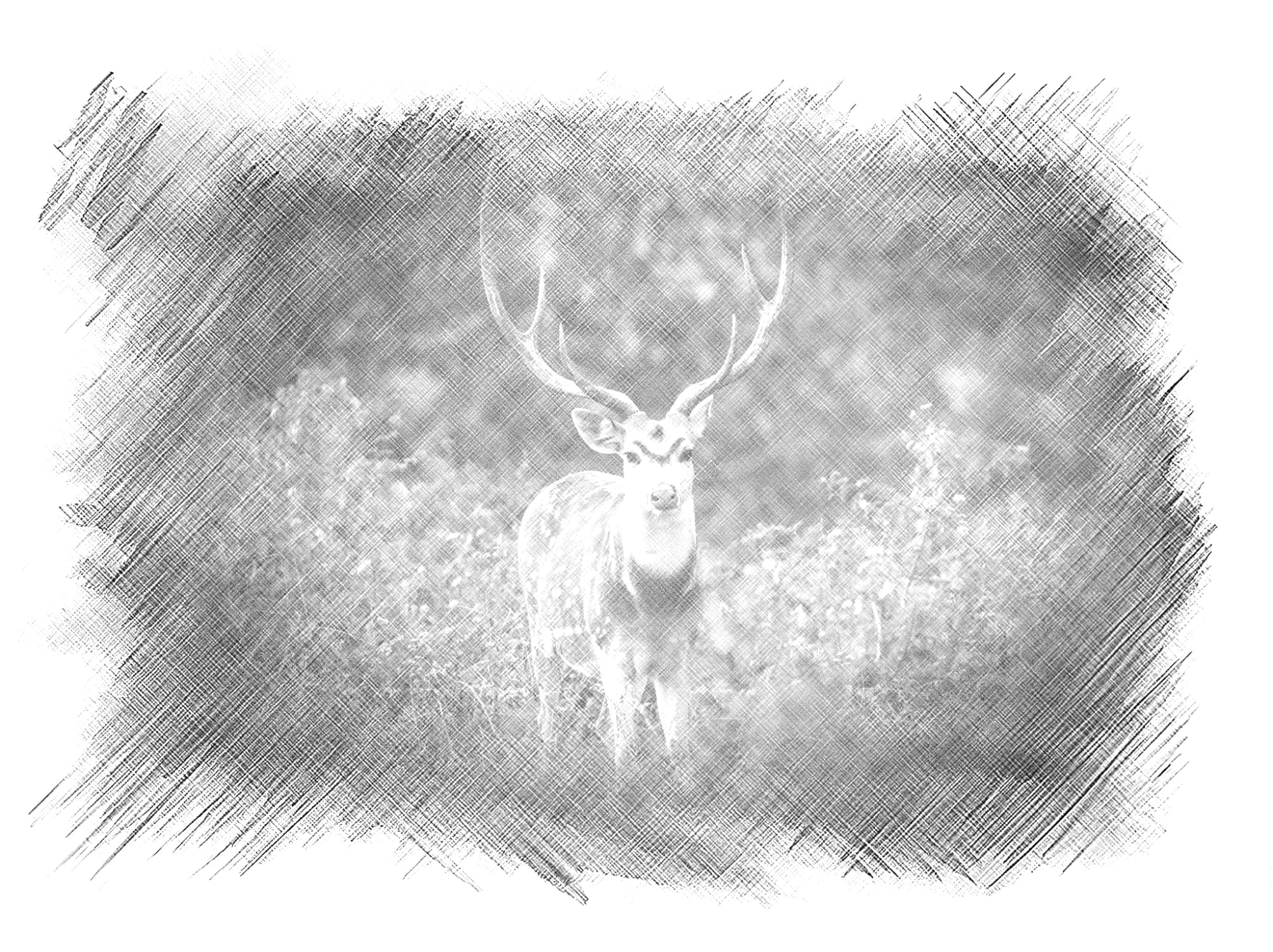
The true weight of the forest's gaze often comes from the most unexpected quarters. A magnificent Sambar Stag, crowned with thick, rugged antlers, might be wandering through the brush or grazing in a clearing. As you wait and watch, he freezes becoming aware of your presence. Is it your scent? Is it some subtle movement? Or is it simply their sixth sense? There is a magnificent "double-take"—a sharp, muscular snap of the head as he recalibrates his vision to focus entirely on you. In those massive, liquid-brown eyes, you see the ancient vigilance of the forest. He isn't just looking; he is assessing your soul for intent.
In a rarer, more electric moment, you might encounter a solitary Dhole (Asiatic Wild Dog), one of the super predators of these forests. Unlike the nervous retreat of many smaller mammals, the Dhole is driven by a fierce, pack-oriented intelligence. To see one trot toward a rocky outcrop, scramble up the stone, and stand tall just to get a better vantage point of you is to experience true wild curiosity. As it cocks its head, its rust-colored fur glowing in the sun, you realize that in the eyes of the Dhole, you are the fascinating anomaly.
The Ancient Observer
This curiosity extends even to the banks of the River Krishna, at the water’s edge, where the Mugger Crocodile offers a prehistoric connection. Often dismissed as a static, sun-baked log, the Mugger is a master of subtle investigation. If you sit patiently by the bank or in the fisherman’s catamaran - sitting low in the water, refusing the urge to move for a "closer" angle, the crocodile may slowly glide toward you, its eyes breaking the surface to study the stationary intruder. This is the heart of Shinrin-yoku: the realization that we are being watched as much as we are watching.
This is not the lunging movement of a hunt, but a slow, reptilian curiosity. By choosing to wait rather than chase, you allow the animal to become the observer. In that unblinking, ancient stare, you feel the weight of an evolutionary lineage that has remained unchanged for millennia. To look into the eye of a Mugger is to peer into deep time, a reminder that the tiger's kingdom is built upon foundations of ancient, patient life.
The Evolution of the Visitor
To change the culture of our Tiger Reserves and National Parks, this philosophy must be shared as a sacred trust between safari guides, drivers, and tourists. The transition from "chasing the frame" to "receiving the gaze" is the ultimate evolution of a visitor. The “tiger-centric” narrative of all our reserves has to transform into one of holistic immersion. Guides should be empowered to be naturalists rather than mere trackers, then the energy of the park shifts from frantic extraction to a quiet reverence.
We must inspire a shift in the traveler’s psyche: a "successful" safari is not a conquest of rare sightings, but the depth of a singular, shared gaze. By enshrining a "Wait and Watch" protocol—silencing the engine to let the forest’s heartbeat resume—we move beyond the intrusive role of the hunter. In this stillness, we allow the wild to dictate the terms of the encounter, transforming the safari from a frantic extraction of images into a hallowed ritual of mutual respect.
In the end, the forest grants its deepest secrets only to those who possess the grace to disappear into it. When we relinquish the frantic pursuit of the apex predator and instead open our senses to the quiet brilliance of the ecosystem, we find the true, restorative power of Amrabad. The healing begins the moment we stop being a disruption and start being a witness—tuning our pulse to the curiosity of a Honey Buzzard, the electric snap-focus of a Sambhar stag, or the ancient, unblinking wisdom of a Mugger. These are not mere sightings; they are invitations to belonging. We realize, with a sudden and humbling clarity, that the most spectacular, soul-stirring moments are not the trophies we hunted down through a viewfinder, but the wild gazes that found us only when we finally became still enough to be seen. In that silence, the forest no longer feels like a gallery of animals, but a singular, living entity that has finally accepted our presence.
‡‡‡‡‡

Related Posts



Hidden deep within the Amrabad Tiger Reserve, Chenchu sacred groves like Maisamma Madugu are protected patches of forest revered by the indigenous Chenchu tribe. These sites are managed through traditional wisdom, serving as biodiversity hotspots, conserving rare flora & acting as sanctuaries for wildlife. The tribe’s belief system ensures these groves remain untouched, fostering ecological balance and protecting natural resources.
#WildArtWorks #AmrabadTigerReserve #ChenchuTribe #SacredGroves #TelanganaTourism #WildlifeConservation #NallamalaHills #IndigenousKnowledge #EcoTourism #IndiaBiodiversity #TribalHeritage #MaisammaMadugu #AchampetRange