
Brown Shrike
Lanius cristatus
Butcher bird of Nallamala
As the monsoon retreats from the Deccan Plateau, a quiet but profound transformation takes place in the scrublands and deciduous forests of Telangana. The humid heat gives way to a crisp morning air, and the avian soundscape shifts. Among the many arrivals, one bird carries a reputation that precedes its diminutive size: the Brown Shrike (Lanius cristatus). Known as the "Butcher Bird" due to its habit of impaling prey on thorns, this long-distance traveler connects the icy taigas of Siberia to the rugged landscapes of the Amrabad Tiger Reserve and Kawal Tiger Reserve.
Telangana's landscape is dotted with ideal habitats, from the urban oases of Ameenpur Lake, Osman Sagar, HImayat Sagar, Kistareddypet Lake near Hyderabad to the sprawling Singur Dam, the Sri Ram Sagar Reservoir and the Dindi Reservoir. Renowned for its extensive natural resources, breathtaking scenery, and rich cultural legacy Telangana is the eleventh largest state in India situated on the south-central stretch of the Indian peninsula on the high Deccan Plateau. It is the twelfth-most populated state in India with a geographical area of 112,077 km² of which 21,214 km² is forest cover. The dry deciduous forests ecoregion of the central Deccan Plateau covers much of the state, including Hyderabad. The characteristic vegetation is woodlands of Hardwickia binata and Albizia amara. Over 80% of the original forest cover has been cleared for agriculture, timber harvesting, or cattle grazing, but large blocks of forest can be found in the Amrabad Tiger Reserve and elsewhere. The more humid Eastern Highlands moist deciduous forests cover the Eastern Ghats in the eastern part of the state. The Central Deccan forests have an upper canopy at 15–25 meters, and an understory at 10–15 meters, with little undergrowth.
The dry sub-humid zone or Dichanthium-cenchrus-lasitrrus type of grasslands are prevalent here and cover almost the entirety of peninsular India except the Nilgiris. One sees thorny bushes like the Acacia catechu or Khair as it is known in Hindi, Mimosa, Zizyphus (Ber) and sometimes the fleshy Euphorbia, along with low trees of Anogeissus letifolia or Axle Wood, Soymida febrifuga - the Indian Redwood - and other deciduous species. Sehima (grass) which is more prevalent on gravel is about 27% of the cover and Dichanthium(grass) which flourishes on level soil is almost 80% of the coverage.
Nallamala Hills & forest range
The Nallamala Hills and forest range is a significant geographical feature within the Eastern Ghats of southern India, located in Telangana and stretching into Andhra Pradesh. This ~430 km long range, parallel to the Coromandel Coast, features rugged hills and deep valleys and hosts one of the largest contiguous forest areas in the region, encompassing a significant portion of the Nagarjuna Sagar Srisailam Tiger Reserve. The rugged, sparsely populated hills are composed for the most part of jumbled quartzites and slates and exemplify the mountain scenery of the Eastern Ghats. The range is known for its rich biodiversity, eco-tourism opportunities, and important religious sites like the Srisailam temple. It is bounded by the Krishna River to the north and the Pennar River to the south. The region includes important religious sites like the Srisailam Temple, one of the twelve Jyotirlingas. The Nallamala region has faced threats from proposed uranium mining projects, which would jeopardize the Tiger Reserve and the Chenchu's traditional way of life. Organisations like HYTICOS and local tribes have actively campaigned against these projects to protect the delicate ecosystem.
In the Nallamalla Hills and forest range the predominant vegetation is dry deciduous forest, with species such as Terminalia (తెల్ల మద్ది, అర్జున, ఎర్రమద్ది), Hardwickia (ఏపీ, నరేపీ), and Pterocarpus (ఏగిస, పెద్దగి and ఎర్ర చందనం). The forest also has a variety of medicinal plants. The forest is home to various mammals like Tigers, Leopards, Sloth Bears, Wild Boar, Sambhar, Blackbucks, and Pangolins. A variety of birds, including rare and migratory species, inhabit the sanctuary. Read about some of the species here. It is also host to diverse reptile species, including the King Cobra and Indian Rock Python and the forest is known for unique spider species like the critically endangered Gooty Sapphire Ornamental Tarantula (Poecilotheria metallica). The Chenchus, a forest-dwelling tribe, are the indigenous inhabitants of the Nallamala forest. They traditionally live a semi-nomadic, hunter-gatherer lifestyle and have remained largely cut off from modern society. The Chenchus have a unique, symbiotic relationship with the forest and play a key role in its conservation.
Uma Maheshwaram is the northern gateway to Srisailam — one of the jyotirlingas, on a hill surrounded by high trees. The Uma Maheshwaram temple is dedicated to the Hindu god Shiva located in the Nallamala Forest around 100 km from Hyderabad on the Hyderabad-Srisailam highway, about 4 kms from the village of Rangapur, Achampet. Nearby hills shield the temple and the 500-metre stretch to PapaNasanam (a mysterious spring of unknown source from which water can be drawn continuously through the year) from sunlight for most of the day, maintaining a temperature lower than the surroundings during the entire year. The area abounds in flora and fauna like the beautiful and Vulnerable Yellow-throated Bulbul.
‡‡‡‡‡
For a print of the beautiful wildlife from my various sojourns click on the button below to read my process and order a limited edition canvas from the catalog.
Brown Shrike
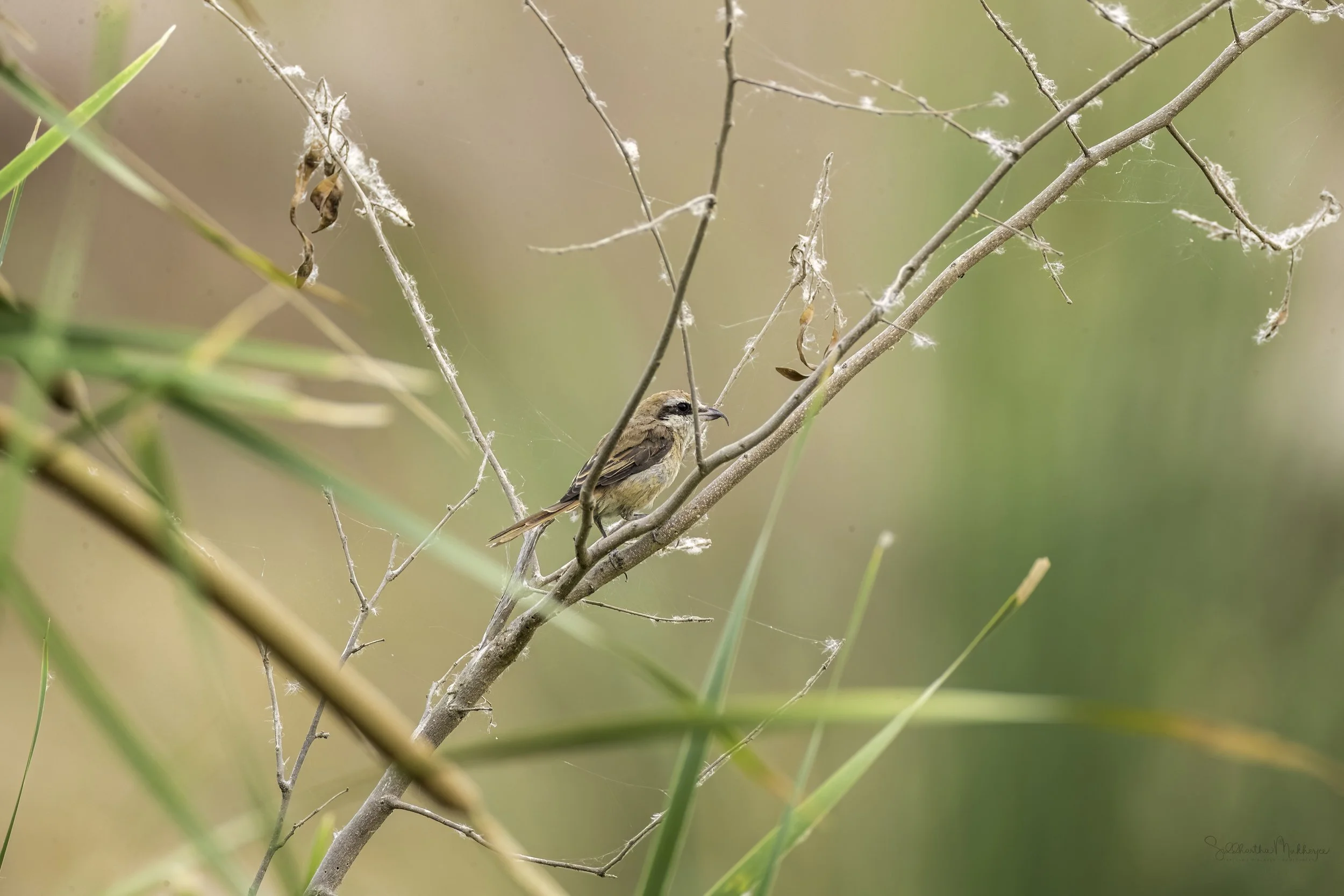
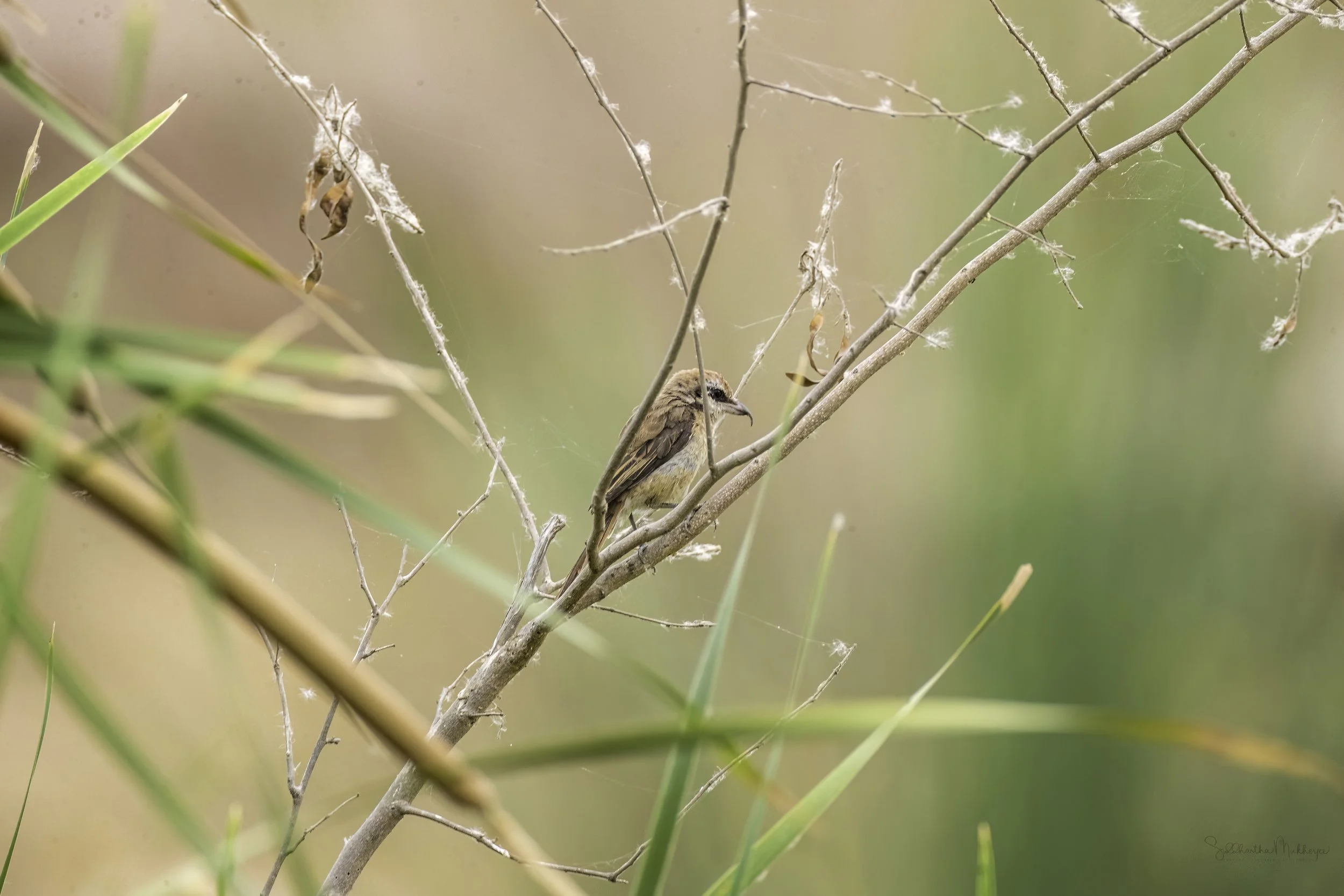
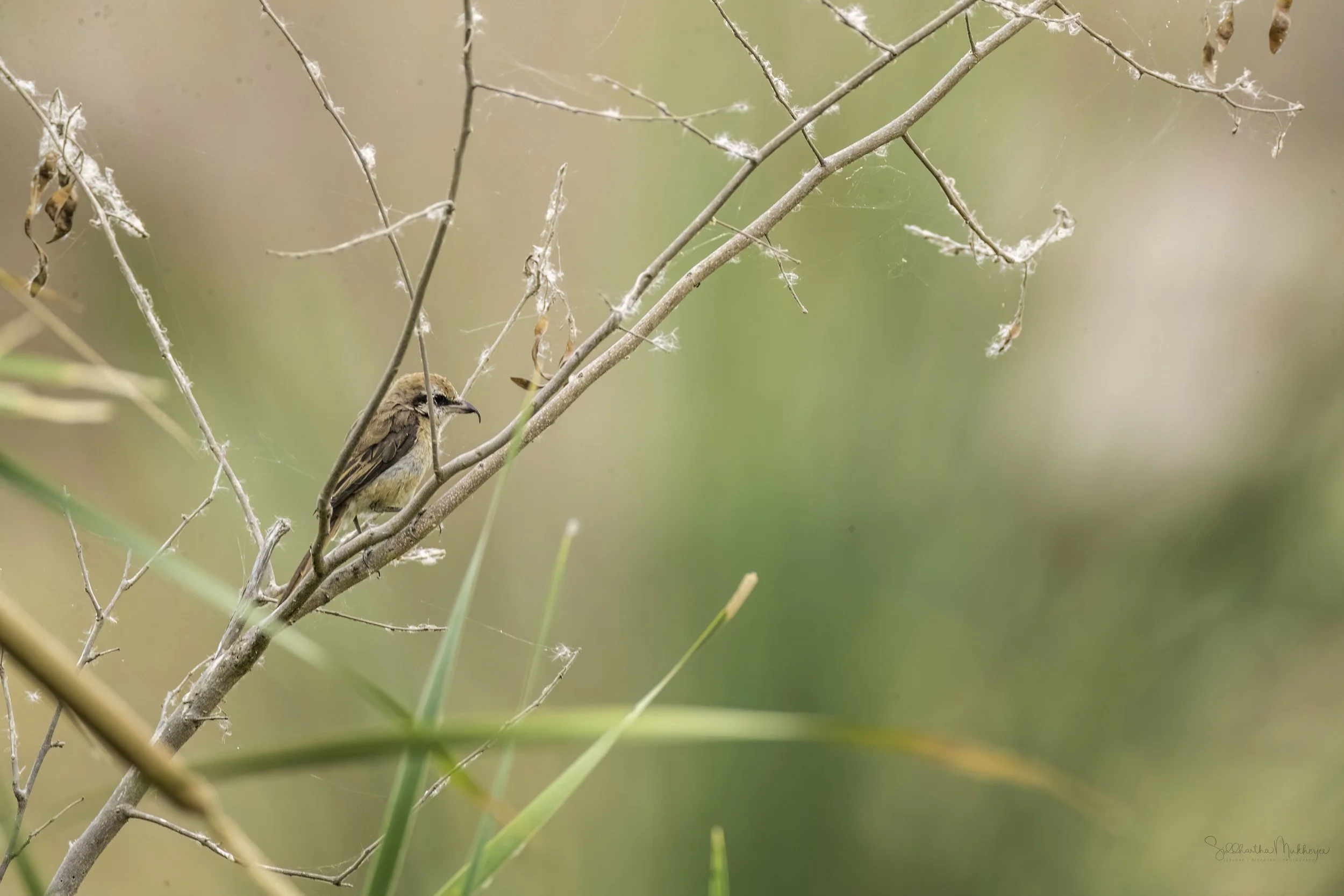
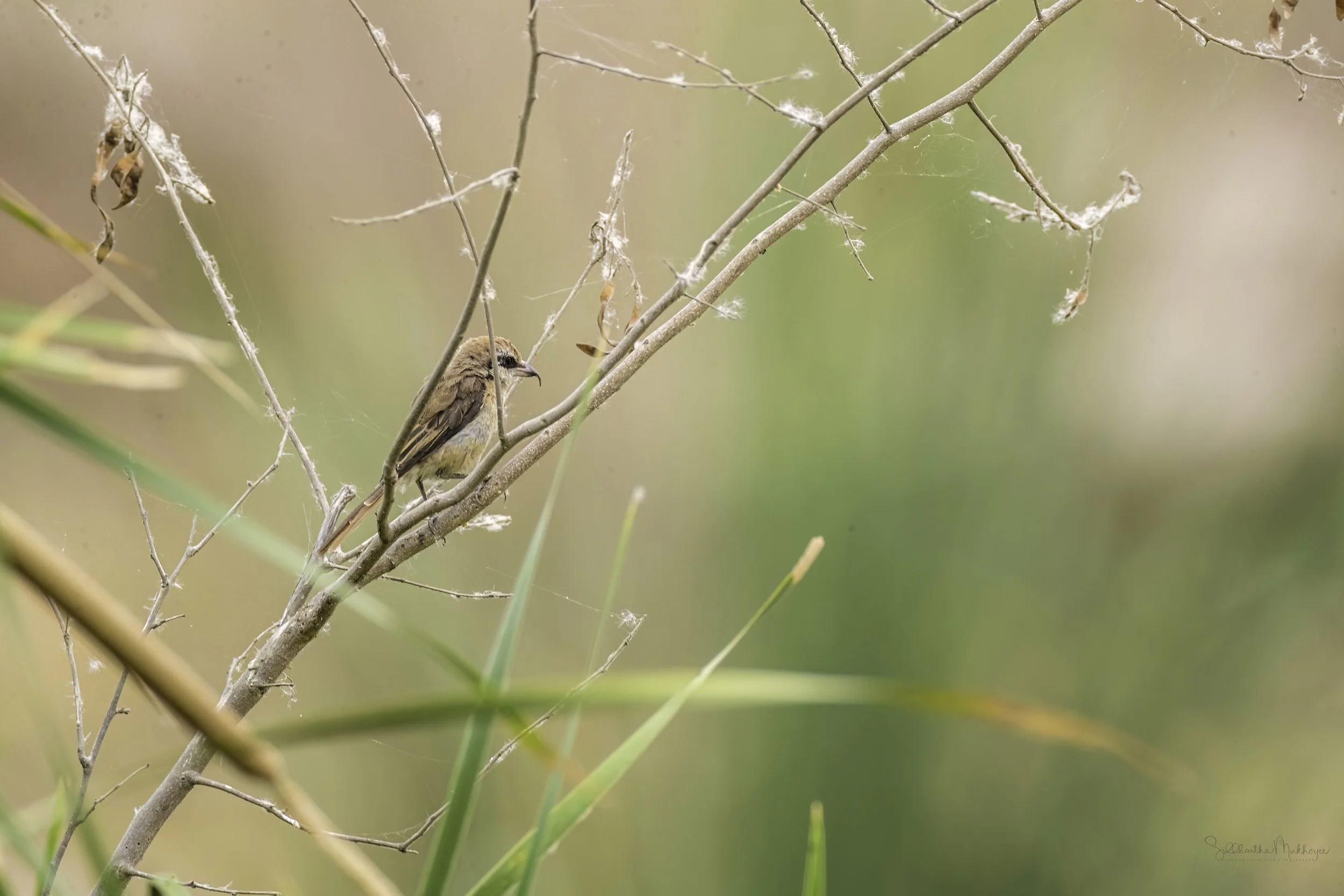
The Brown Shrike (Lanius cristatus) is a bird in the shrike family that is found mainly in Asia. It is closely related to the Red-backed Shrike (Lanius collurio) and Isabelline Shrike (Lanius isabellinus). The genus name, Lanius, is derived from the Latin word for "butcher", and some shrikes are also known as "butcher birds" because of their feeding habits. The specific cristatus is Latin for "crested", used in a broader sense than in English. The common English name "shrike" is from Old English scríc, "shriek", referring to the shrill call. Like most other shrikes, it has a distinctive black "bandit-mask" through the eye and is found mainly in open scrub habitats, where it perches on the tops of thorny bushes in search of prey. Several populations of this widespread species form distinctive subspecies which breed in temperate Asia and migrate to their winter quarters in tropical Asia. They are sometimes found as vagrants in Europe and North America.
The Brown Shrike is a widespread winter visitor to the Indian subcontinent, arriving in August and September and departing by April. While common across India, its presence in Telangana is particularly notable in protected areas where open scrub meets dense forest. In the Amrabad Tiger Reserve, situated in the Nallamala Hills, it finds refuge among the hilly gorges and dry deciduous tracts. Further north, in the Kawal Tiger Reserve, it patrols the edges of grasslands and teak-dominated forests along the Godavari river basin.
These reserves provide the "edge" habitat shrikes crave—areas where they can perch on a prominent branch or wire and scan the ground for insects, lizards, or small birds. While not endemic to India, the Brown Shrike is a staple of the winter birding calendar, though its numbers in certain regions like Japan have seen drastic declines.
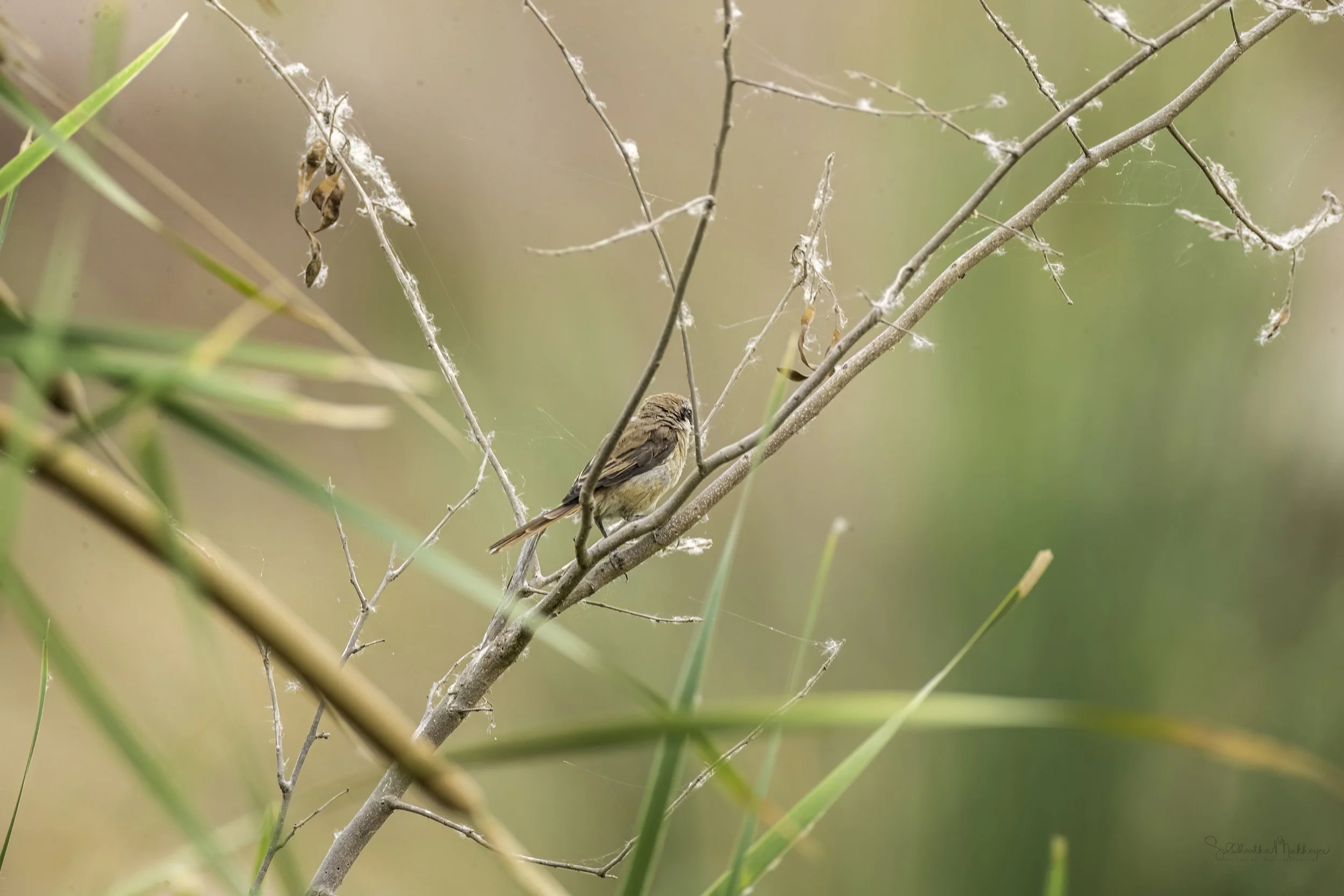
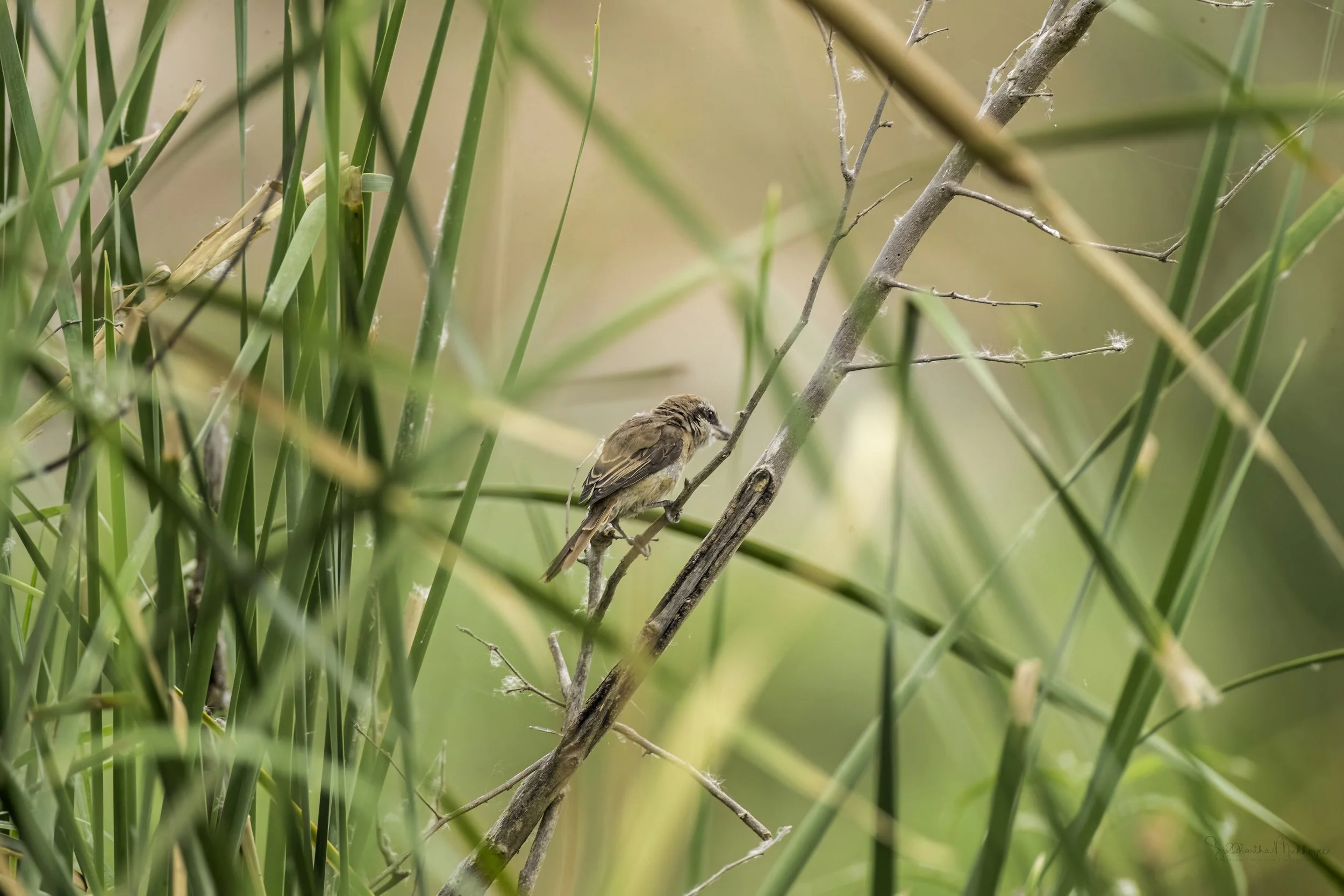
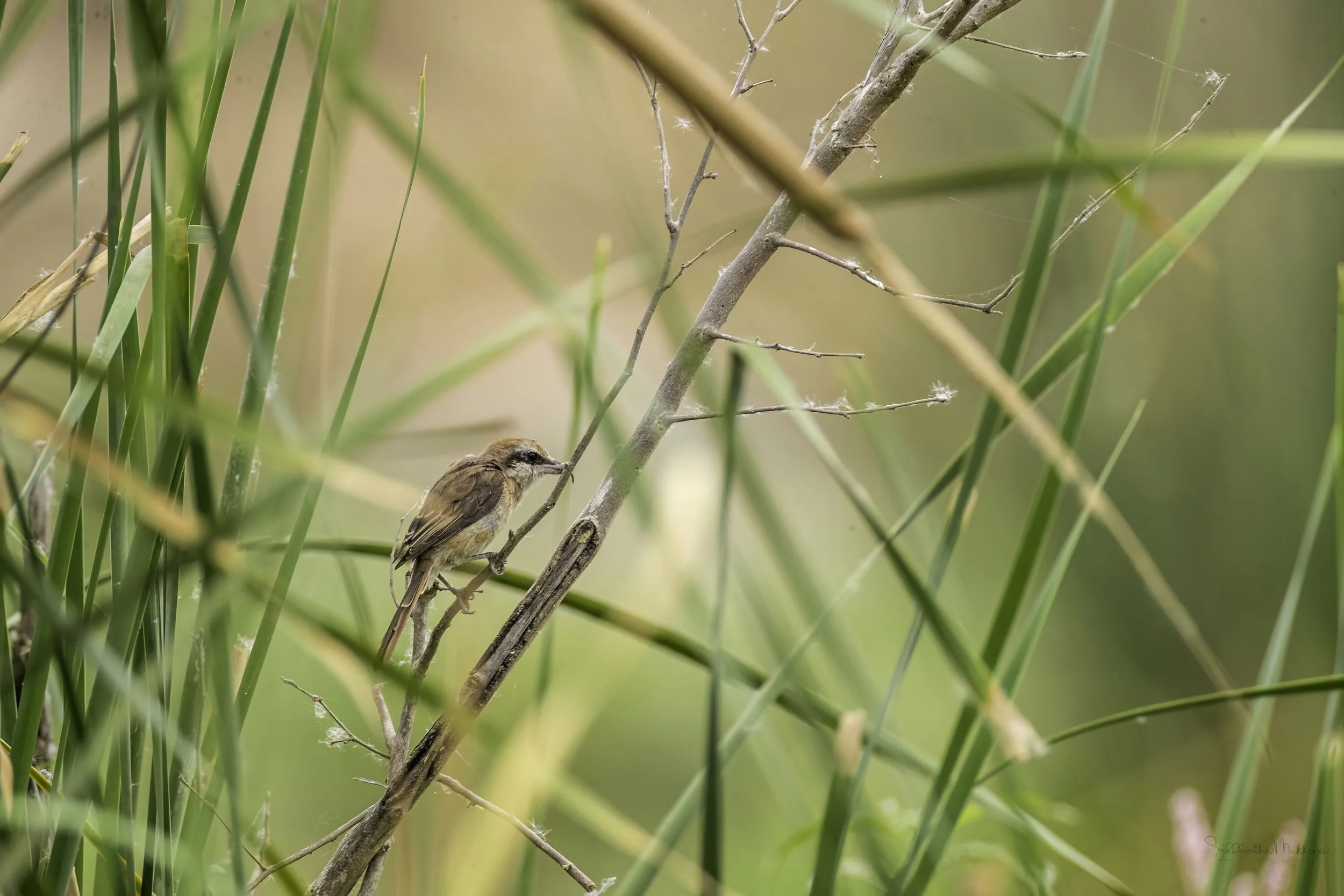
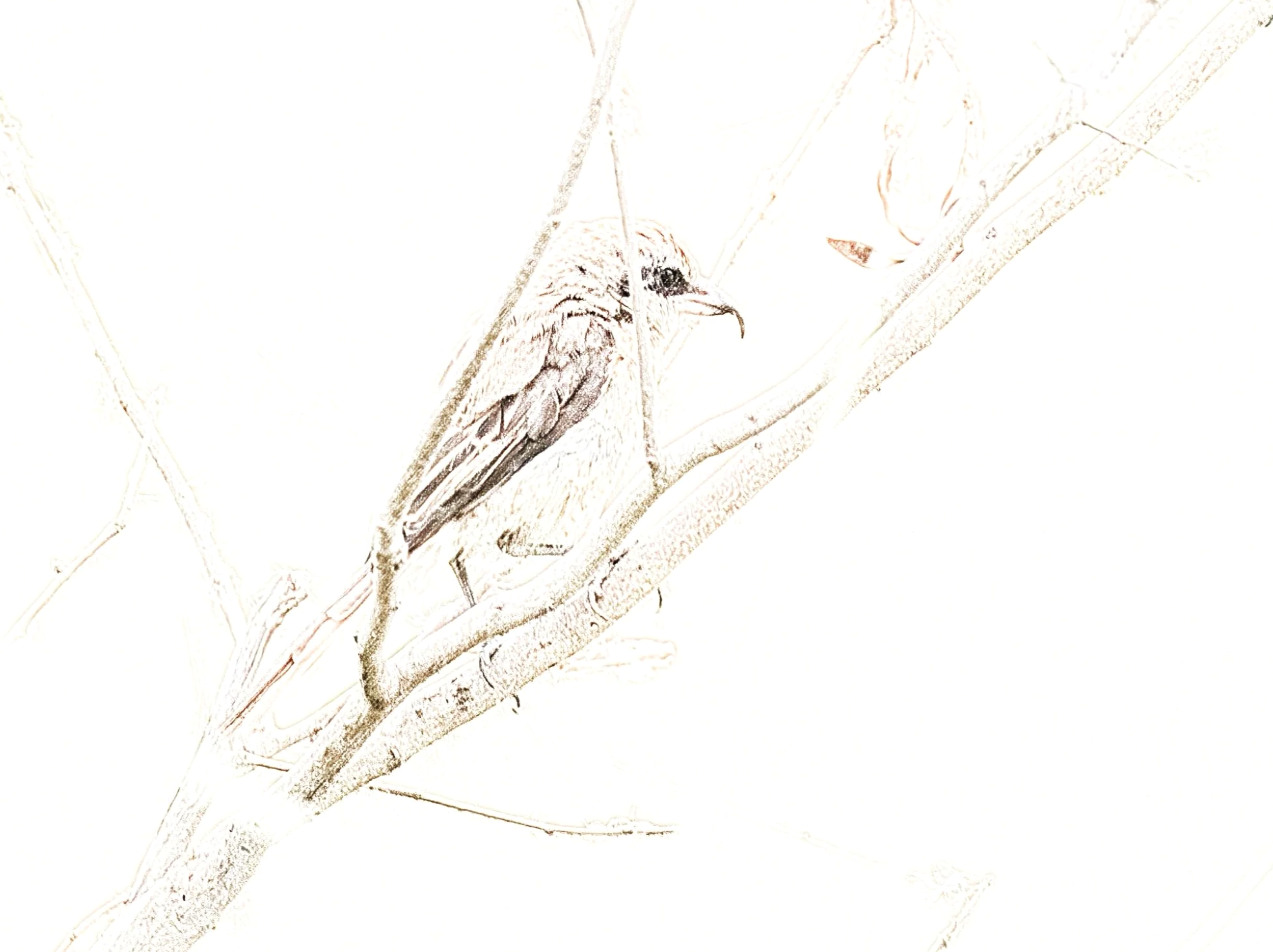
Despite its fierce nature, the Brown Shrike is a medium-sized bird, roughly 17–20 cm in length and weighing between 27–37 grams. Its most striking feature is the black "bandit mask" that stretches from the lores through the eye to the ear coverts, often highlighted by a thin, white "eyebrow" or supercilium. The nominate race (Lanius cristatus cristatus) typically displays earthy brown upperparts - the mantle and nape, with a warmer, more rufous crown and rump. The underparts are creamy white to buff, with a subtle rufous wash on the flanks with brown wings without white patches (unlike some other shrikes) and a rounded, graduated tail. Subspecies like the Philippine Shrike (Lanius cristatus lucionensis), also seen in peninsular India, are distinguishable by their grey-washed crown and nape, which contrasts sharply with the brown back. Diet mainly insects, also other arthropods and small vertebrates. Orthoptera and beetles (Coleoptera) usually main prey; vertebrates taken are mostly small mammals, lizards, amphibians, and small passerine birds (including nestlings).
Four subspecies currently recognized.
EBIRD GROUP (POLYTYPIC)
Brown Shrike (Brown) Lanius cristatus cristatus/confusus
Lanius cristatus cristatus: Distributed in Central and East Siberia South to North Mongolia, Lake Baikal area, North Sakhalin, East Chukotka and Kamchatka; non-breeding Central and South India, Sri Lanka, Bangladesh, Myanmar (mainly coast) and the Malay Peninsula.
Lanius cristatus confusus: Distributed in East Mongolia, South East Russia (South East Transbaikalia East to Amurland and Ussuriland) and North East China; non-breeding South Malay Peninsula and Sumatra.
EBIRD GROUP (MONOTYPIC)
Brown Shrike (Japanese) Lanius cristatus superciliosus: Distributed in coastal Russian Far East, South Sakhalin, South Kuril Is and North and Central Japan (Hokkaido, North and Central Honshu); non-breeding mainly coastal South China, Hainan, North East and East Indochina, Sumatra, Java and West Lesser Sundas.
EBIRD GROUP (MONOTYPIC)
Brown Shrike (Philippine) Lanius cristatus lucionensis: Distributed in North and East China, Korea, South Japan (Kyushu), and recently found in East Mongolia; non-breeding mainly coastal South East China, Taiwan, Philippines, North Borneo and North Sulawesi.
The Shrike Family: Distinguishing the Cousins
In the environs of Telangana, the Brown Shrike often shares territory with other members of its genus, leading to identification challenges for the uninitiated:
Isabelline / Daurian Shrike: A sandier, paler bird with a contrasting reddish tail. Structurally, it has a slighter bill and shorter tail than the Brown Shrike.
Long-tailed Shrike: A resident king of the grasslands, it is larger with a much longer, narrower black tail and a rufous-orange wash on its back and flanks.
Bay-backed Shrike: Easily identified by its maroon-red (bay) back, grey crown, and prominent white wing patches.
Grey-backed Shrike: Prefers higher altitudes but can be a winter vagrant; it features a grey mantle and lack of the Brown Shrike's warm rufous tones.
The Brown Shrike is a master of site fidelity, often returning to the exact same tree or hedge in Amrabad or Kawal year after year. Their migration is a feat of endurance, spanning thousands of miles from the breeding grounds in Mongolia and Siberia. Once they arrive, they are highly territorial, announcing their presence with a harsh, rattling "kichi-kichi-kichi" call. Their hunting strategy is a patient "sit-and-wait" technique. From a low perch (usually below 2 metres), they sally out to snatch prey from the ground. Their "larder"—the habit of impaling prey on thorns—serves as both a cache for leaner times and a way to steady a carcass while they use their hooked, raptor-like bill to tear it apart.
Incidentally, this is the only time I have seen the Brown Shrike in these environs.
‡‡‡‡‡

Related Posts


The Bay-backed Shrike is a brightly-colored small shrike, reminiscent of the Long-tailed Shrike in overall coloration. It has a black mask, rufous flanks & back, a clean white throat, and its small size makes it distinctive within its range. It prefers open areas, often in dry regions, with scattered vegetation. Often perches up on exposed snags, fenceposts, or telephone lines.
#wildartworks, #Canon, #Bird, #Birdinginthewild, #BirdWatching, #Wildlife, #WildBirds, #naturephotography, #your_best_birds, #planetbirds, #earthcapture, #photo_pond, #earthpix, #naturyst, #conservationphotography, #yesbbcearth, #indian_wildlifes, #indianwildlifeofficial, #wildlifeonearth, #bbcearth, #natgeowild, #natgeoindia, @globalcapture, #TelanganaBirds, #HyderabadBirds, #Tellapur, #GHMCUrbanForestryNursery, #TelanganaUrbanForestry, #Nallagandla, #baybackedshrike, #shrike