
Rudra
Panthera tigris tigris
ENDANGERED
The lord of Gundam, Amrabad Tiger Reserve
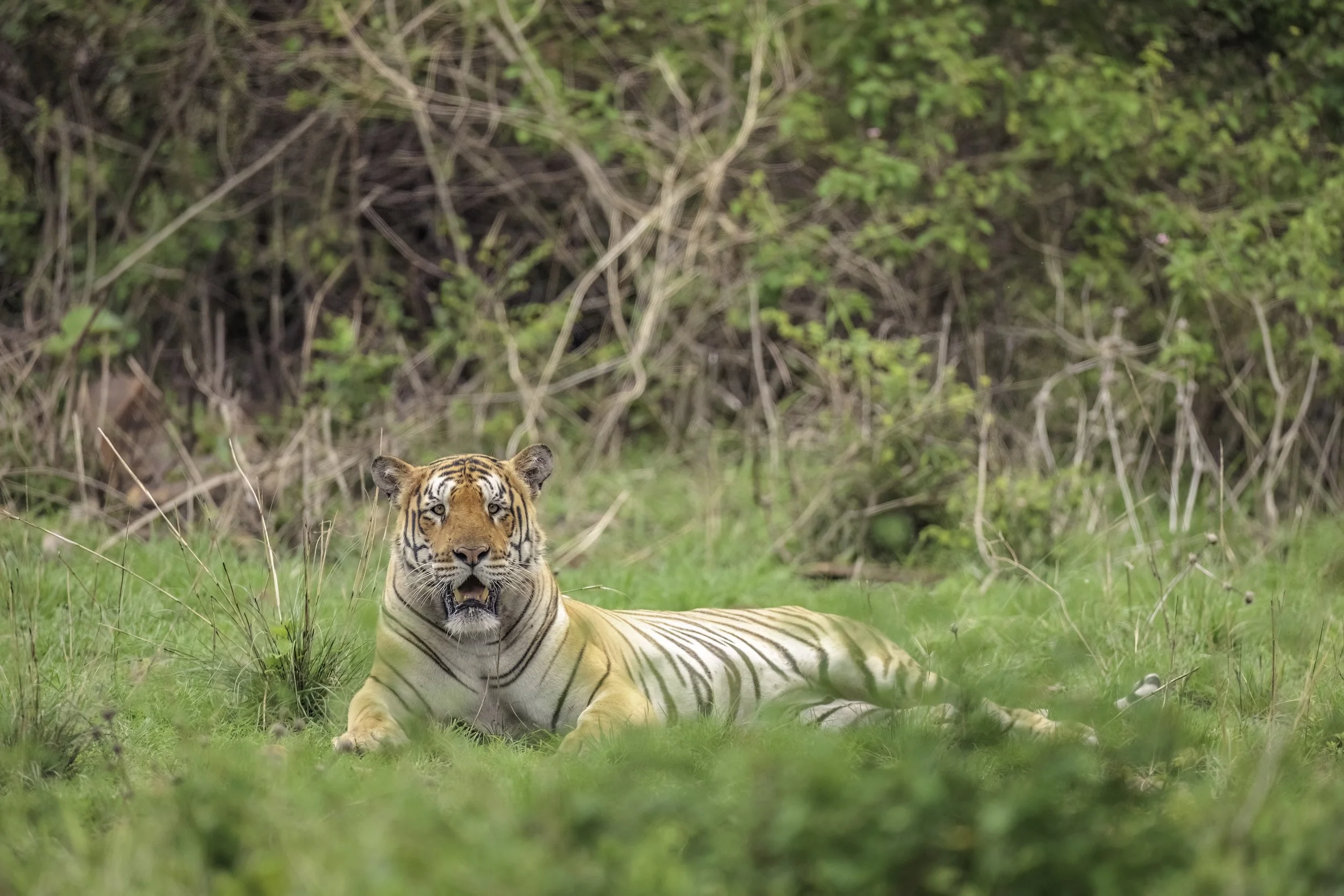
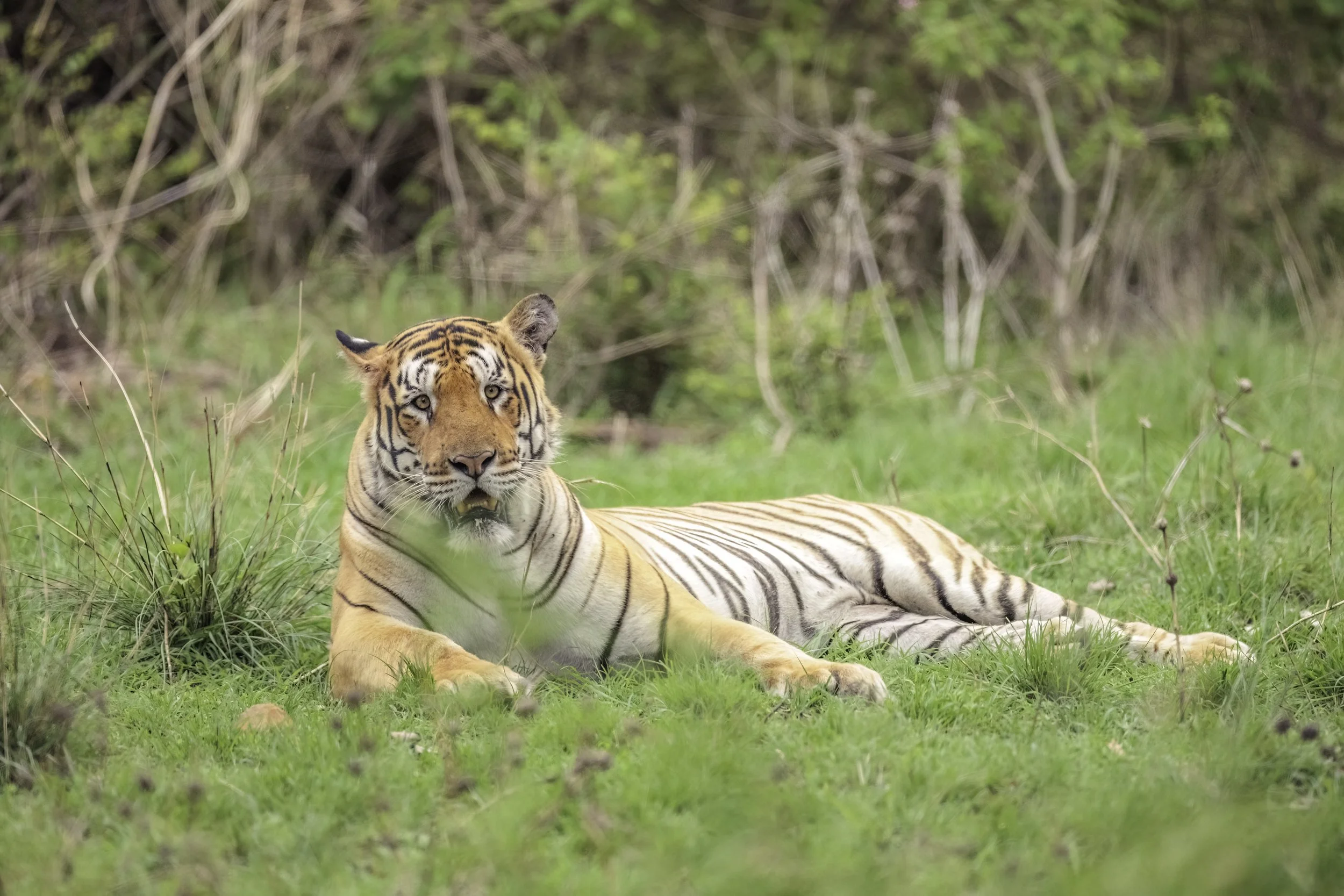
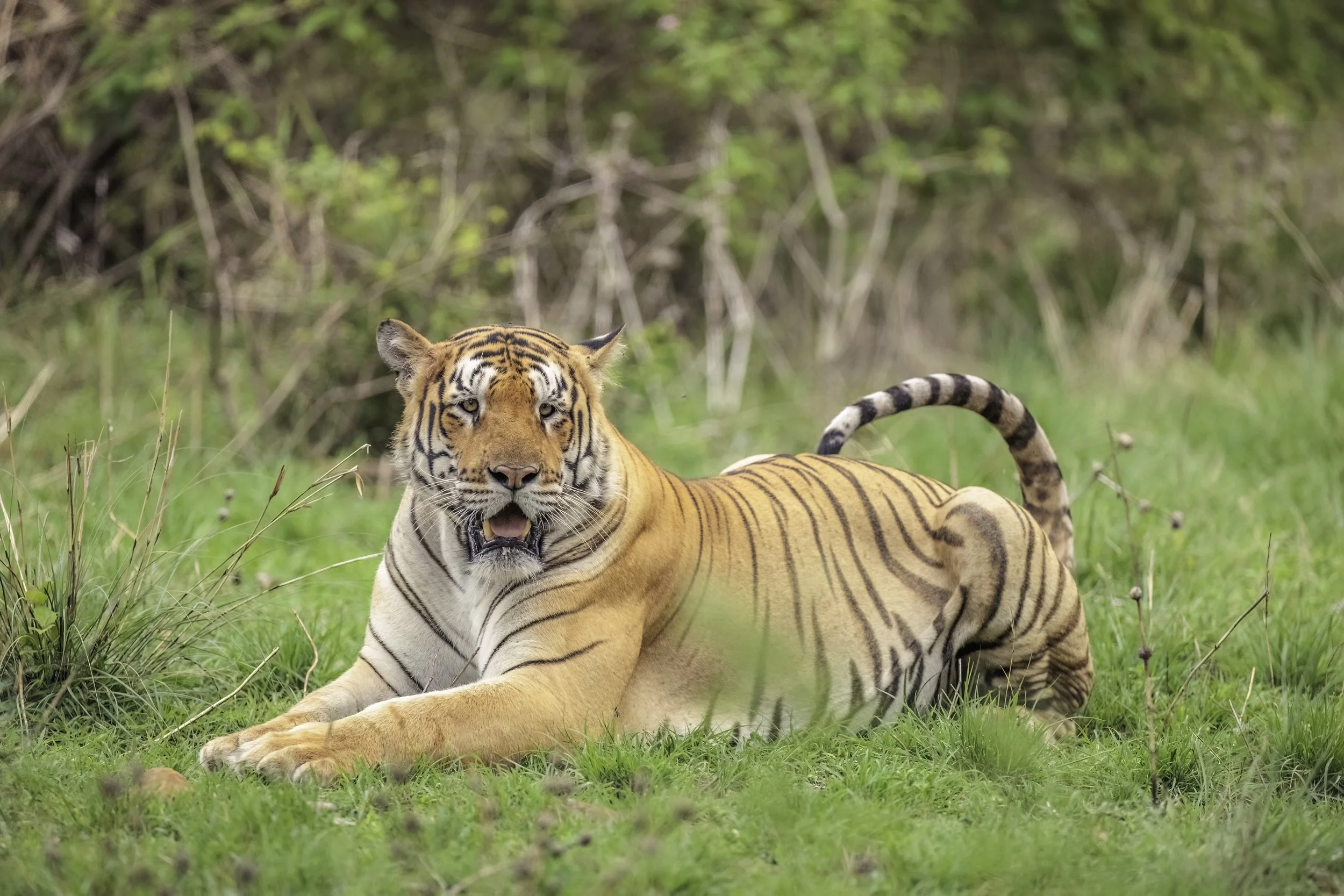
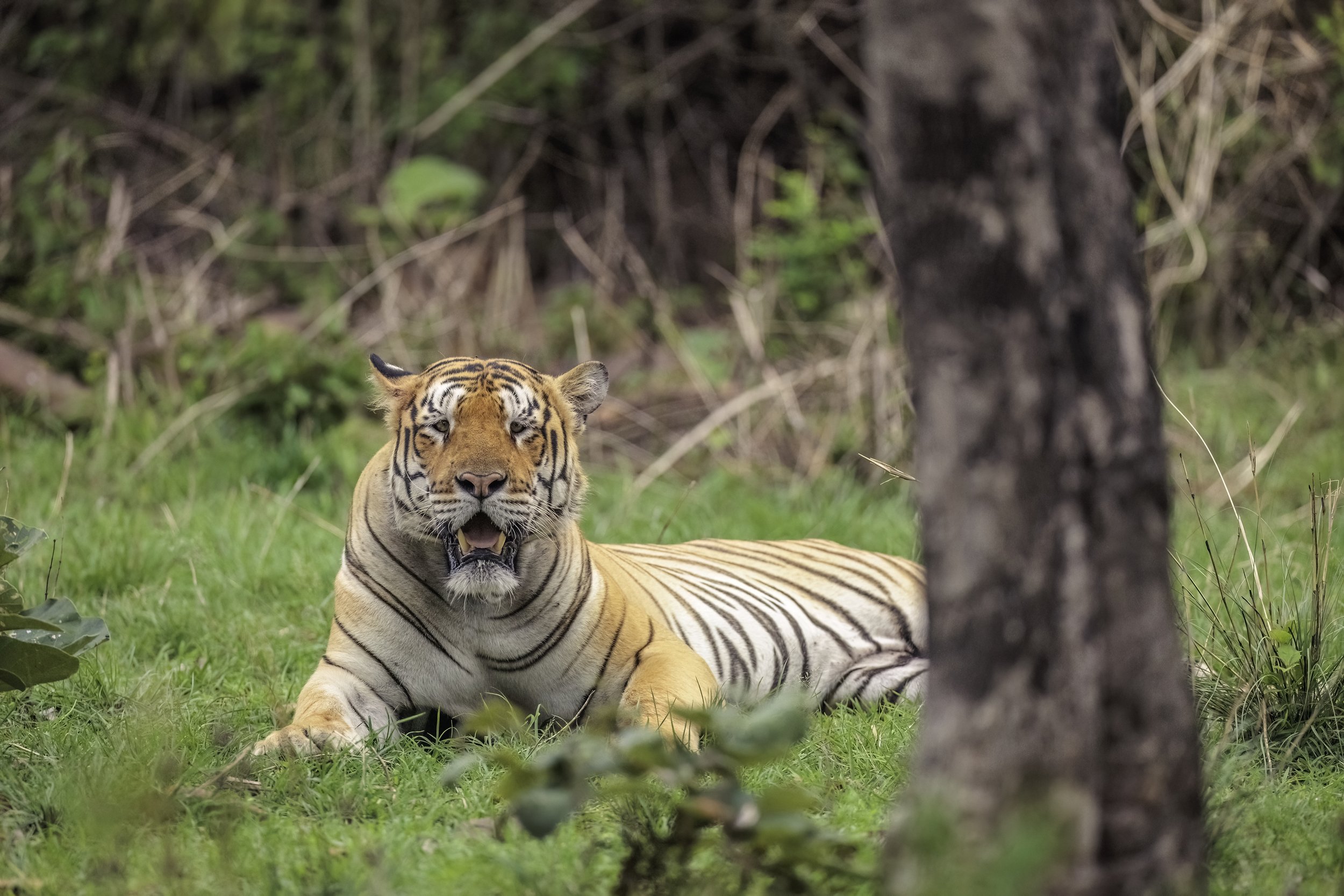
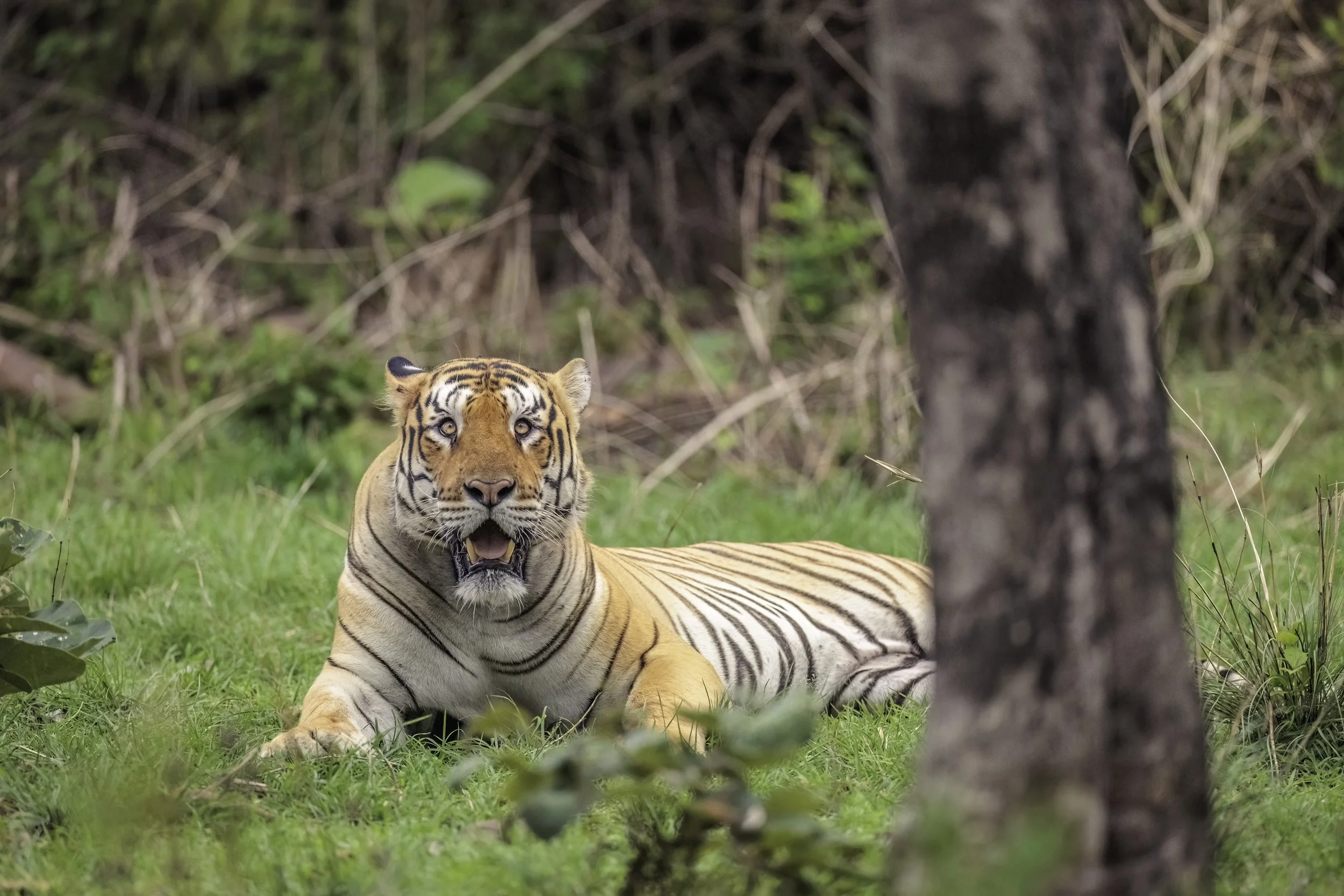
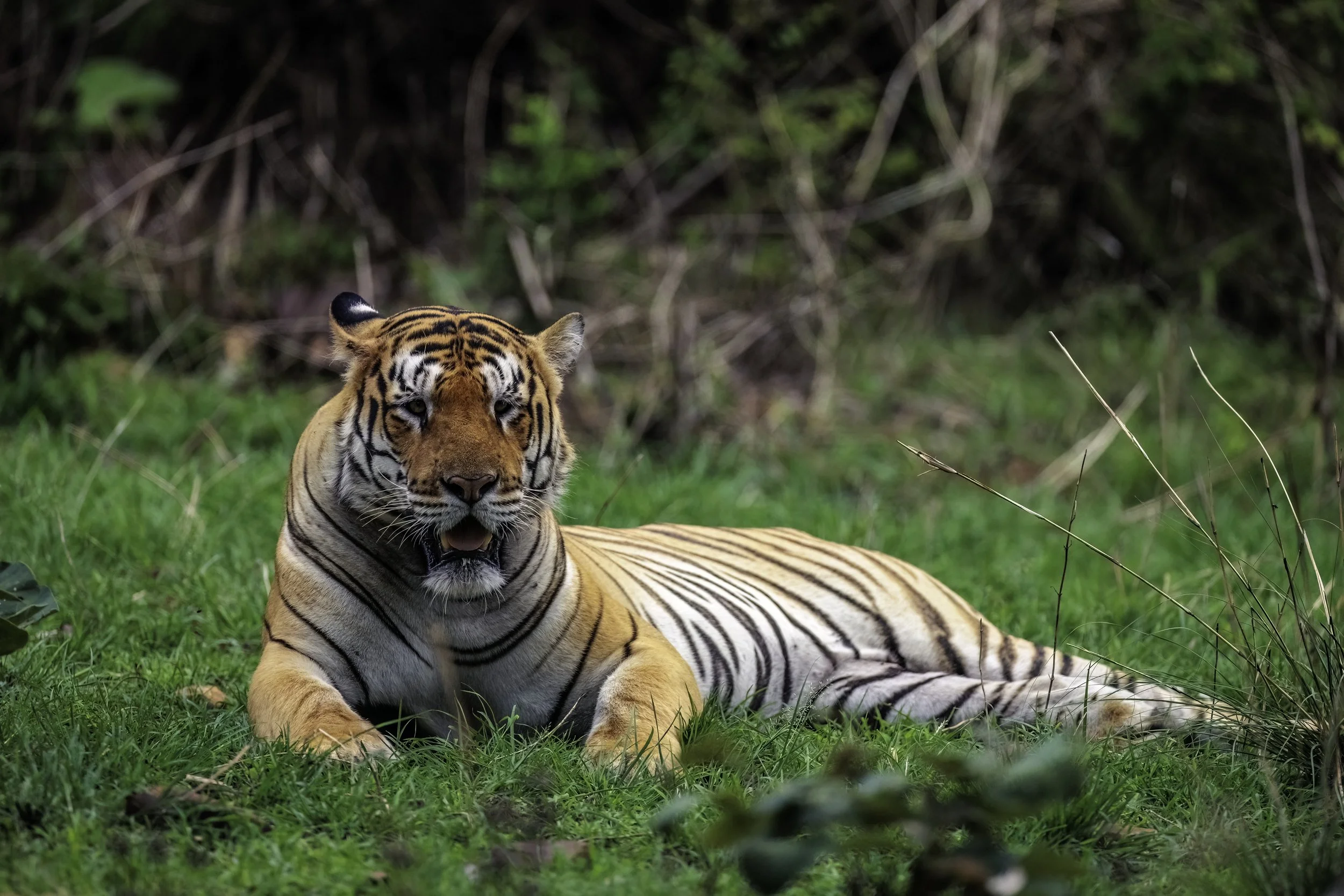
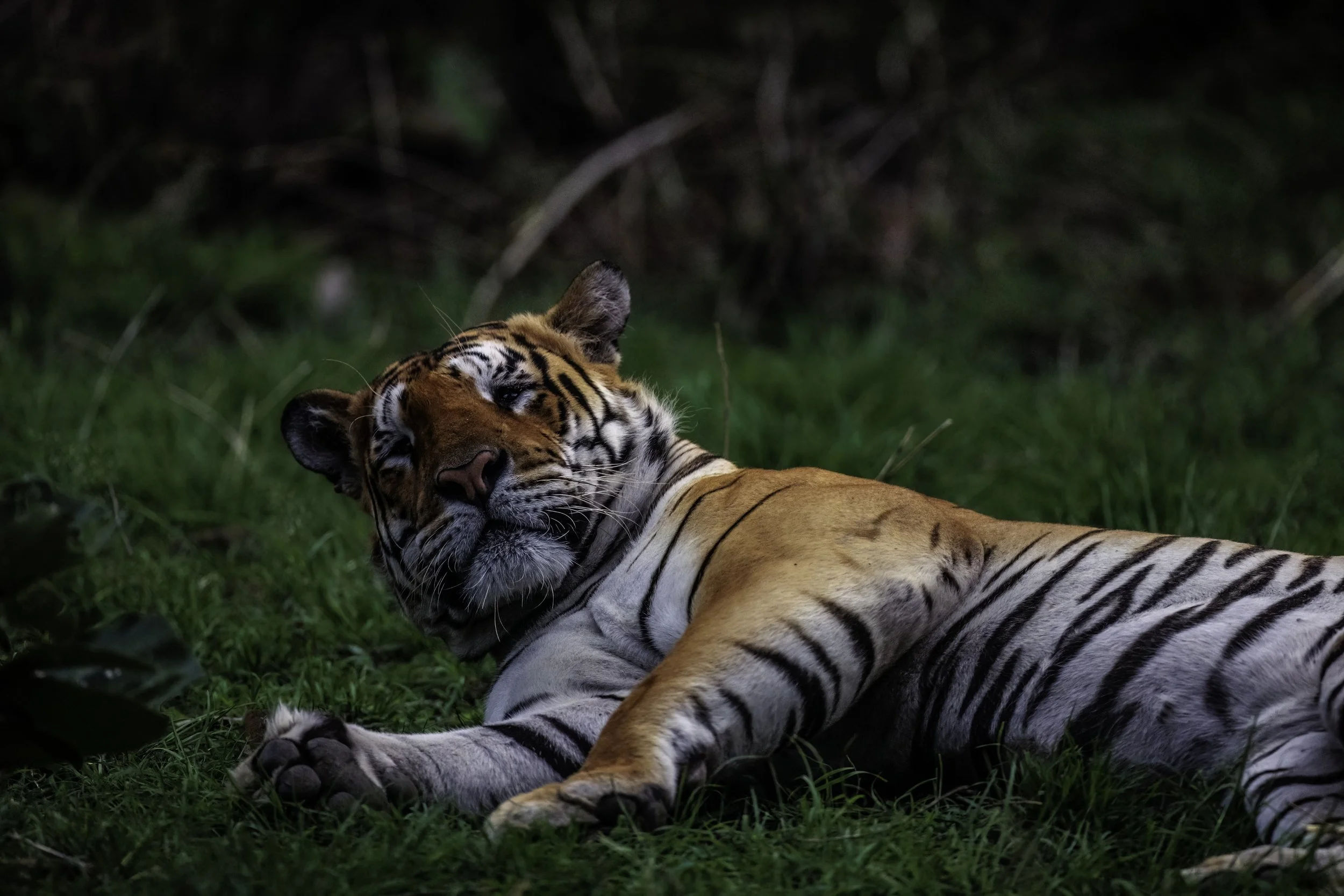
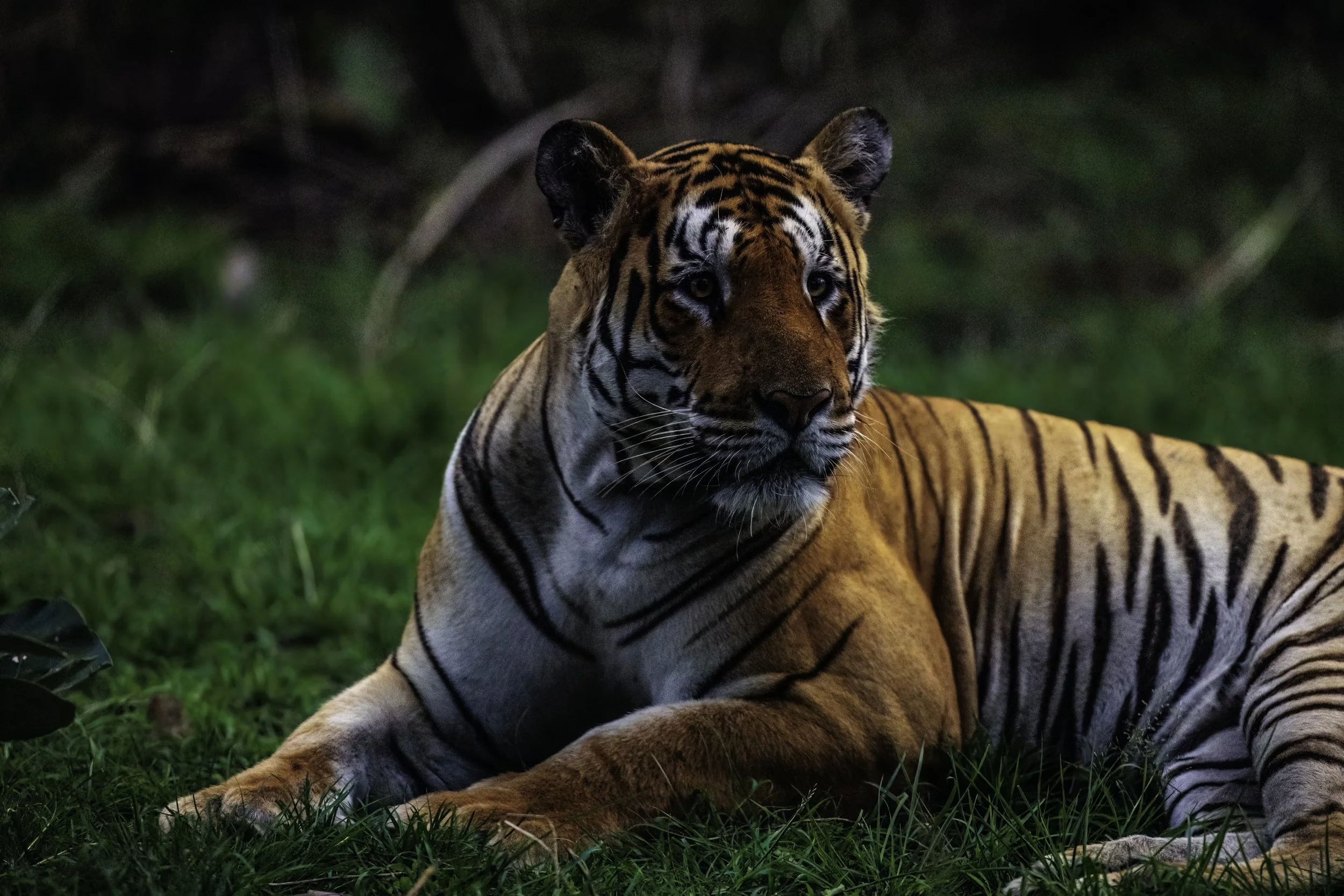
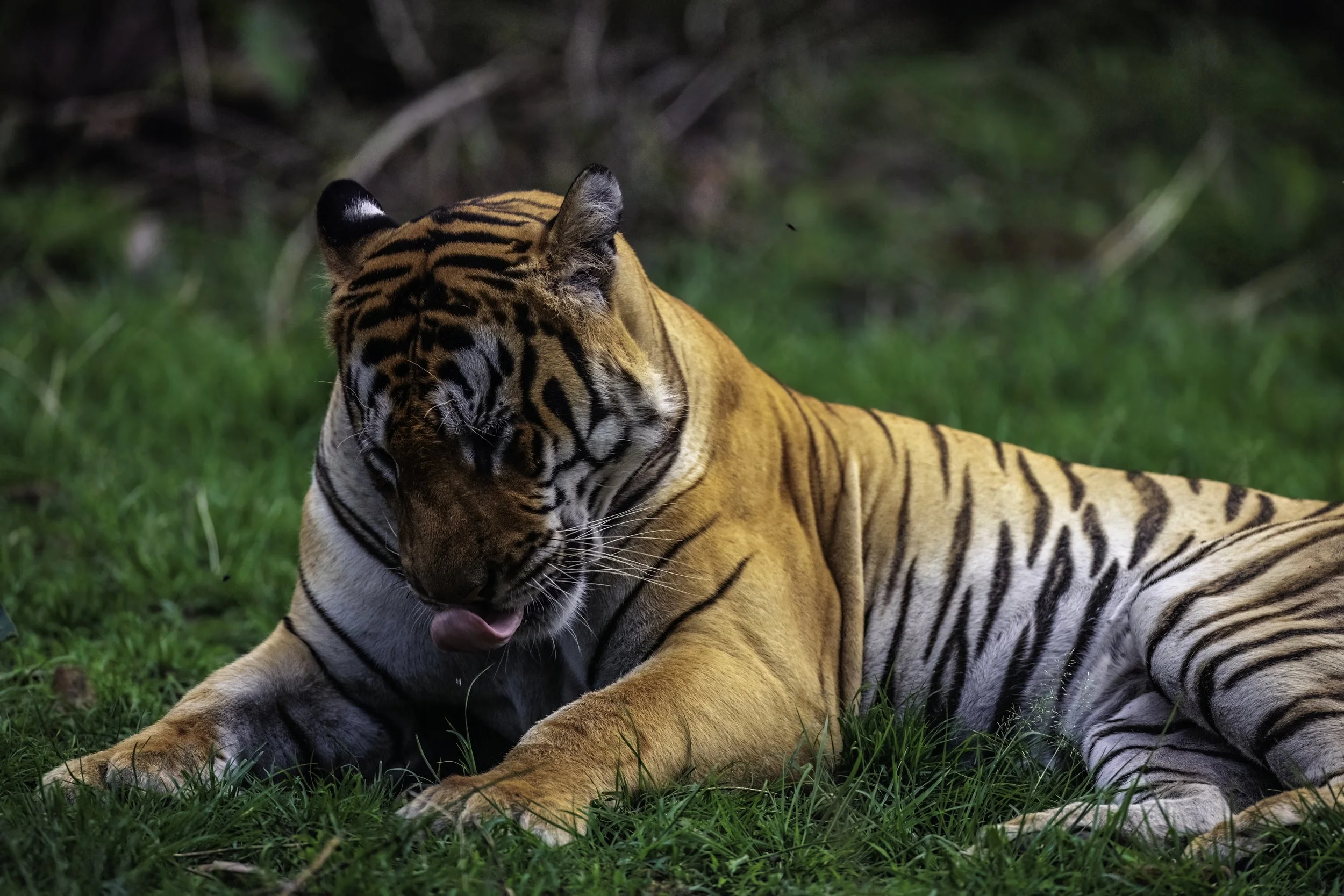
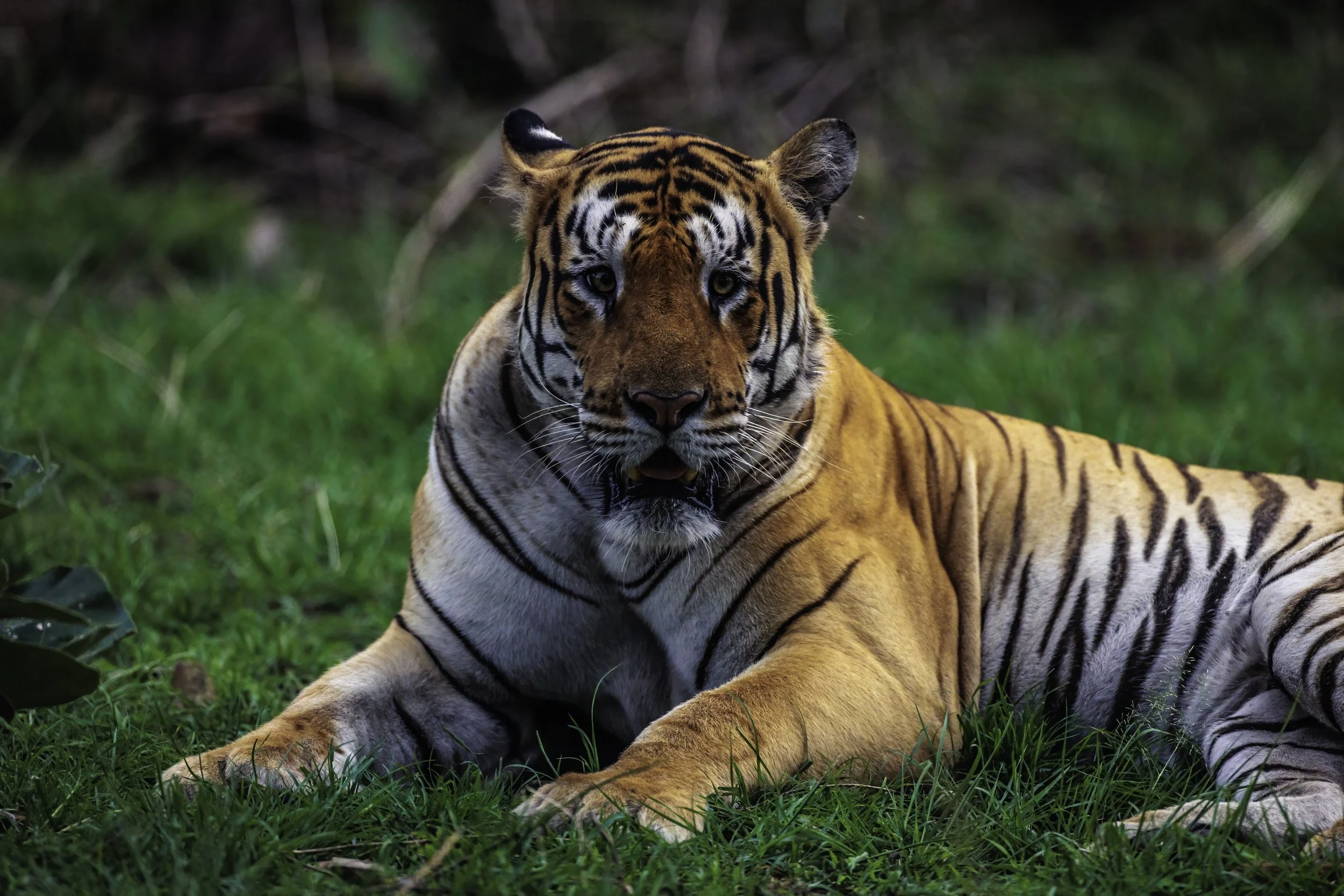
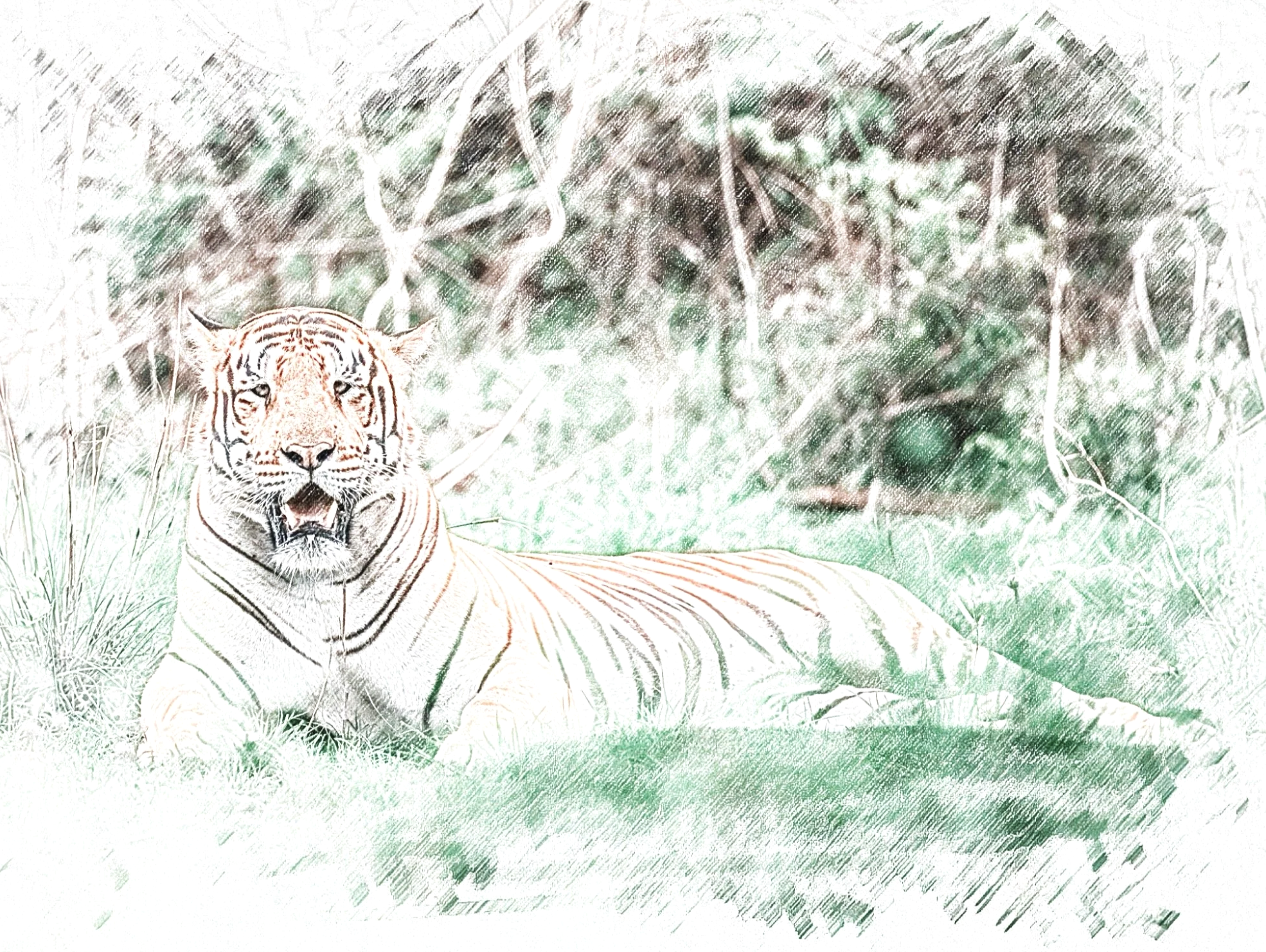
The late summer afternoon in Telangana was heavy with the scent of parched earth and crushed teak leaves, a golden hour that felt frozen in time. Within the sprawling expanses of the Amrabad Tiger Reserve, specifically inside the dense and tightly protected Gundam area of the Mannanur Range, the wilderness seemed to hold its breath. The dry, deciduous canopy of the Nallamala Hills filtered the amber sunlight, casting elongated shadows across a small, lush green grassy knoll that rose like an emerald island amidst the rugged basalt terrain. Sitting in absolute silence from our vantage point, the atmosphere was electrified by an undeniable presence. There, resting grandly upon the soft, grassy stage, was the magnificent male tiger known to scientists and trackers as M56, affectionately named Rudra.
Telangana is endowed with rich diversity of flora and fauna (Species Directory). It has dense teak forests on the northern part along the banks of river Godavari and to the south along the banks of the Krishna. As per the Champion & Seth Classification of Forest Types (1968), the forests in Telangana belong to three Forest Type groups, which are further divided into 12 Forest Types. The State Government’s massive greening programme, 'Telangana Ku Harita Haram', aims at achieving the twin objectives of increasing the forest cover and reduce pressure on the existing forest resources, through massive community participation by Vana Samrakshna Samithis (VSS) and Eco-Development Committees (EDCs) in Protected Areas and Watershed Development Committees in the Watershed areas. Recorded Forest Area (RFA) in the State is 26,904 km² of which 20,353 km² is Reserved Forest, 5,939 km² is Protected Forest and 612 km² is Unclassed Forests.
Three National Parks and nine Wildlife Sanctuaries constitute the Protected Area network of the State covering 5.08% of its geographical area and our focus area today is within the north western fringe of the Nallamalla forest - the Amrabad Tiger Reserve - India's second-largest tiger reserve by core area (2,611 km²). Known for its rugged terrain, deep gorges, and dry deciduous forests, it hosts Bengal tigers, leopards, and over 300 bird species. The river Krishna flows through it, supporting rich biodiversity and the indigenous Chenchu tribes.
Gundam Range, Amrabad Tiger Reserve
The Gundam Range is a crucial, high-density wildlife corridor within the Amrabad Tiger Reserve (ATR) in Telangana. Characterized by the rugged terrain, deep valleys, and dense dry deciduous forests of the Nallamala Hills, this deep-jungle territory serves as an essential habitat for India’s growing Bengal tiger population, which has risen to at least 42 individuals. The range is highly regarded for its raw wilderness and exceptional biodiversity, supporting co-predators like leopards, alongside wild dogs, sloth bears, and various herbivores. To enhance protection and sustainable infrastructure, the Forest Department has integrated eco-tourism with indigenous support, employing members of the local Chenchu tribe as skilled drivers and nature guides.
To meet growing visitor interest while maintaining ecological balance, authorities highlight the deep-jungle Gundam Safari alongside a newly finalized track. Traditionally, the immersive, 35-kilometre Gundam safari takes adventurers deep into the wilderness, often routing vehicles through the Farahabad gate to exit at the Gundam gate over a thrilling three-hour journey. To expand upon these eco-tourism circuits, the Forest Department has finalized a new 20-kilometre Kollam safari route. This upcoming track is designed to reduce vehicle congestion on existing pathways, feature sustainable amenities like bio-toilets, and offer fresh opportunities to witness undisturbed wildlife habitats and traditional Chenchu settlements up close.
Biologically, the range boasts a phenomenal level of diversity across multiple animal classes. Among the mammals, it supports apex predators like the Bengal tiger and Indian Leopard, alongside packs of Wild Dogs (Dhole) and Sloth Bears. The dense floor is also home to a unique assemblage of all four of India's native antelope species—Chinkara, Nilgai, Blackbuck, and the four-horned antelope—as well as the elusive Indian Mouse Deer. Looking to the skies and canopy, the avian biodiversity is equally impressive, hosting part of the reserve's 300+ documented bird species. Avian life ranges from formidable raptors like the Changeable Hawk Eagle, Crested Serpent Eagle, Black Kite & Oriental Honey Buzzard to the vibrant, endemic and VulnerableYellow-throated Bulbul, Grey Hornbills, and Painted Spurfowl.
On a smaller scale, the moist leaf litter and riverine edges of the Lingal Range shelter thriving micro-ecosystems of amphibians, reptiles, and insects. The range's water bodies and damp ravines provide vital breeding grounds for over 18 amphibian species, including the Common Indian Toad, the Narrow-mouthed Frog, the Indian Burrowing Frog, and the Common Tree Frog. These amphibians share their damp habitats with reptiles like the Spectacled Cobra, Russell's Viper, and the Indian Python. Meanwhile, the insect world dominates the invertebrate biomass, with the class Insecta making up over half of the reserve’s total documented faunal species. This includes a spectacular array of over 150 species of butterflies and moths—such as those belonging to the Lepidoptera order—alongside numerous odonates (dragonflies and damselflies) that serve as critical pollinators and environmental indicators across the entire range.
There are also numerous Chenchu sacred groves in the vicinity. These “Sacred Groves”, hidden "islands" of dense, untouched vegetation that serve as the spiritual anchors for the Chenchus in their small, bee-hive shaped, traditional settlements, known as pentas. These groves are more than just clusters of old-growth trees; they are the spiritual sanctuaries of the tribe, acting as living temples where deities like Garelamai Sama, the goddess of the forest, are believed to dwell. The tribe, which has 26 distinct gotras (clans), performs rituals for deities like Garelamai Sama and Gangamma (the Water Goddess), often during the month of Shravan.
Because these patches of land are considered the residence of the divine, hunting and logging are strictly forbidden within their boundaries. This traditional belief system has created accidental but vital biodiversity hotspots, preserving rare flora and fauna that thrive under the tribe’s spiritual protection. The Chenchus live by a strict ethos of reciprocity—taking only what is necessary, such as leaving honey larvae behind to ensure the bees return, maintaining a perfect balance between man and nature. To step into a Chenchu Sacred Grove is to enter a space where human law bows to divine order. No axe is ever raised here & even the collection of fallen wood is often forbidden, ensuring these pockets remain pristine refuges for rare medicinal plants and the very wildlife the reserve seeks to protect.
Read more about the Chenchu Sacred Groves.
High Resolution Tiger Scape
While the tiger was dozing I had the time to shoot a few panning frames in portrait mode. The images below are the high resolution end result.
231 Image panorama | 8,836 x 3,899 pixels
The Rise of a Sovereign: Rudra’s Heritage
To understand the sheer poetry of seeing Rudra reigning over the Gundam area, one must look back to his lineage, which represents a modern triumph for Indian conservation. Rudra was born in February 2024 in the Dhara-Thurkapally-Gajjibandalu region of the adjacent Amrabad Range. He was part of a rare and historic three-cub litter born to the famed tigress F26 and her mate, the dominant male M22. Among his siblings was a female cub, F55, and another male cub, M57. While Rudra and his brother M57 grew bold, frequently captured by camera traps and delighted trackers as they grew into massive sub-adults, their sister F55 inherited the deepest spirits of the deep jungle—remaining exceptionally shy, elusive, and rarely spotted by human eyes.
The genetic story of Rudra is a beacon of hope for the long-term survival of big cats in the Eastern Ghats. Both of his parents, F26 and M22, had migrated naturally into Amrabad from the contiguous Nagarjuna Sagar Srisailam Tiger Reserve (NSTR). This natural movement across the interstate and inter-reserve corridors bodes exceptionally well for the genetic diversity of the Amrabad Tiger Reserve, effectively mitigating the dangers of genetic isolation and inbreeding that plague many smaller pockets of wild India.
For the first two years of his life, Rudra remained under the fierce and watchful protection of his mother in the rugged valleys of the Amrabad Range. But as the immutable laws of the wild dictated, the time for separation eventually arrived. Turning two, the young prince set out to carve his own destiny. He traversed the perilous ridges and fractured corridors, moving west into the Mannanur Range. It was here, in the secluded, water-rich, and prey-abundant Gundam area, that Rudra laid claim to his sovereign territory, establishing it fully as his permanent home.
Now, at just over two years old, Rudra is a picture of youthful majesty and absolute tranquility.
Time with the Prince of Gundam
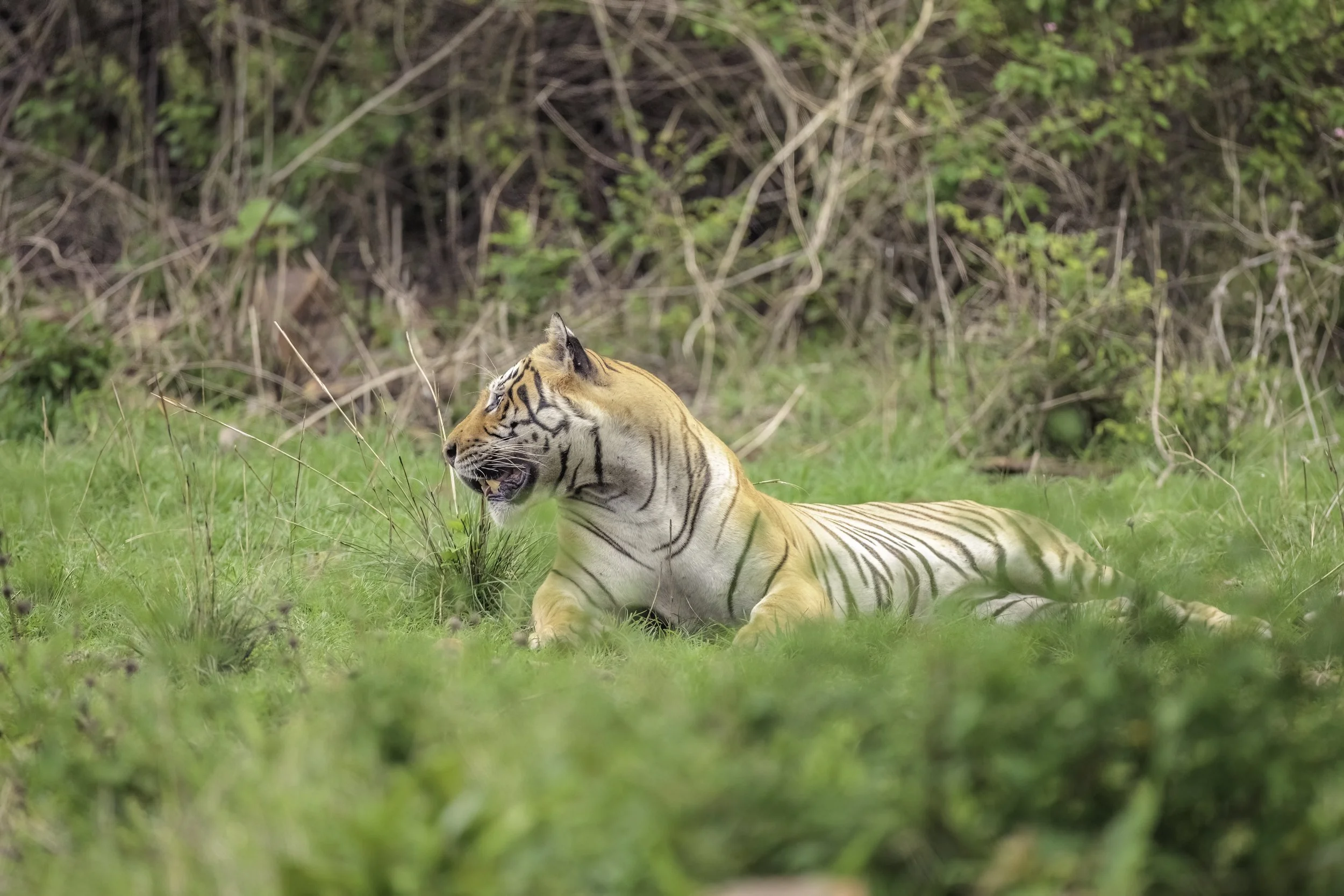
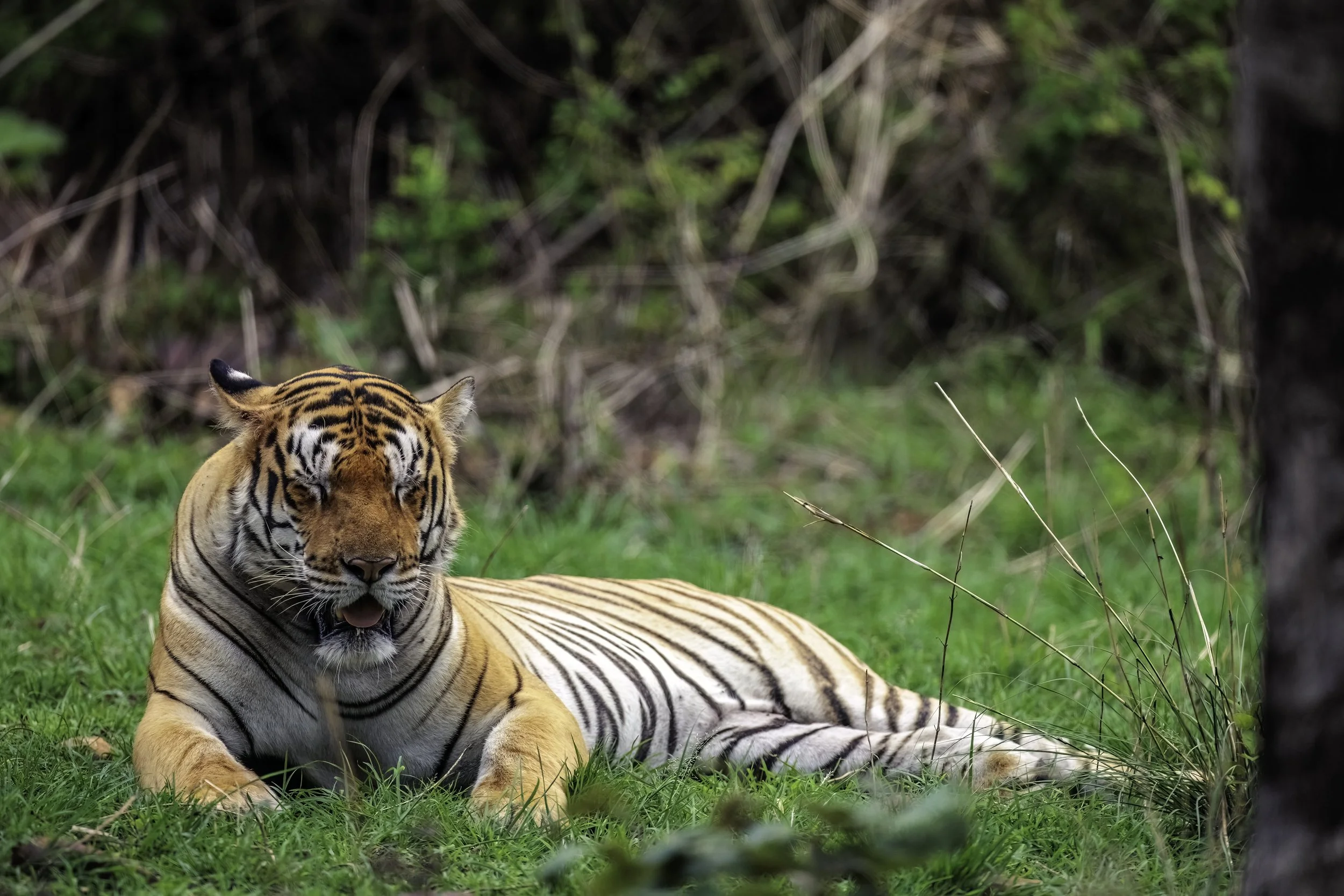
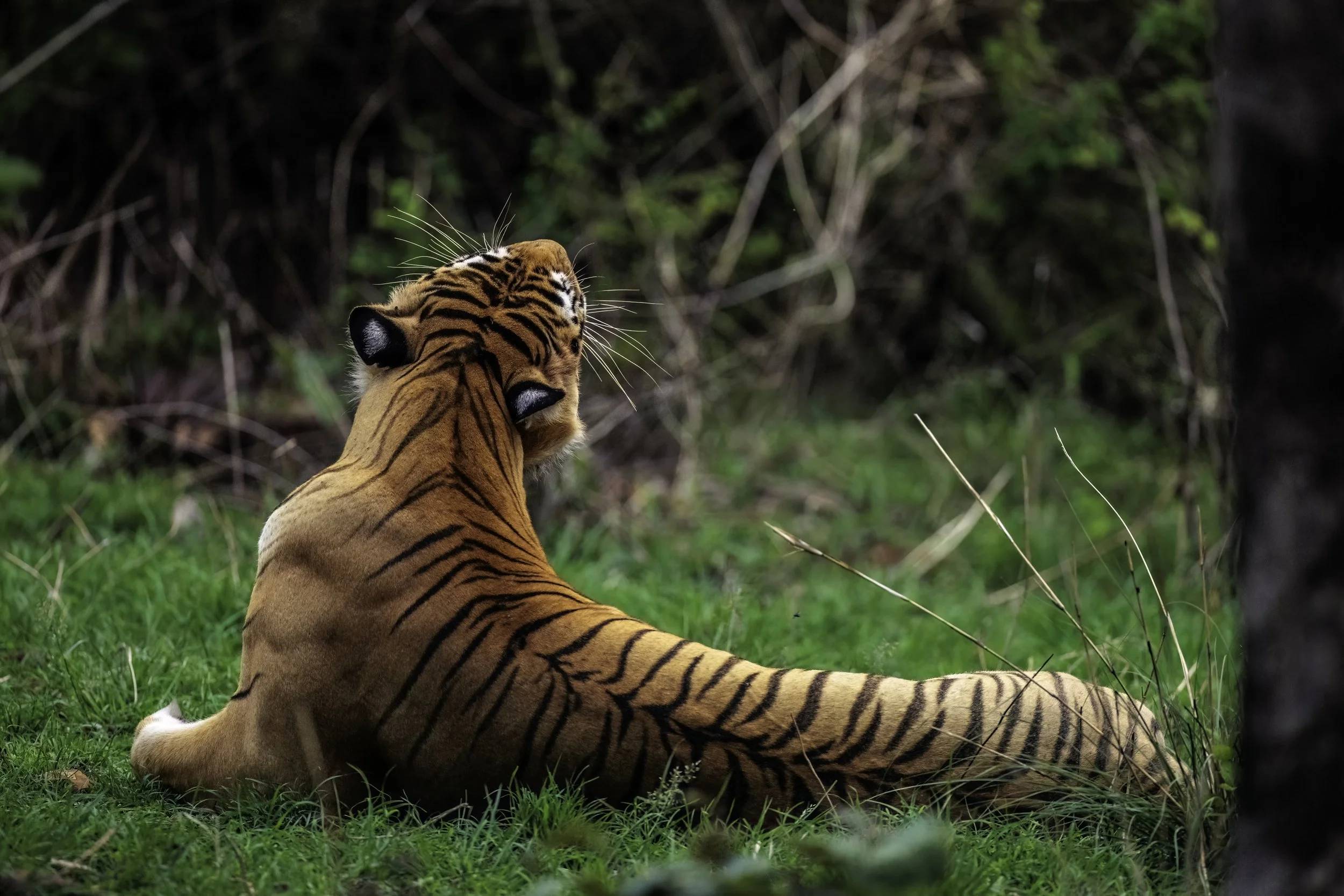
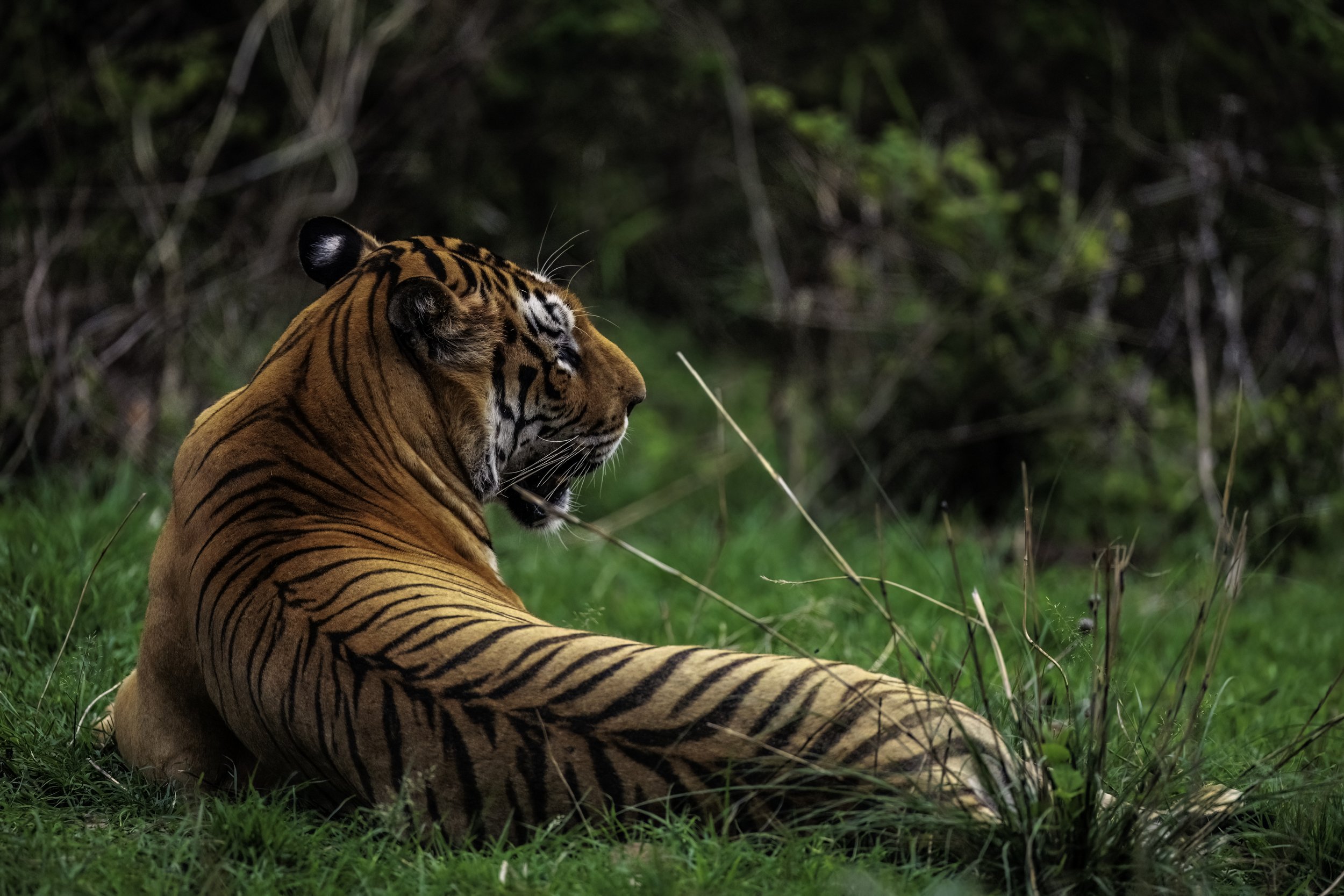
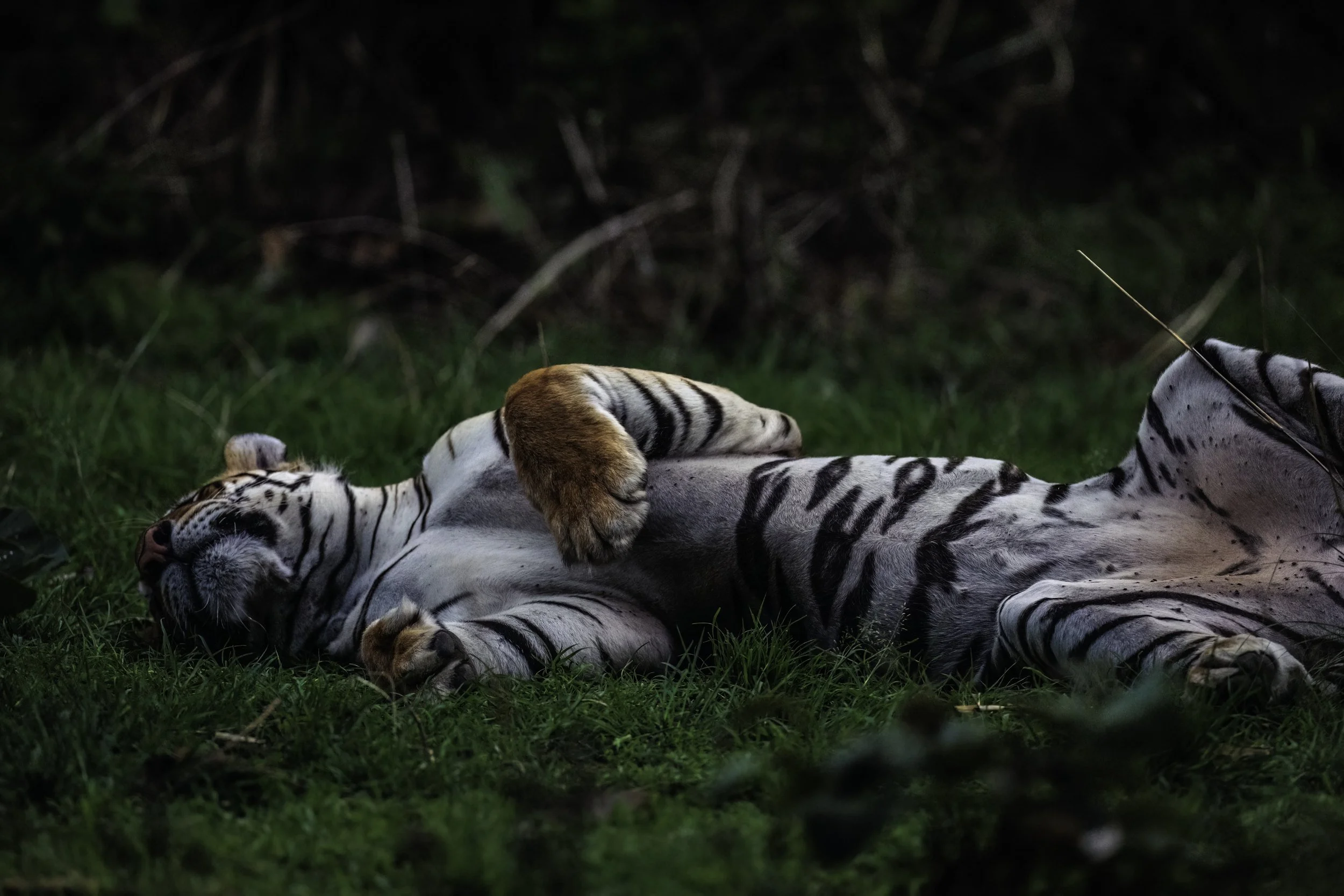
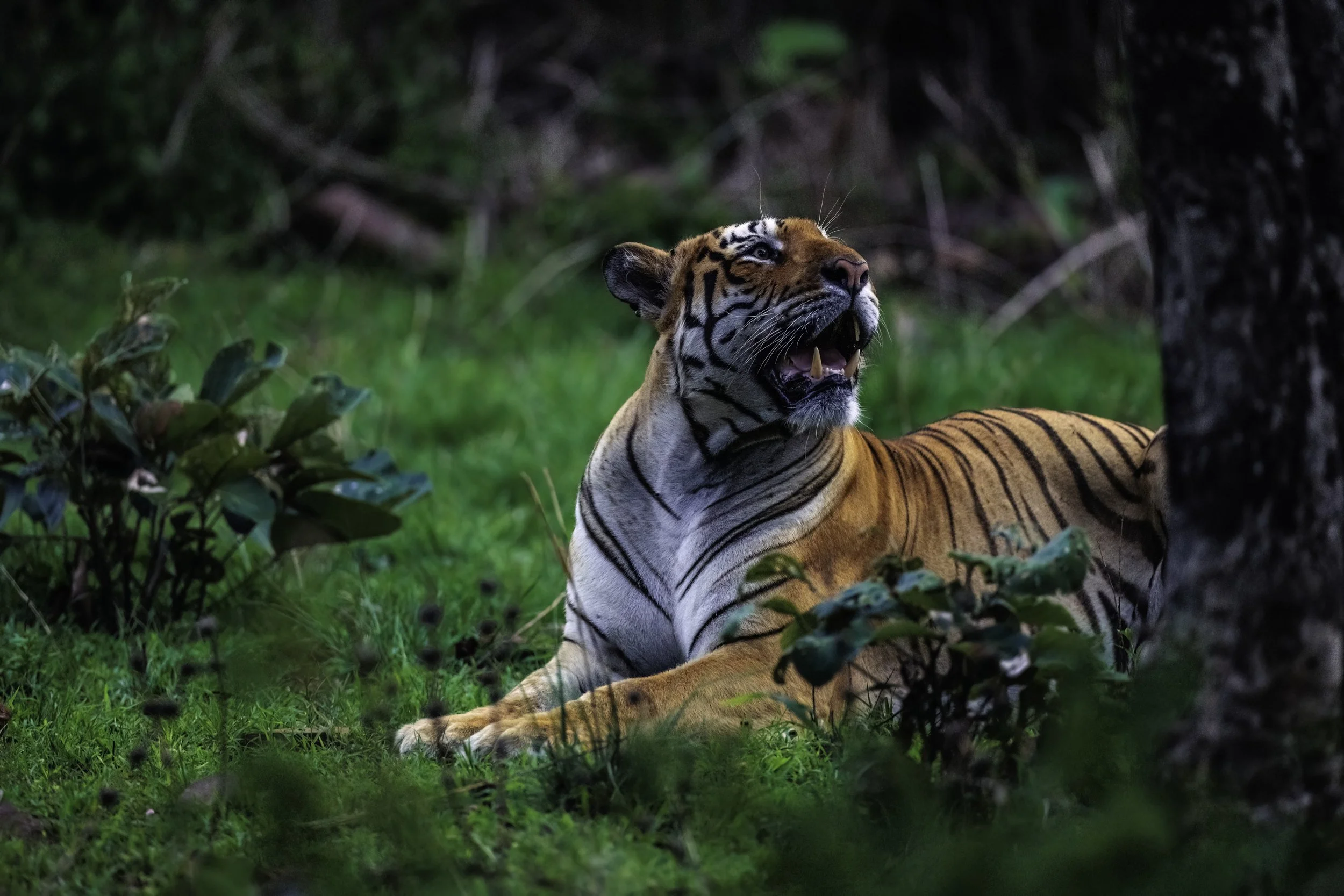
On this extraordinary evening, I was privileged to spend a solid, uninterrupted two hours watching and documenting, in breathless silence, the grand cat simply exist within his kingdom. For a creature capable of terrifying, explosive power, Rudra in repose was a masterclass in tranquility. He lay stretched out on the plush carpet of green grass covering the knoll, unbothered by the stifling heat of the fading summer.
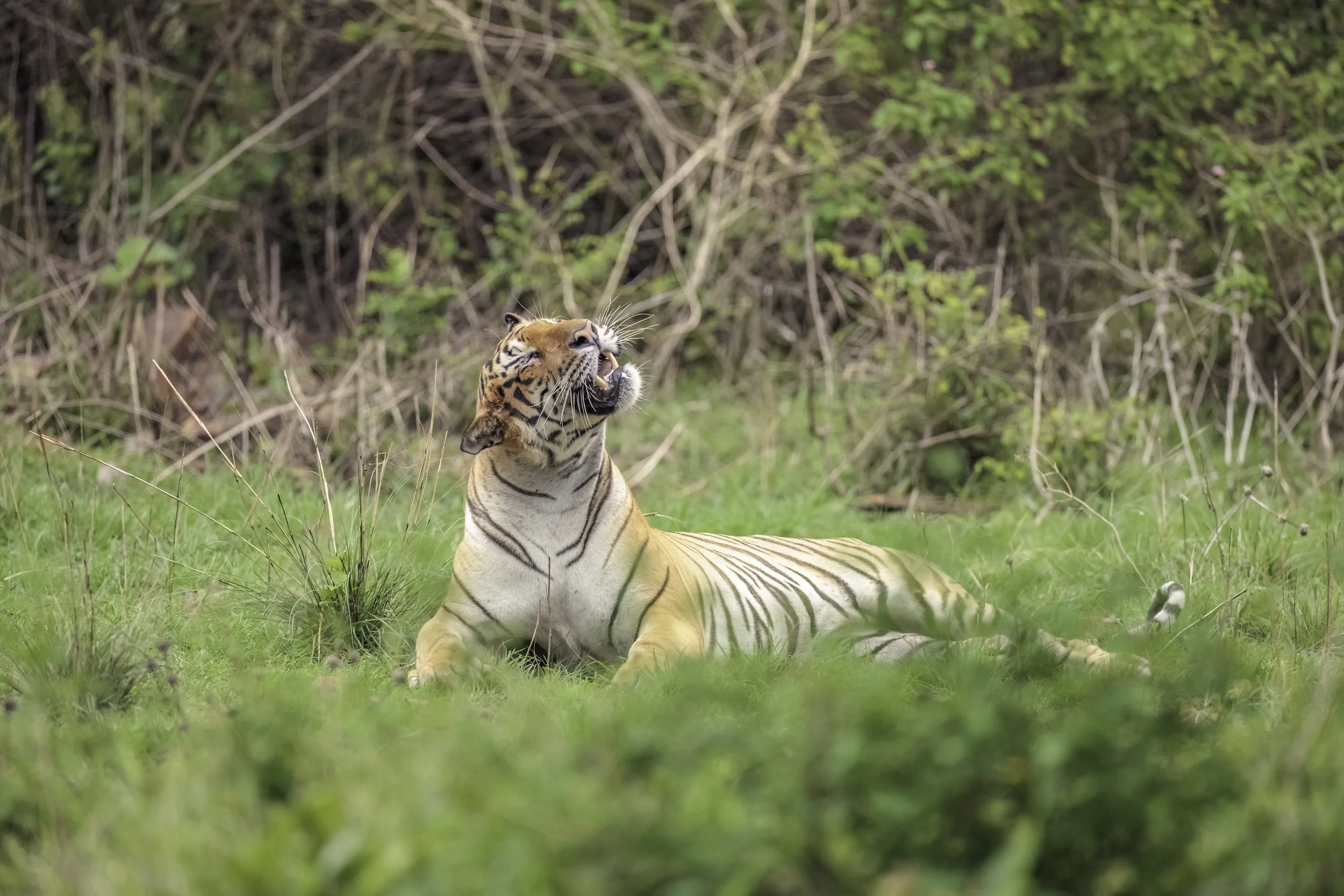
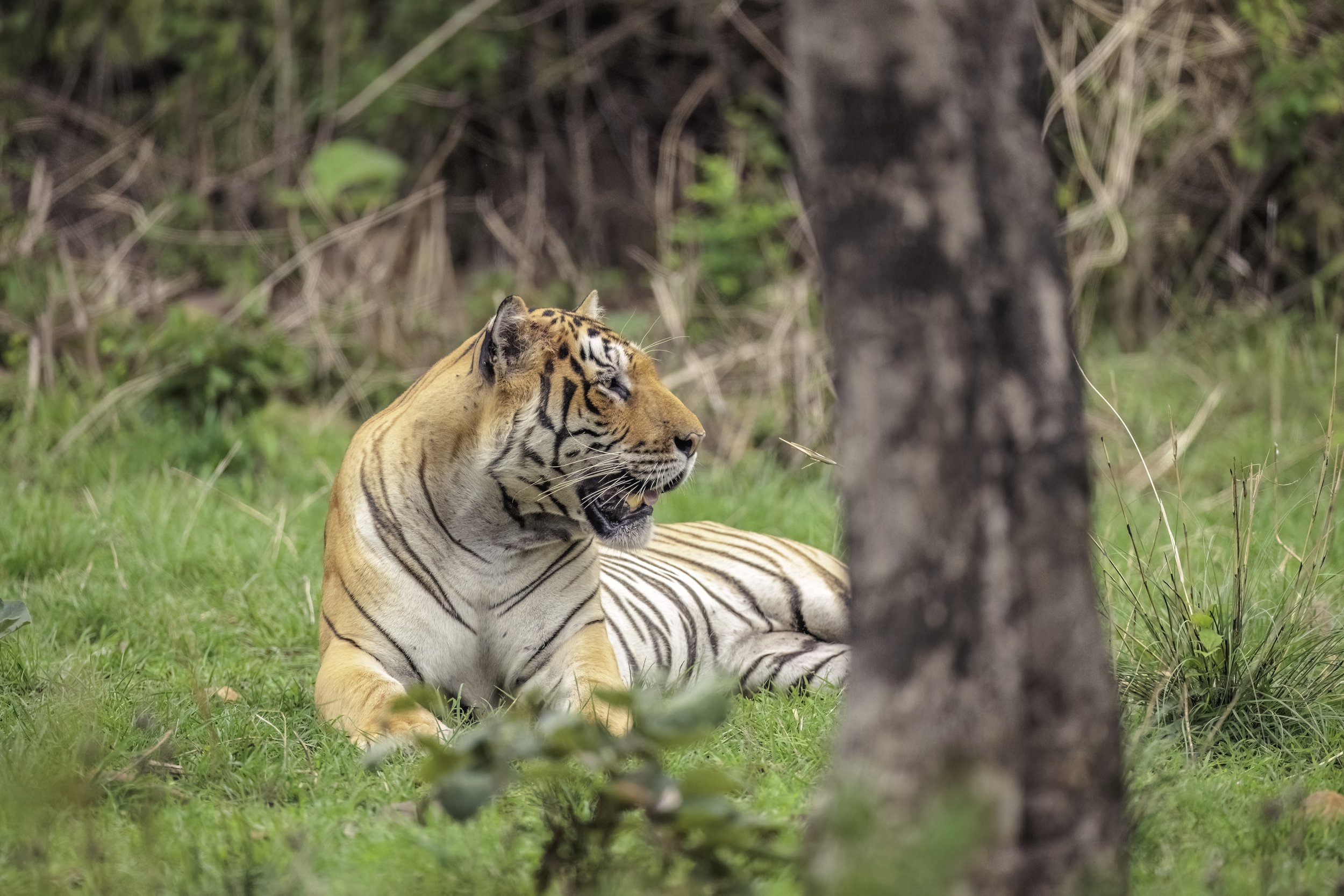
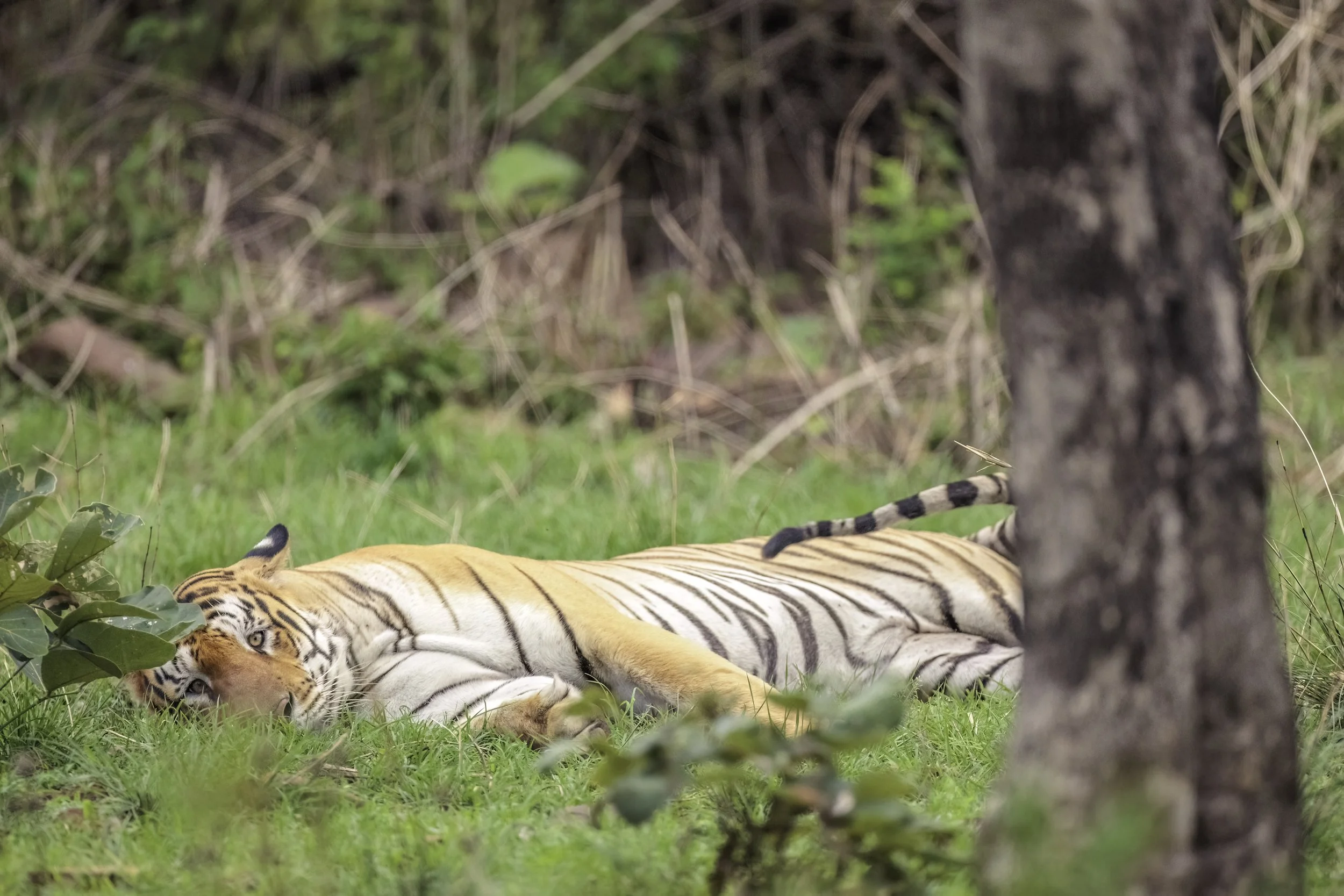
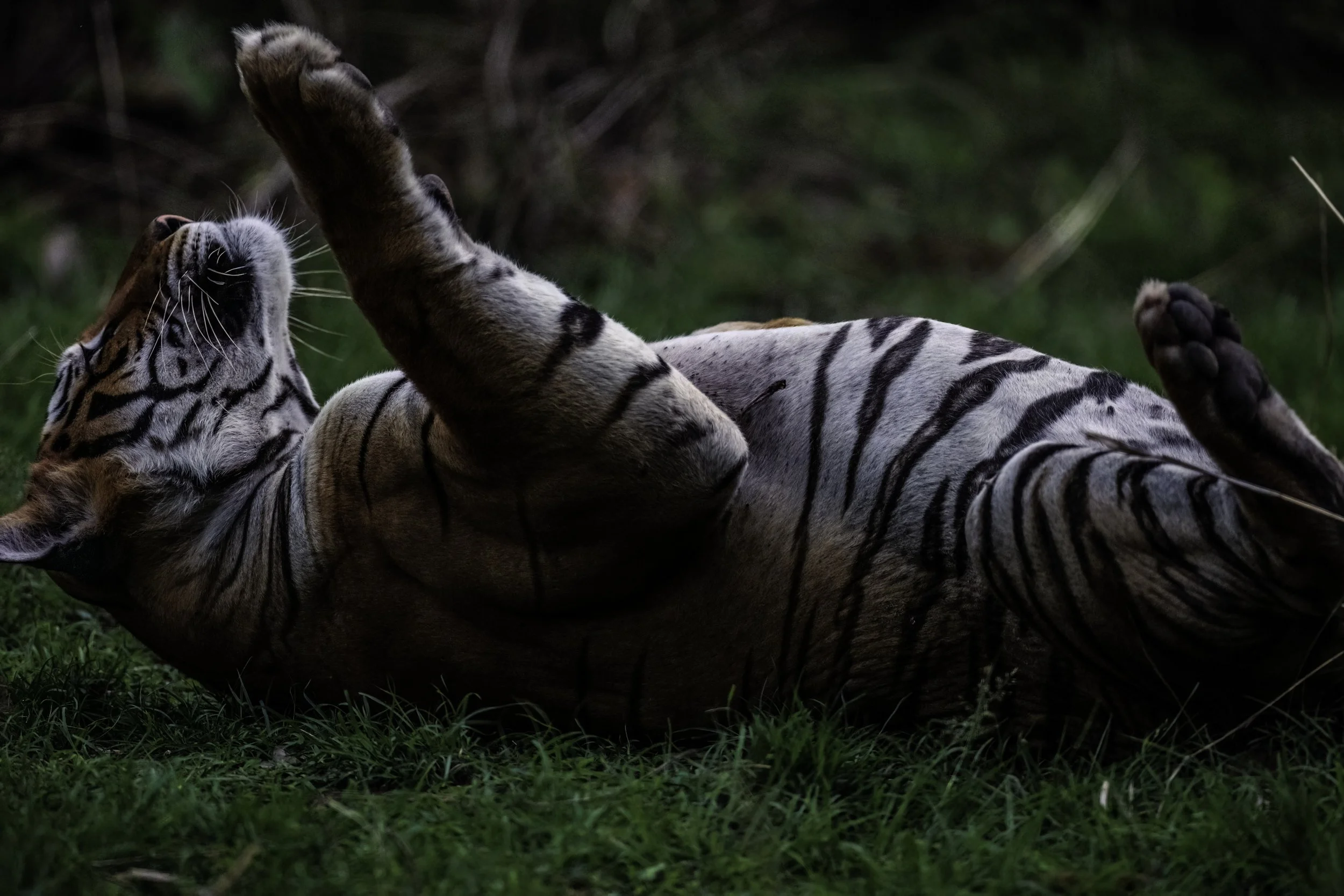
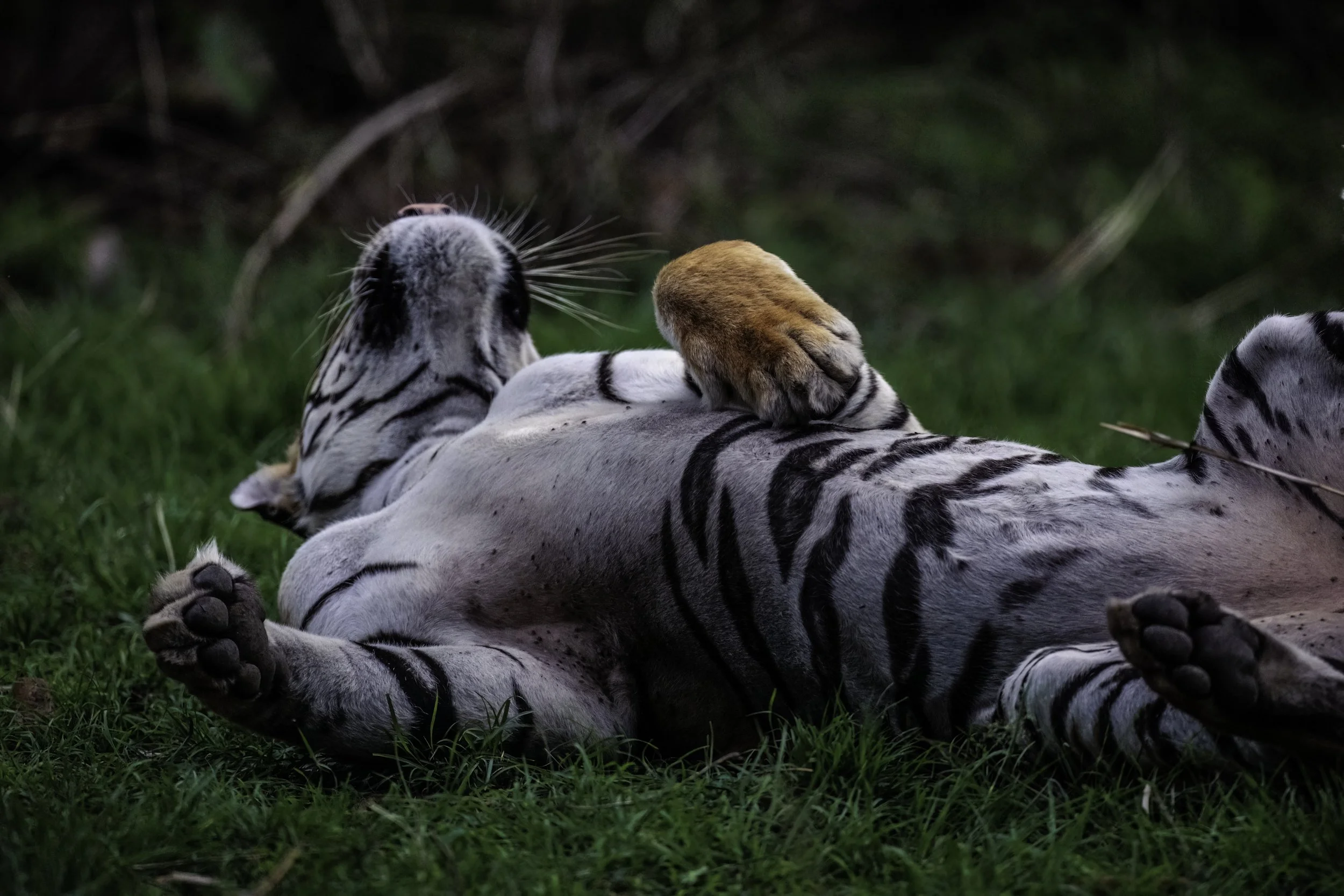
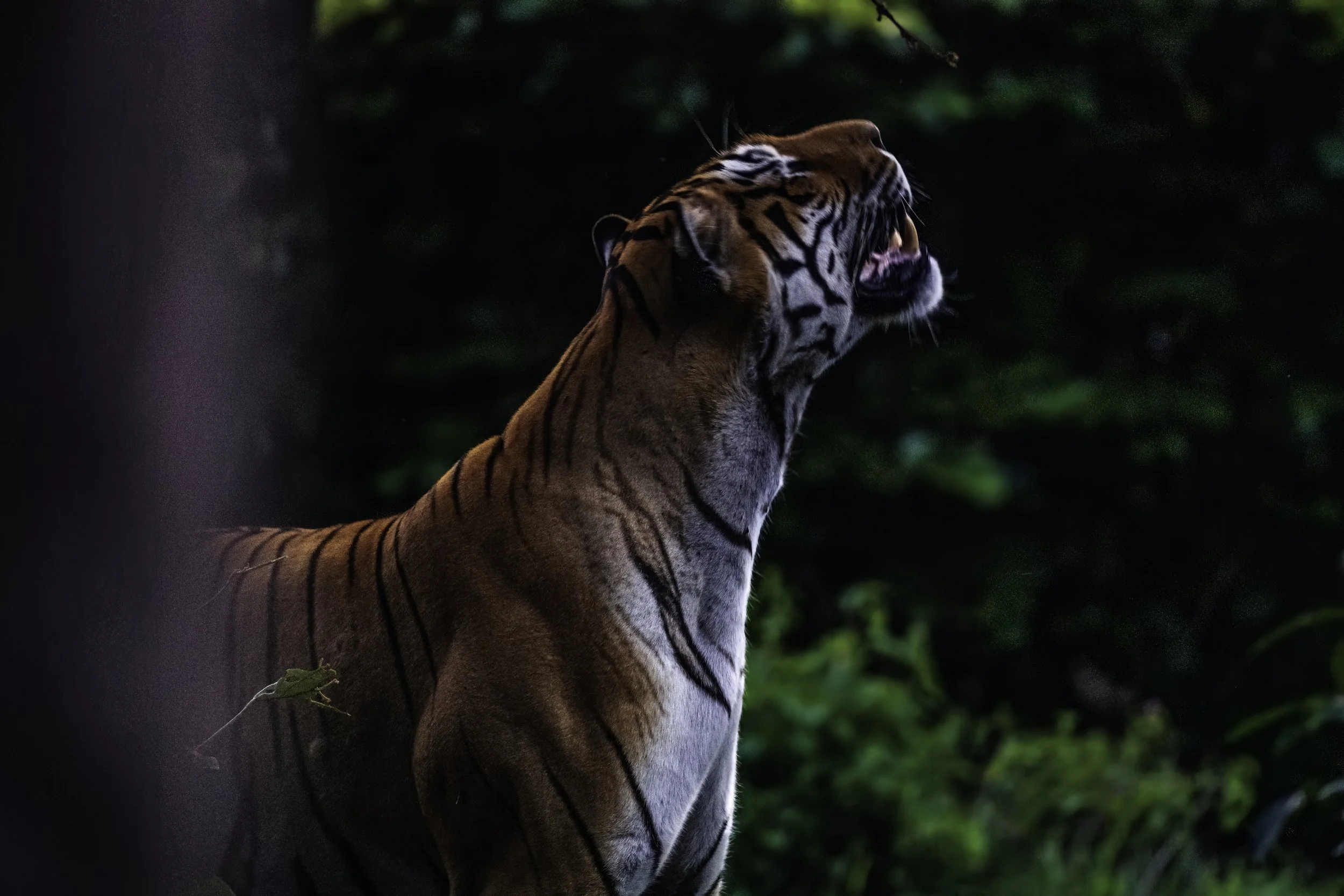
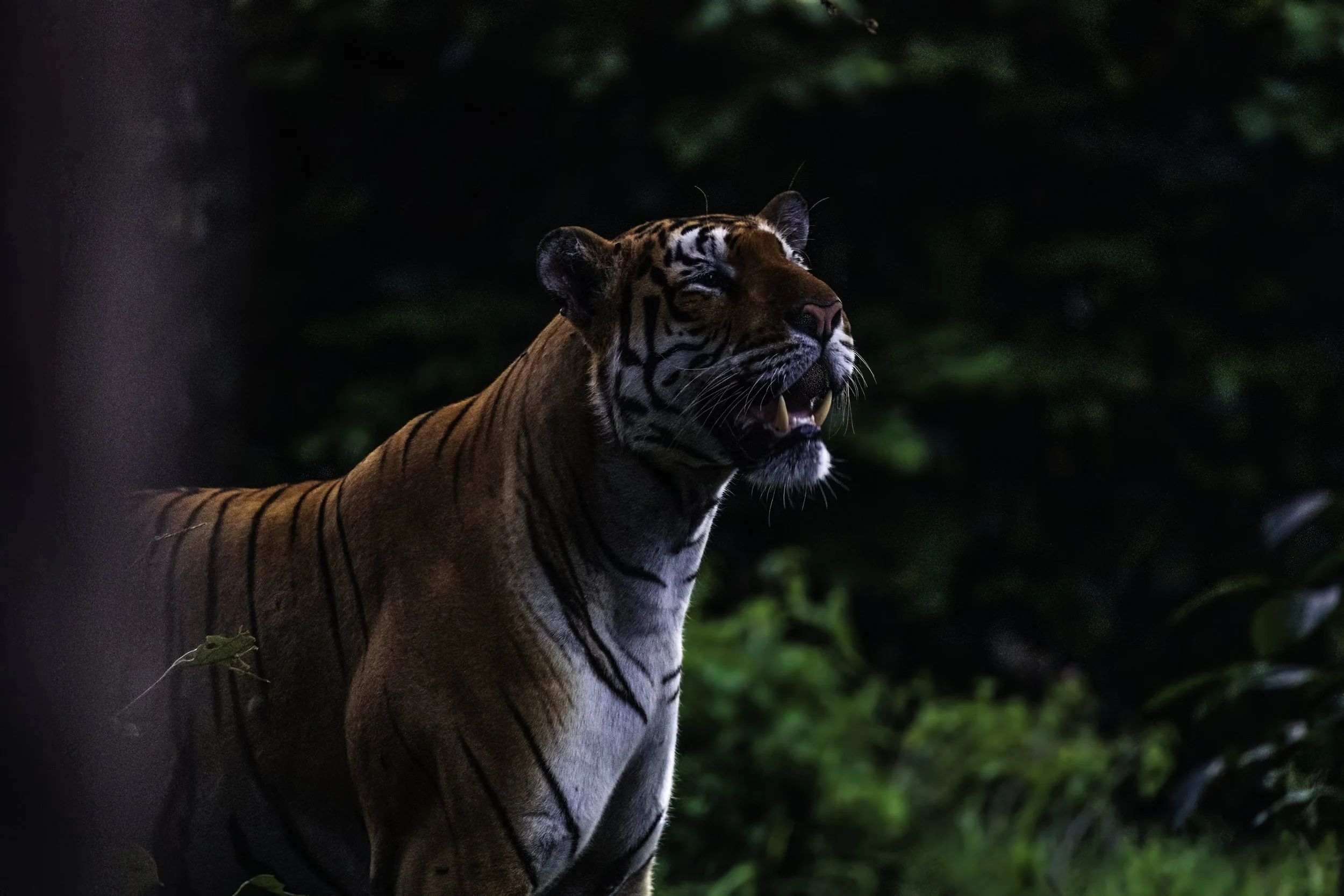
With an air of royal nonchalance, Rudra started with an inspection of his immediate surroundings. He raised his massive, blocky head, parted his lips, and drew in the warm evening air, exposing his upper teeth in a classic Flehmen’s response. His sensory receptors worked intensely, analyzing the chemical signatures left behind by passing wildlife or rival predators. Satisfied that his kingdom remained unchallenged, the giant cat rolled over onto his back, his massive white underbelly exposed to the sky, paws curled loosely in the air. He turned this way and that, rubbing his thick shoulders against the coarse blades of grass, before settling back down to doze, his amber eyes blinking sleepily against the late afternoon sun.
Yet, the jungle around him was far from at peace with his presence. The ecosystem was screaming its warning. High up in the branches of an ancient, sprawling white-bark tree about 50 meters away, a pair of brilliant Indian peacocks perched precariously, their long train of feathers cascading down like a blue-green waterfall. At regular but intermittent intervals, their sharp, trumpet-like "may-aw" alarm calls shattered the quietude. Deeper in the brush, the metallic, bell-like barking of a chital stag and the deep, resonant honk of a hidden sambhar deer echoed through the valley, verifying that every prey species in Gundam was tracking the tiger's coordinates.
Remarkably, Rudra paid absolutely no attention to the frantic chorus of alarm calls. He was a well-fed apex predator, fully aware that he had nothing to fear and no immediate need to hunt. Beyond these periodic outbursts from the birds and ungulates, the rest of the jungle remained remarkably quiet. Just a few meters from the base of the knoll, a noisy troupe of Jungle Babblers hopped through the dry leaf litter, self-absorbed and bickering over insects, while a solitary Indian Hare nervously forged on the perimeter of the clearing, keeping one long ear cocked toward the sleeping deity on the hill.
As the sun began its final descent behind the craggy horizon of Telangana, casting deep violet and indigo hues over the landscape, the mood changes swiftly. The golden light evaporated, and darkness started to permeate the forest floor. Suddenly, Rudra’s ears twitched. His eyes snapped wide open. He lifted his heavy chest off the ground, his body instantly transforming from a relaxed cat into a coiled spring of pure muscle.
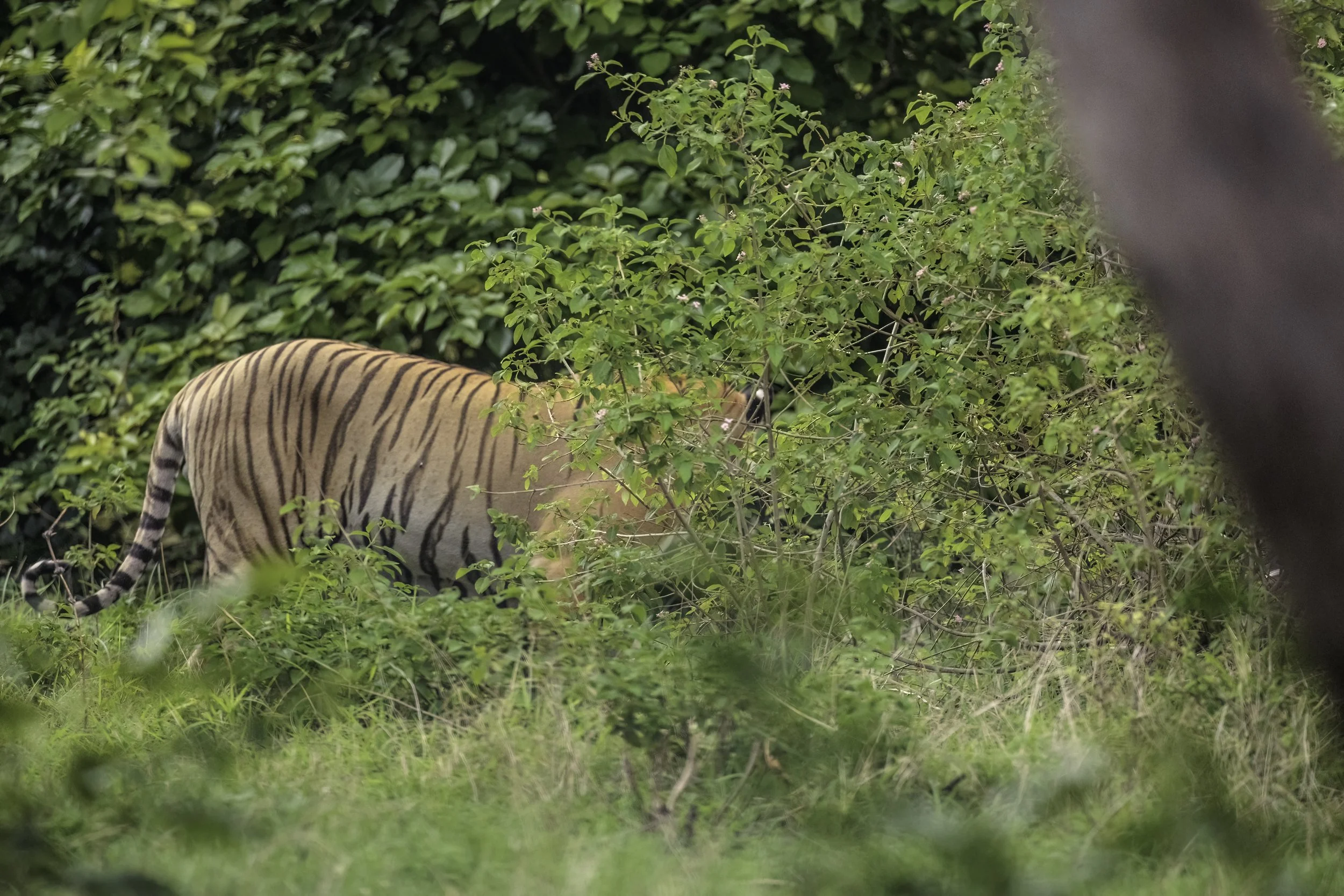
He had caught a scent. It was a phantom fragrance carried on the cool, descending night breeze—one that clearly fascinated him. He stood up, lowered his head close to the earth, and began sniffing around intently, circling the crest of the knoll to determine the precise direction of the airborne trail. Having locked onto the invisible path, the great tiger stepped off the knoll with fluid, silent grace. Without a backwards glance, he sauntered off into the darkening brush, his striped flanks dissolving like a ghost into the shadows of the emerging Telangana night.
Conservation Milestones: The 2026 Census Triumph
The serene sight of an apex predator like Rudra thriving in his prime is not an accident of nature; it is the direct result of rigorous, data-driven wildlife management. According to the groundbreaking results of the All-India Tiger Estimation (AITE) 2026 released by the Telangana Forest Department, the tiger population in the Amrabad Tiger Reserve has officially risen to an incredible 42 individuals, up from 36 in the previous estimation cycle.
This comprehensive, eight-month monitoring exercise used over 1,594 advanced camera traps distributed across 797 sophisticated grid zones. The rigorous scientific breakdown of Amrabad's current population reveals a highly stable, breeding-vibrant population structure:
18 Adult Tigresses (Forming the reproductive backbone of the reserve)
14 Adult Male Tigers (Securing vast territorial ranges like Rudra)
2 Sub-Adults (The emerging generation exploring new corridors)
8 Healthy Cubs (Proof of excellent habitat health and safety)
This surge from a critically low baseline of nearly ten tigers a decade ago to 42 today highlights Amrabad's emergence as a national model for big cat restoration, driven by improved prey-base augmentation, habitat management, and water conservation.
Coexistence at the Core: International Tiger Day 2026
The unforgettable evening spent witnessing Rudra coinciding peacefully alongside the surrounding forest community perfectly mirrors the global philosophy celebrated today on International Tiger Day (29th July 2026). Established originally at the Saint Petersburg Tiger Summit in 2010 to prevent the global extinction of wild tigers, Global Tiger Day has evolved into a vital framework for looking beyond mere protection toward sustainable coexistence.
The official global theme for International Tiger Day 2026 is "Securing the future of Tigers with Indigenous Peoples and Local Communities at the heart". This year's core objectives aim to:
Empower Indigenous Populations: Recognize that ancestral forest dwellers possess the traditional knowledge required to safeguard biodiversity - In our case the Chenchu.
Mitigate Human-Wildlife Conflict: Shift from reactive compensation to proactive, community-led monitoring systems.
Enhance Landscape Connectivity: Secure biological corridors that allow tigers to roam freely outside human-dominated spaces.
The Amrabad Tiger Reserve stands as an exceptional showcase of how these 2026 objectives are successfully executed on the ground. Nestled deep within Amrabad are the Chenchus, an indigenous, particularly vulnerable tribal group who have lived alongside the big cats for generations. Rather than enforcing exclusionary conservation, the Telangana Forest Department has actively integrated the Chenchus into the heart of the reserve’s operations.
Chenchu youth are employed as tracking experts, strike-force forest watchers, and camera-trap technicians. Their unmatched understanding of the terrain helps intercept poachers and track individual tigers like Rudra with pinpoint accuracy. Furthermore, by initiating local community-based eco-tourism initiatives and supporting local livelihoods, the reserve has turned potential conflict into a shared pride. When a tiger like Rudra roars in the Gundam area, the local communities do not hear a threat—they hear the heartbeat of a healthy, protected forest that sustains them all.
As the last remnants of twilight disappeared from the Gundam sky, leaving behind a canopy littered with brilliant stars, the distant, fading trumpet of the peacocks signaled that the prince had successfully vanished into his domain. Thanks to the combined triumphs of modern science, dedicated forest guards, and indigenous partnerships, Rudra's future, and the future of all 42 tigers of Amrabad, remains secure in the wild heart of Telangana.
‡‡‡‡‡

Related Posts



Scion of Wagdoh, Shambhu is one of four gladiators waiting in the wings in the Junona - Adegaon - Dewada - Agarzari range; Chota Dhadiyal, Taru & Paras the other three. The stage is set for some significant battles as each of these approach their age of dominance. The first skirmish was with Taru on 4th December with Shambhu emerging the winner.
#wildartworks, #wildlifephotography, #canon, #tiger, #wildlife, #conservationphotography, #indian_wildlifes, #indianwildlifeofficial, #wildlifeonearth, #bbcearth, #natgeowild, #natgeoindia, #maharashtra, #Tadoba, #Dewada, #Adegaaon, #DewadaGate, #pantheratigris, #bengaltiger, #royalbengaltiger, #bigcats, #tadobatiger, #gladiatoroftaru, #wagdoh, #waghdoh, #wagdohcub, #Shambhu, #shambhumaletiger, #shambhutiger,