
Asian Common Toad
Duttaphrynus melanostictus
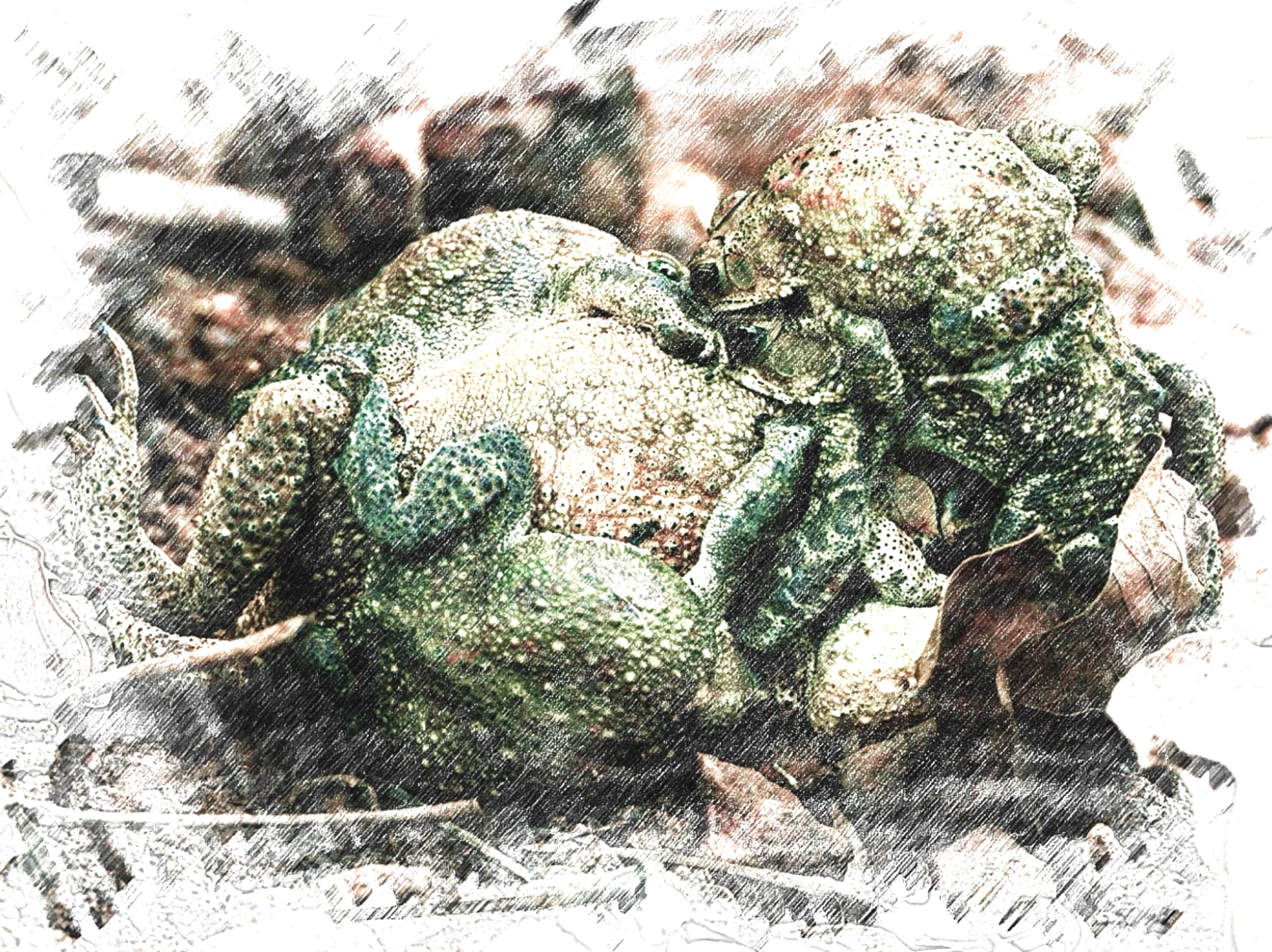
Mating Behaviour - Amplexus
Distributed widely across the Indian subcontinent & Southeast Asia
The first heavy thunderclap of the southwest monsoon shatters the sweltering silence over the Nallamala Hills. Within the Amrabad Tiger Reserve, the parched, cracked earth of the dry deciduous forest drinks deeply for the first time in months. As the rain intensifies, filling seasonal ditches, rocky rock-pools, and forest puddles, a rhythmic, high-pitched, dial-tone-like chorus (creo-o-o; croro-ro-ro) begins to echo through the dark. Emerging from beneath leaf litter, decaying logs, and subterranean burrows, thousands of hidden creatures march toward the rising water. Among them is the Asian Common Toad (Duttaphrynus melanostictus), an amphibian about to undergo one of the most frantic, spectacular transformations in the natural world.
Telangana is endowed with rich diversity of flora and fauna (Species Directory). It has dense teak forests on the northern part along the banks of river Godavari and to the south along the banks of the Krishna. As per the Champion & Seth Classification of Forest Types (1968), the forests in Telangana belong to three Forest Type groups, which are further divided into 12 Forest Types. The State Government’s massive greening programme, 'Telangana Ku Harita Haram', aims at achieving the twin objectives of increasing the forest cover and reduce pressure on the existing forest resources, through massive community participation by Vana Samrakshna Samithis (VSS) and Eco-Development Committees (EDCs) in Protected Areas and Watershed Development Committees in the Watershed areas. Recorded Forest Area (RFA) in the State is 26,904 km² of which 20,353 km² is Reserved Forest, 5,939 km² is Protected Forest and 612 km² is Unclassed Forests. Three National Parks and nine Wildlife Sanctuaries constitute the Protected Area network of the State covering 5.08% of its geographical area. The Amrabad Tiger Reserve - India's second-largest tiger reserve by core area (2,611 km²) - known for its rugged terrain, deep gorges, and dry deciduous forests, hosts Bengal tigers, leopards, Sloth Bears, Foxes, Civets and over 300 bird species. The river Krishna flows through it, supporting rich biodiversity and the indigenous Chenchu tribes.
Maddimadugu Range, Amrabad Tiger Reserve
The Maddimadugu Range serves as a vital ecological corridor within the broader Amrabad Tiger Reserve, anchoring the reserve's south-eastern territory along the rugged contours of the Nallamala Hills. Dominated by dense dry deciduous woodlands, rocky plateaus, and deep sandstone gorges, this range borders the vast catchment area of the Krishna River. During the peak summer months, the range plays a crucial role in regional wildlife dynamics; as water sources dry up across adjacent landscapes, apex predators like the Bengal Tiger and Indian Leopard routinely swim across the Krishna River to seek refuge, water, and denser canopy cover within the cooler valleys of Maddimadugu.
Ecologically, the range has taken center stage in Telangana's wildlife management through the establishment of a specialized Prey Augmentation Centre. Spanning over 35 hectares of heavily secured, chain-link fenced habitat, this soft-release facility was specifically built to counteract a historical deficit of large herbivores in the sector. By systematically translocating excess populations of Spotted Deer (Chital), Nilgai, and Sambhar from urban parks like Hyderabad's Nehru Zoological Park, conservationists are actively building a self-sustaining prey base. This targeted boost in herbivore biomass directly supports the territory of the reserve’s expanding wild cat population, which has steadily risen to over 33 tigers.
For birdwatchers and wildlife photographers, the Maddimadugu Range provides a pristine, low-traffic environment to observe deep-forest dynamics and avian behavior. The presence of large grazing herds in the prey-enrichment zones attracts a high concentration of Indian Jungle Crows (Corvus culminatus), which can be seen foraging for ticks on the backs of deer or tracking the movements of predators moving through the undergrowth. The range effortlessly blends its rich wildlife territory with cultural heritage, housing the remote Maddi Madugu Sri Anjaneya Swamy Temple. This balance creates a fascinating edge-effect where forest-dwelling corvids, raptors, and large mammals interact right along the boundary of human spiritual paths and untamed wilderness.
There are also numerous Chenchu sacred groves in the vicinity. These “Sacred Groves”, hidden "islands" of dense, untouched vegetation that serve as the spiritual anchors for the Chenchus in their small, bee-hive shaped, traditional settlements, known as pentas. These groves are more than just clusters of old-growth trees; they are the spiritual sanctuaries of the tribe, acting as living temples where deities like Garelamai Sama, the goddess of the forest, are believed to dwell. The tribe, which has 26 distinct gotras (clans), performs rituals for deities like Garelamai Sama and Gangamma (the Water Goddess), often during the month of Shravan.
Because these patches of land are considered the residence of the divine, hunting and logging are strictly forbidden within their boundaries. This traditional belief system has created accidental but vital biodiversity hotspots, preserving rare flora and fauna that thrive under the tribe’s spiritual protection. The Chenchus live by a strict ethos of reciprocity—taking only what is necessary, such as leaving honey larvae behind to ensure the bees return, maintaining a perfect balance between man and nature. To step into a Chenchu Sacred Grove is to enter a space where human law bows to divine order. No axe is ever raised here & even the collection of fallen wood is often forbidden, ensuring these pockets remain pristine refuges for rare medicinal plants and the very wildlife the reserve seeks to protect.
Read more about the Chenchu Sacred Groves.
Asian Common Toad - Amplexus
The Asian Common Toad (Duttaphrynus melanostictus) is a remarkably resilient, ubiquitous amphibian distributed widely across the Indian subcontinent and Southeast Asia. In the newly greening landscapes of Telangana, its populations thrive within protected forest ecosystems, rural agricultural lands, and urban fringes alike. A resilient habitat generalist, it maintains a widespread & stable presence across Telangana's dry deciduous and scrub forests, including protected zones like the Amrabad & Kawal Tiger Reserves. It is a prolific, explosive breeder whose mating behavior relies on intense speed and visual signaling. This frantic breeding behavior is highly seasonal and entirely triggered by the arrival of the first monsoon rains. The specific timing of the mating event is incredibly narrow, typically lasting only 24 to 48 hours at the very start of the rainy season. High humidity, sudden drops in ambient temperature and the physical filling of seasonal wetlands act as environmental cues.
Amrabad Tiger Reserve: Spanning the rugged, hilly tracts of Nagarkurnool and Nalgonda districts along the Krishna River, Amrabad Tiger Reserve provides a pristine sanctuary. Here, the toads utilize the shaded floors of the dry mixed deciduous forests, sheltering under large boulders and near perennial springs that feed into the river basin.
Kawal Tiger Reserve: Located in the northern reaches of the state within the Mancherial and Adilabad landscape, Kawal Tiger Reserve features a dense canopy of teak and bamboo. The Asian Common Toad utilizes Kawal's network of forest streams, low-lying marshes, and waterholes improved for large mammals to aggregate and breed safely away from heavy human disturbance.
State-wide and National Footprint: Beyond these flagship tiger reserves, this toad is common across Telangana's rural farming belts, the green lungs of Hyderabad like KBR National Park, and water bodies like Shamirpet Lake. Across India, it ranges from the high-rainfall zones of the Western Ghats to the foothills of the Himalayas, showcasing an extraordinary ecological tolerance.
Anatomy of a True Toad
The Asian common toad is a medium-to-large amphibian built robustly for a terrestrial lifestyle. Adult males generally measure between 57 to 83 mm in snout-vent length (SVL), while the larger females range from 65 to 85 mm, with some exceptional specimens reaching up to 100 mm. The top of the head features a series of striking, black, elevated bony ridges. These include the canthal ridge along the snout, preorbital, supraorbital (above the eyes), postorbital, and a short orbitotympanic ridge between the eyes and the ear. The skin is thick, dry, and heavily covered in spiny warts. For most of the year, both sexes display a cryptic, mud-brown, olive, or brick-red coloration, boldly marked with darker spots. The tips of the warts, spines, and cranial ridges are consistently capped in pitch black. Prominent, large, kidney-shaped or elliptical parotoid glands sit just behind the distinct, circular tympanum (ear drum). These glands secrete a thick, milky-white toxin known as bufotoxin, safeguarding the toad against potential predators. The first finger is typically longer than the second. During the breeding season, males develop specialized dark, cornified nuptial pads on their inner fingers to grip the slippery skin of females securely.
The preferred habitats of the Asian Common Toad are diverse, ranging from pristine primary forest floors to heavily disturbed agricultural fields and suburban gardens. In places like the Eastern Ghats and the hills of Amrabad, their habitats naturally overlap with other amphibians, such as the Indian Burrowing Frog (Sphaerotheca breviceps) and the Marbled Toad (Duttaphrynus stomaticus). While they share the same monsoon pools for breeding, the Asian Common Toad's larger size and toxic skin secretions allow it to dominate the open, shallow margins of these pools.
However, relentless habitat loss, illegal sand mining, and deforestation across Telangana's wilderness are forcing dramatic shifts in their natural behavior. As deep forest canopies are felled, microclimates dry out quickly. This forces toads to abandon their typical nocturnal forest foraging and seek refuge closer to human habitations, artificial cattle troughs, and irrigated agricultural lands.
This forced migration brings severe risks. In rural and peri-urban spaces, they face high mortality from vehicular traffic, agricultural pesticides, and domestic pollution. Biologists have also observed a rise in maladaptive interspecific amplexus—where disoriented male toads, arriving at depleted, overcrowded waterholes, desperately attempt to mate with entirely different species, such as frogs or even lizards, wasting vital energy and disrupting local reproductive success.
The Breeding Frenzy: Mating and Seasonal Drivers
The reproduction of the Asian common toad on the Indian subcontinent is characterized by a phenomenon known as explosive breeding. Unlike amphibians that call steadily throughout a long season, these toads compress their primary reproductive window into an astonishingly brief 24 to 48-hour flash event right at the onset of the heavy monsoon rains. Driven by the sensory triggers of dropping atmospheric pressure, rising humidity, and the physical sound of rain, hundreds of toads synchronize their arrival at temporary pools. The aquatic arena quickly devolves into absolute chaos.
Males outnumber females significantly, sparking fierce, non-stop combat as you can see in the video. They kick, push, and wrestle to displace rivals. When a female arrives, multiple males frequently pile onto her simultaneously, forming tightly packed, chaotic "mating balls". In this intense struggle, females can occasionally be pinned underwater and accidentally drowned by the sheer weight of desperate suitors.
Once a single male successfully secures the female in amplexus—clasping her firmly from behind using his rough nuptial pads—she releases long, gelatinous, double-stringed coils containing up to 40,000 black eggs. These strings are carefully woven around submerged roots and aquatic vegetation. The male fertilises them externally, and within a mere 24 to 48 hours, the water teems with thousands of tiny, jet-black tadpoles.
The Threat of Climate Change
Climate change is directly disrupting these fragile, time-sensitive breeding windows. The southwest monsoon across Telangana has become increasingly erratic, characterized by prolonged dry spells interrupted by sudden, unpredictable cloudbursts. When the initial rains fail or arrive too late, the toads delay their emergence. Conversely, if a sudden cloudburst triggers a breeding event but is followed by weeks of absolute drought, the temporary shallow pools evaporate rapidly. This dries out the egg strings and strand clusters of young tadpoles before they can complete their 34-to-90-day metamorphosis, resulting in catastrophic local population crashes.
The most fascinating aspect of this explosive event is the temporary, dramatic wardrobe change of the male toad. For just two days, the male sheds his dull, muddy-brown exterior and adopts a striking, neon-lemon yellow suit, while the females remain an inconspicuous brown. This phenomenon is called dynamic sexual dichromatism. Unlike chameleons or octopuses, which use direct nervous system control to change color in seconds, the toad’s transformation takes about 10 to 15 minutes because it is completely driven by hormonal pathways.
The onset of explosive breeding acts as an intense physiological stressor. This trigger floods the toad's system with catecholaminergic hormones, specifically epinephrine (adrenaline) and norepinephrine. Beneath the toad’s tough epidermis sit three specialized layers of pigment cells called chromatophores:
Melanophores: Deepest layer, containing dark melanin pigments.
Iridophores: Middle layer, containing structural, reflective purine crystals that act like microscopic mirrors.
Xanthophores: Topmost layer, containing yellow pteridine and carotenoid pigments.
When epinephrine and norepinephrine flood the skin, they bind to specific cell receptors, signaling the dark melanin inside the melanophores to aggregate tightly into the center of the cells, hiding the brown and black tones. Simultaneously, the hormones cause the microscopic reflective plates within the iridophores to tilt their angle, altering how light scatters. This reflected light passes through the yellow xanthophores, amplifying the pigment into a brilliant, glowing neon yellow.
Recent studies by researchers at the Schönbrunn Zoo in Vienna solved the evolutionary mystery behind this glow-up. By placing 3D-printed brown and yellow toad models into active breeding frenzies, scientists discovered that males entirely ignored the yellow models but aggressively tried to clasp the brown ones. Therefore, the neon-yellow color does not function to attract females. Instead, it serves as a highly visible, unambiguous visual flag to other males, signaling: "I am a male, do not waste your energy attacking or clasping me." In the blind, chaotic rush of a 48-hour mating storm, this hormone-driven signal saves vital energy and reduces costly male-male harassment.
Photographing the Alchemist
Documenting the explosive breeding of the Asian common toad within Telangana’s premier wilderness areas like the Amrabad and Kawal Tiger Reserves is an intense, unforgettable experience. As the monsoon rolls over the Nallamala tracts, the air turns thick, heavy, and saturated with moisture. Tracking these amphibians requires wading through ankle-deep mud along seasonal channels, accompanied by native Chenchu trackers who read the jungle paths with ease, keeping an eye out for larger residents like leopards, sloth bears, or wild boars.
The sheer volume of the chorus guides you to the breeding site. Reaching the edge of a rain-filled rocky pool, your torch cuts through the mist to reveal an astonishing sight: the water's edge is completely alive with hundreds of glowing, neon-yellow jewels. Photographing them requires getting down to eye level, flat in the wet leaf litter and mud. The technical challenges are significant. The toads' skin, drenched in rainwater and slick with defensive bufotoxin secretions, acts like a mirror, reflecting harsh light and creating distracting hot spots on the camera sensor. To capture the scene cleanly, you must use the diffused light to bring out the rich, bumpy texture of their cranial ridges and contrast the bright yellow skin against the dark volcanic mud.
Looking through the viewfinder, the framing fills with raw, primal energy. You focus on a single male, his vocal sac inflating like a translucent balloon as he belts out his trilling call. Suddenly, another yellow male dives into the frame, kicking up a spray of muddy water as they wrestle for position. You press the shutter, capturing the rich textures of the black-rimmed spines, and the intense gold of their eyes. It is a fleeting, magical moment. In less than forty-eight hours, the brilliant yellow will fade back to a quiet, inconspicuous brown, the frantic chorus will fall silent, and these master alchemists will slip quietly back into the shadows of the Telangana forest floor.
‡‡‡‡‡

Related Posts


The undergrowth of Telangana’s forests is a complex, multi-layered environment shaped by the harsh semi-arid climate & rugged sandstone terrains. A soft rustle stirs the leaf litter before transitioning into a fluid, almost weightless ascent up a low-hanging tree. Moving like a ribbon of liquid metal is the Common Bronzeback Tree Snake (Dendrelaphis tristis). This arboreal master of stealth navigates the fragmented dry woodlands of the Eastern Ghats, serving as a vital link in the region's rich biodiversity
#WildArtWorks #AmrabadTigerReserve #TelanganaTourism #WildlifeConservation #NallamalaHills #EcoTourism #AnanthagiriHills #Vikarabad #IndiaBiodiversity #CommonBronzeback #Bronzebacksnake #Snake #Bronzeback #TreeSnake