
White-browed Wagtail
Motacilla maderaspatensis
The River-Walker of the Ghats
The morning mist over the Krishna River at the edge of the Amrabad Tiger Reserve does not lift so much as it dissolves, turning the water into a sheet of liquid pewter. Silence dominates the dawn, broken only by the distant, deep whoop of a langur. Then, a sharp, metallic chiz-zit rings out from a slick basalt boulder jutting from the current. A small, starkly monochromatic bird drops from the overhanging bamboo canopy. It lands on the wet stone, its long tail immediately setting into a rhythmic, hypnotic up-and-down pumping motion. This is the White-browed Wagtail (Motacilla maderaspatensis), the largest of the Asian wagtails, and a permanent resident of the rugged riverine ecosystems of Telangana. To follow this bird is to map the water systems, rocky gorges, and forest reserves of the Deccan Plateau and the Eastern Ghats. From the pristine, predator-guarded pools of Kawal and Amrabad to the rural check-dams of Telangana’s countryside, the White-browed Wagtail acts as a sentinel of the state’s freshwater health.
Telangana is endowed with rich diversity of flora and fauna (Species Directory). It has dense teak forests on the northern part along the banks of river Godavari and to the south along the banks of the Krishna. As per the Champion & Seth Classification of Forest Types (1968), the forests in Telangana belong to three Forest Type groups, which are further divided into 12 Forest Types. The State Government’s massive greening programme, 'Telangana Ku Harita Haram', aims at achieving the twin objectives of increasing the forest cover and reduce pressure on the existing forest resources, through massive community participation by Vana Samrakshna Samithis (VSS) and Eco-Development Committees (EDCs) in Protected Areas and Watershed Development Committees in the Watershed areas. Recorded Forest Area (RFA) in the State is 26,904 km² of which 20,353 km² is Reserved Forest, 5,939 km² is Protected Forest and 612 km² is Unclassed Forests.
Three National Parks and nine Wildlife Sanctuaries constitute the Protected Area network of the State covering 5.08% of its geographical area and our focus area today is within the north western fringe of the Nallamalla forest - the Amrabad Tiger Reserve - India's second-largest tiger reserve by core area (2,611 km²). Known for its rugged terrain, deep gorges, and dry deciduous forests, it hosts Bengal tigers, leopards, and over 300 bird species. The river Krishna flows through it, supporting rich biodiversity and the indigenous Chenchu tribes.
Lingal Range, Amrabad Tiger Reserve
The Lingal Range forms a critical and geographically rugged component of the larger Amrabad Tiger Reserve in Telangana, nestled within the northern stretch of the ancient Nallamala Hills. Characterised by an undulating landscape of deep valleys, steep gorges, and an extensive network of seasonal streams, this range acts as a key catchment area feeding into the Krishna River basin. The vegetation here is a rich mosaic of tropical dry deciduous forests, mixed woodlands, and dense grasslands, interspersed with some of the finest bamboo (Dendrocalamus strictus) thickets in the Eastern Ghats. This complex structural topography provides an ideal wilderness buffer zone, safeguarding the reserve’s interior while facilitating the safe movement of wildlife across different forest blocks.
Biologically, the range boasts a phenomenal level of diversity across multiple animal classes. Among the mammals, it supports apex predators like the Bengal tiger and Indian Leopard, alongside packs of Wild Dogs (Dhole) and Sloth Bears. The dense floor is also home to a unique assemblage of all four of India's native antelope species—Chinkara, Nilgai, Blackbuck, and the four-horned antelope—as well as the elusive Indian Mouse Deer. Looking to the skies and canopy, the avian biodiversity is equally impressive, hosting part of the reserve's 300+ documented bird species. Avian life ranges from formidable raptors like the Changeable Hawk Eagle, Crested Serpent Eagle, Black Kite & Oriental Honey Buzzard to the vibrant, endemic and VulnerableYellow-throated Bulbul, Grey Hornbills, and Painted Spurfowl.
On a smaller scale, the moist leaf litter and riverine edges of the Lingal Range shelter thriving micro-ecosystems of amphibians, reptiles, and insects. The range's water bodies and damp ravines provide vital breeding grounds for over 18 amphibian species, including the Common Indian Toad, the Narrow-mouthed Frog, the Indian Burrowing Frog, and the Common Tree Frog. These amphibians share their damp habitats with reptiles like the Spectacled Cobra, Russell's Viper, and the Indian Python. Meanwhile, the insect world dominates the invertebrate biomass, with the class Insecta making up over half of the reserve’s total documented faunal species. This includes a spectacular array of over 150 species of butterflies and moths—such as those belonging to the Lepidoptera order—alongside numerous odonates (dragonflies and damselflies) that serve as critical pollinators and environmental indicators across the entire range.
There are also numerous Chenchu sacred groves in the vicinity. These “Sacred Groves”, hidden "islands" of dense, untouched vegetation that serve as the spiritual anchors for the Chenchus in their small, bee-hive shaped, traditional settlements, known as pentas. These groves are more than just clusters of old-growth trees; they are the spiritual sanctuaries of the tribe, acting as living temples where deities like Garelamai Sama, the goddess of the forest, are believed to dwell. The tribe, which has 26 distinct gotras (clans), performs rituals for deities like Garelamai Sama and Gangamma (the Water Goddess), often during the month of Shravan.
Because these patches of land are considered the residence of the divine, hunting and logging are strictly forbidden within their boundaries. This traditional belief system has created accidental but vital biodiversity hotspots, preserving rare flora and fauna that thrive under the tribe’s spiritual protection. The Chenchus live by a strict ethos of reciprocity—taking only what is necessary, such as leaving honey larvae behind to ensure the bees return, maintaining a perfect balance between man and nature. To step into a Chenchu Sacred Grove is to enter a space where human law bows to divine order. No axe is ever raised here & even the collection of fallen wood is often forbidden, ensuring these pockets remain pristine refuges for rare medicinal plants and the very wildlife the reserve seeks to protect.
Read more about the Chenchu Sacred Groves.
White-browed Wagtail
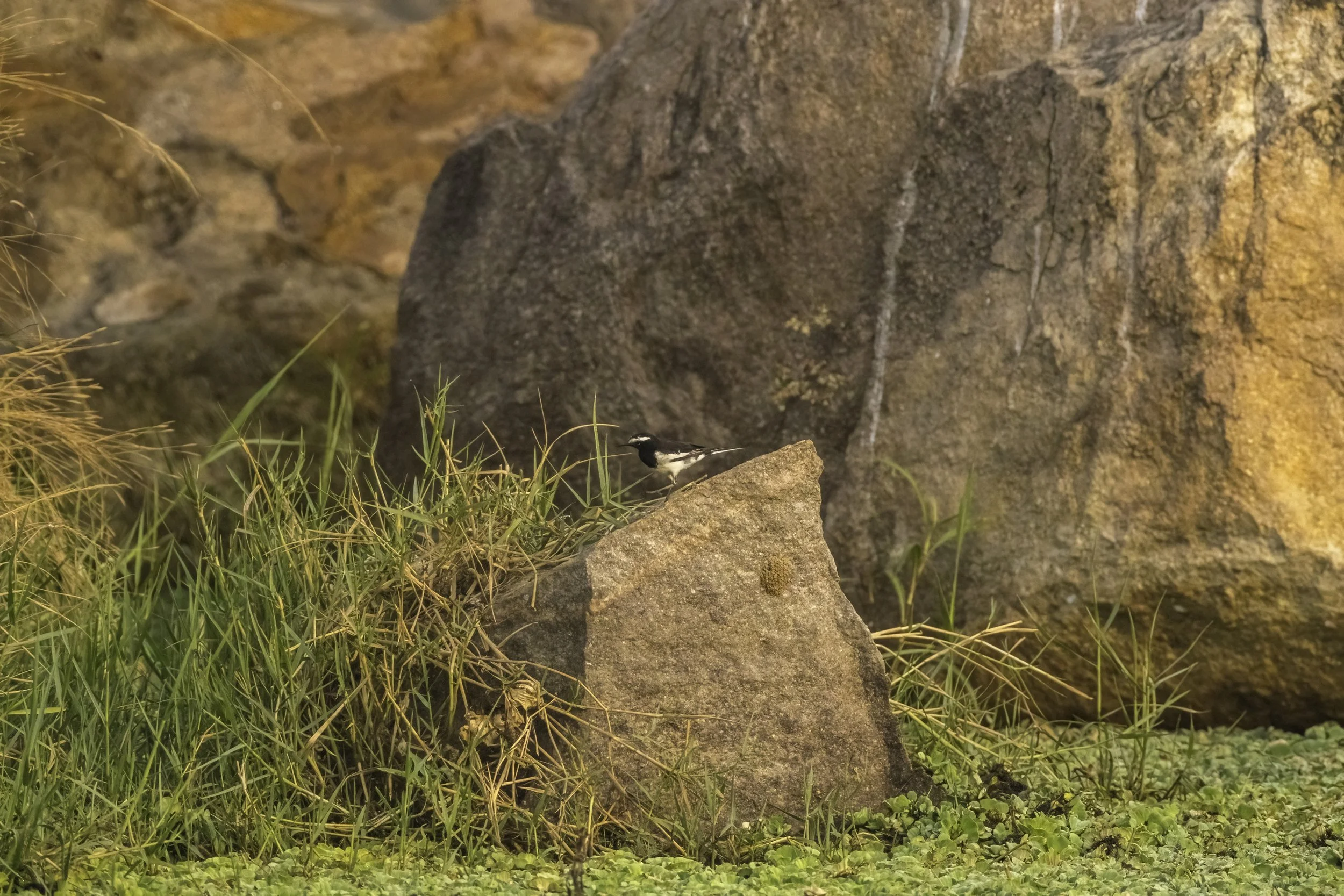
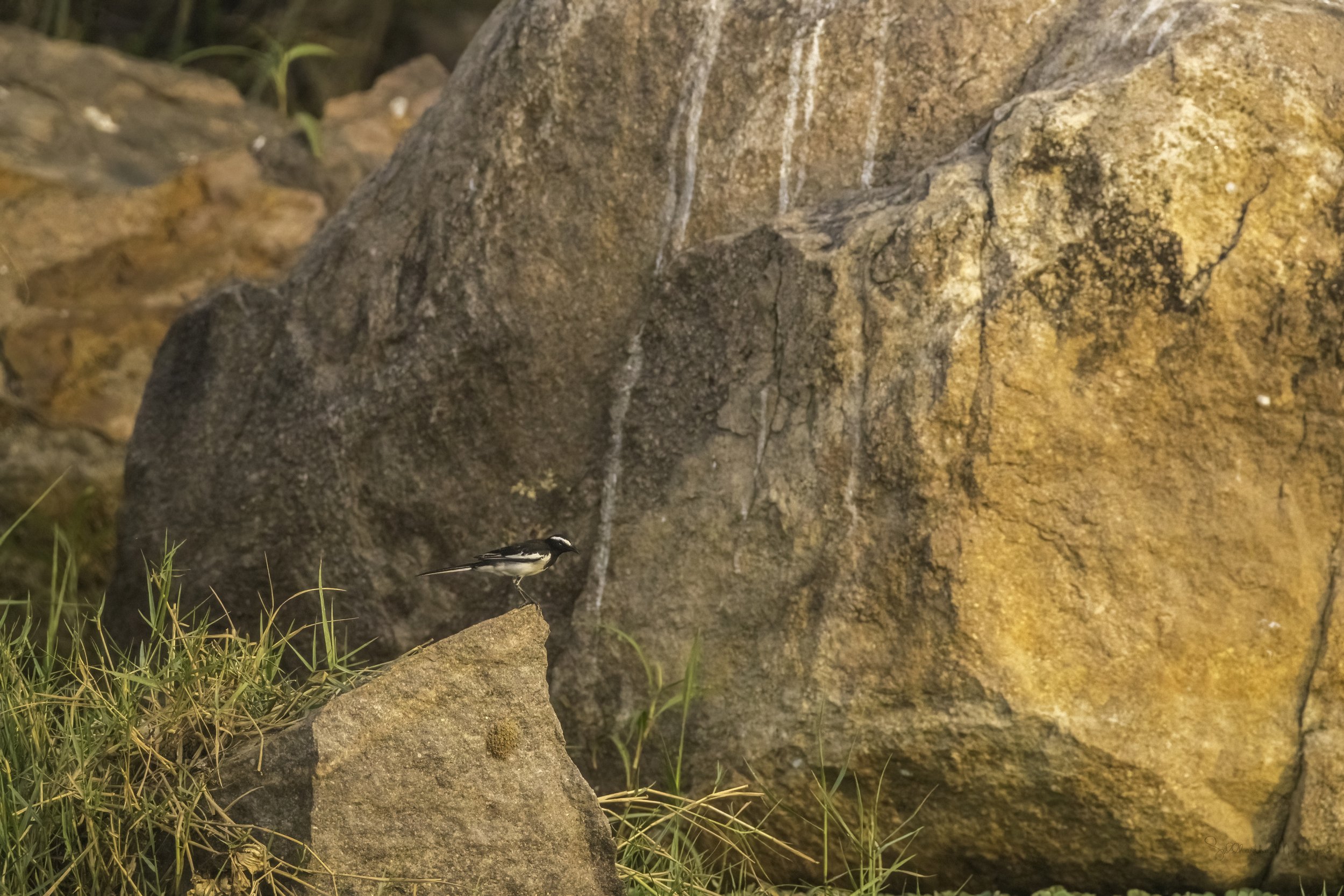
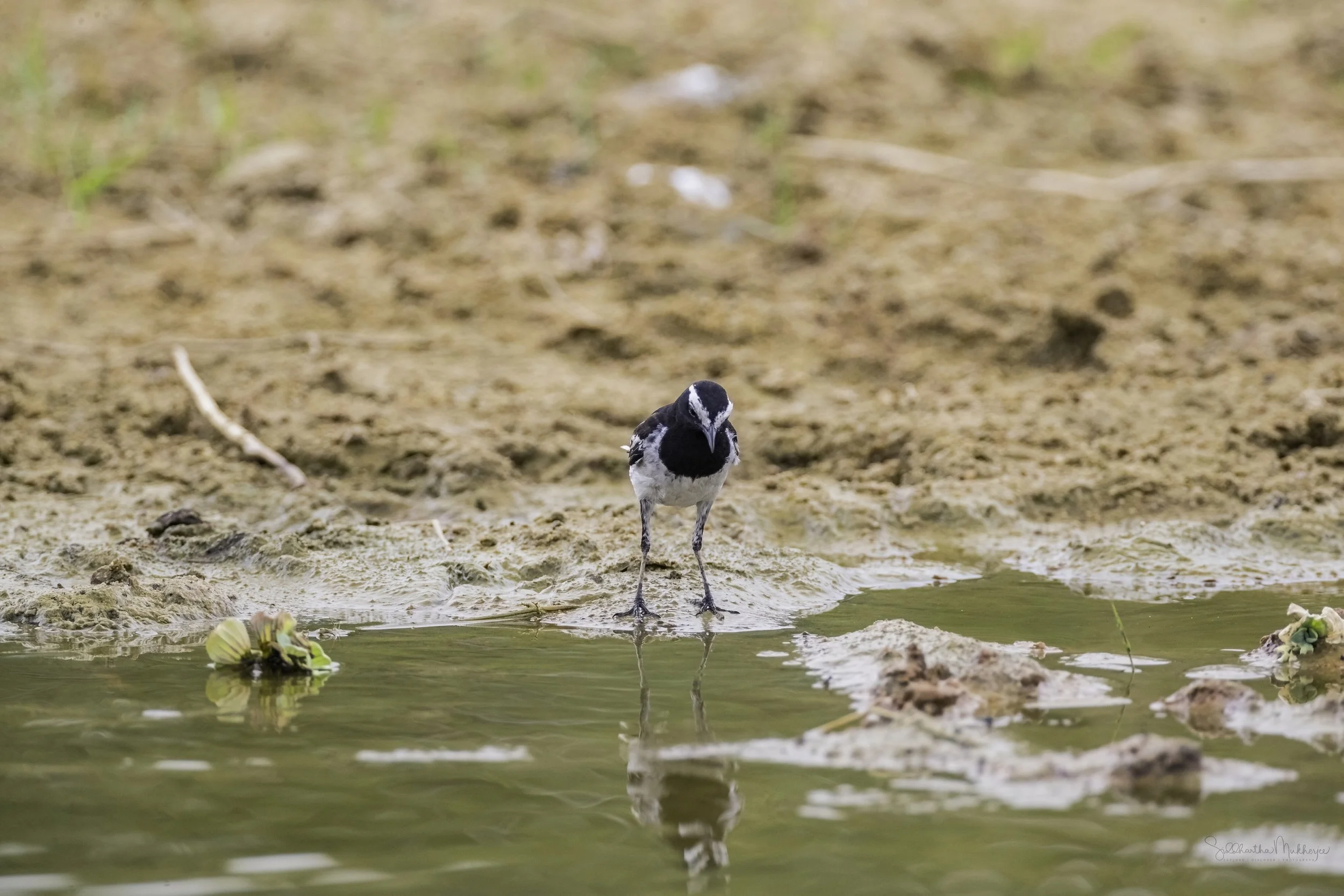
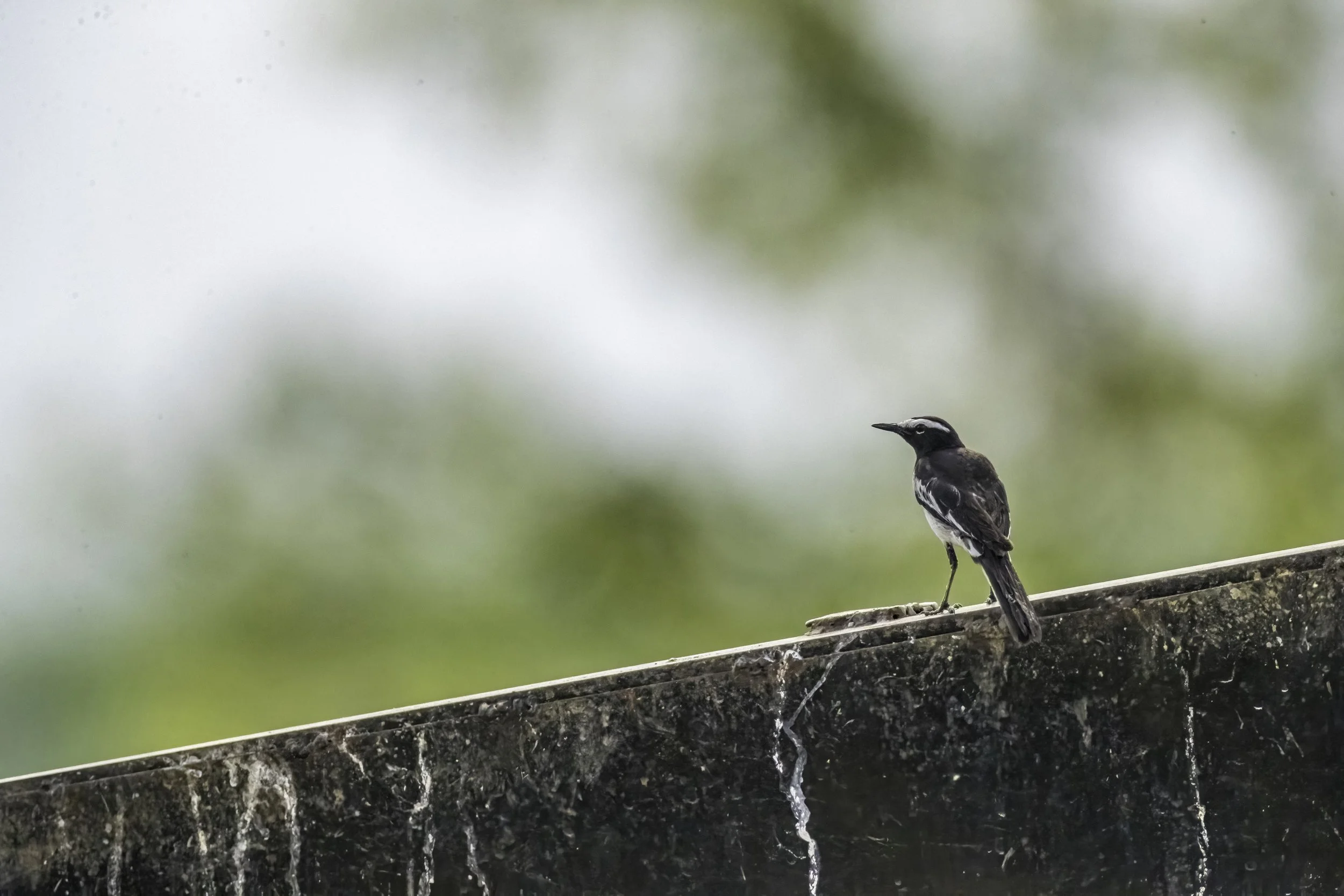
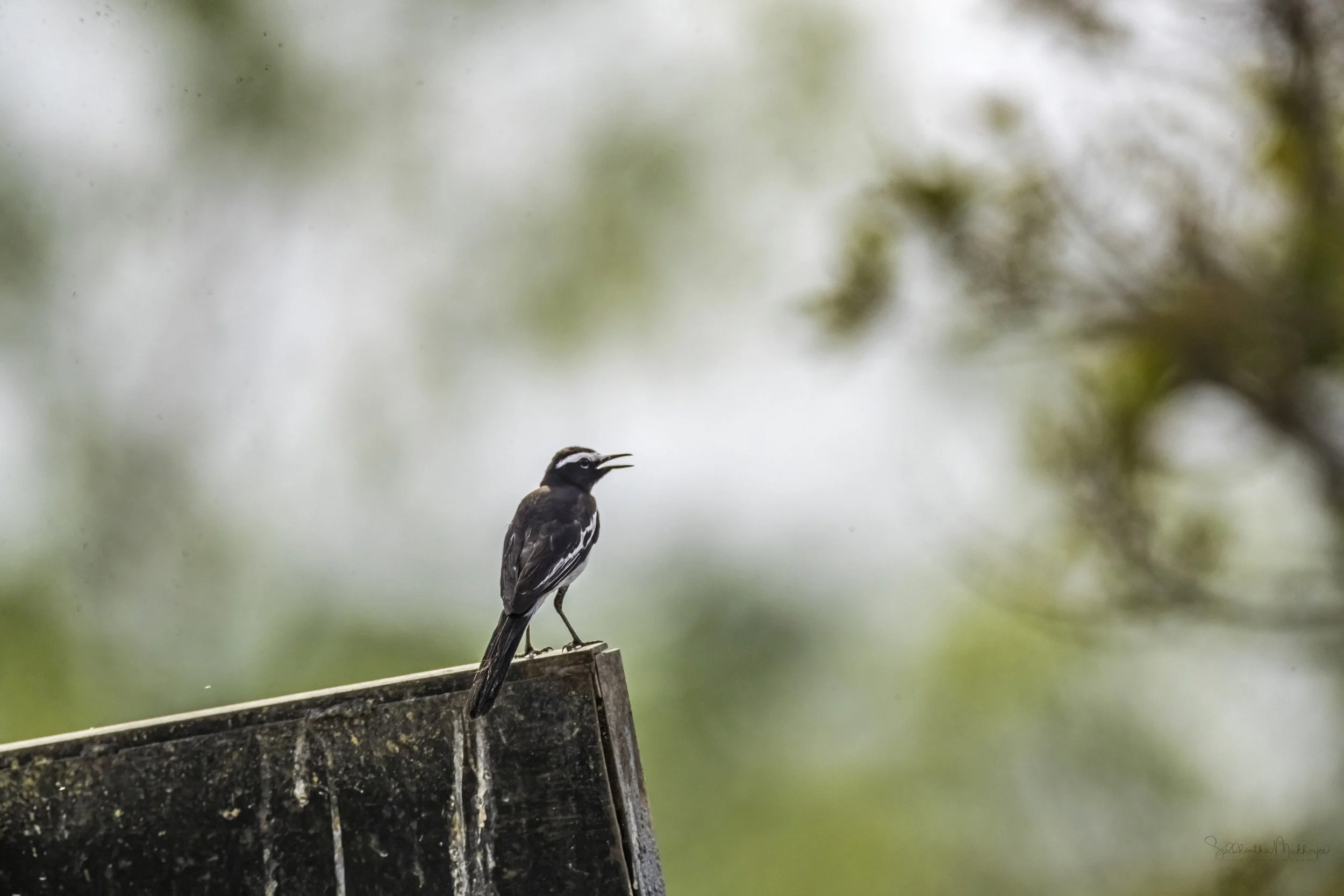
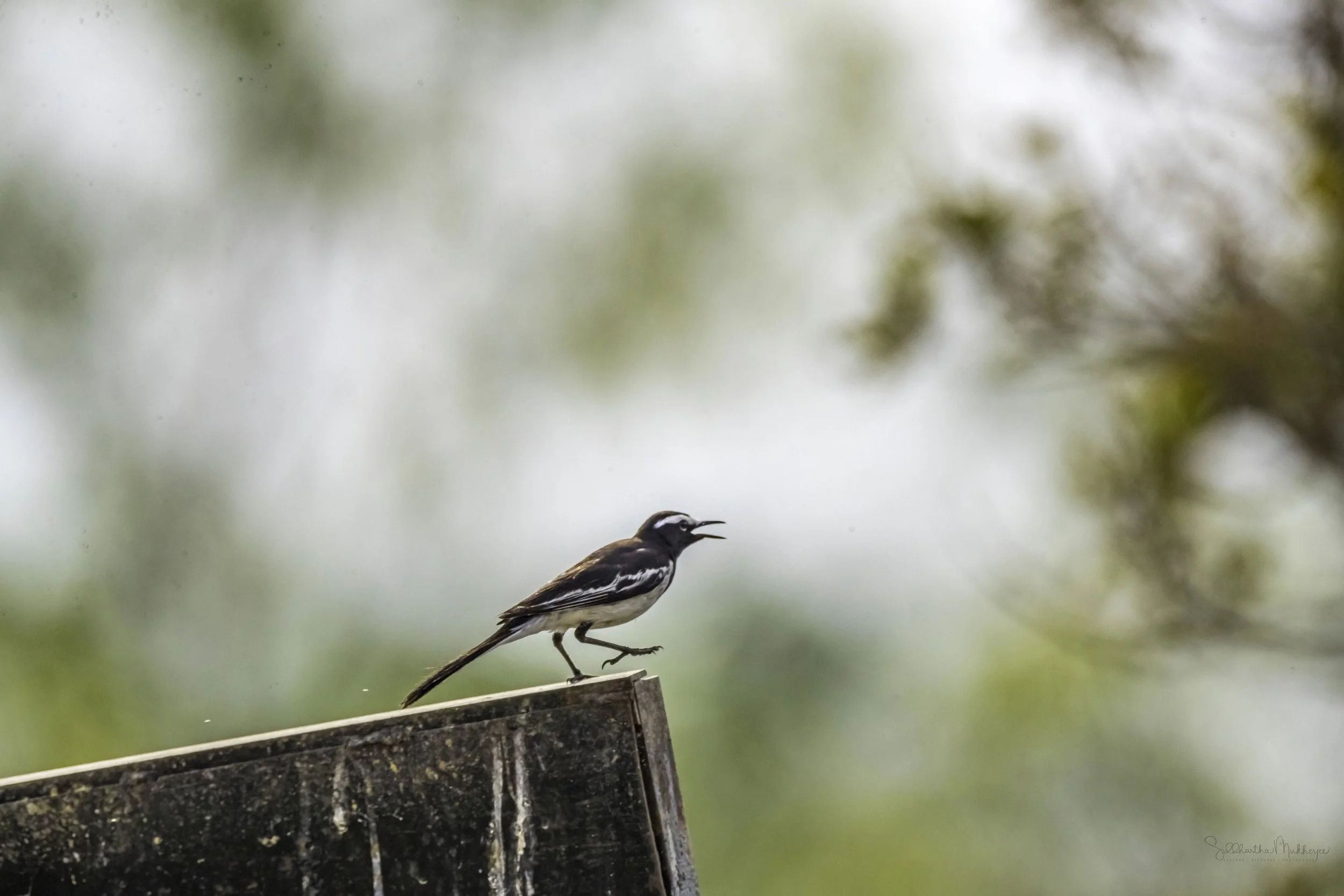
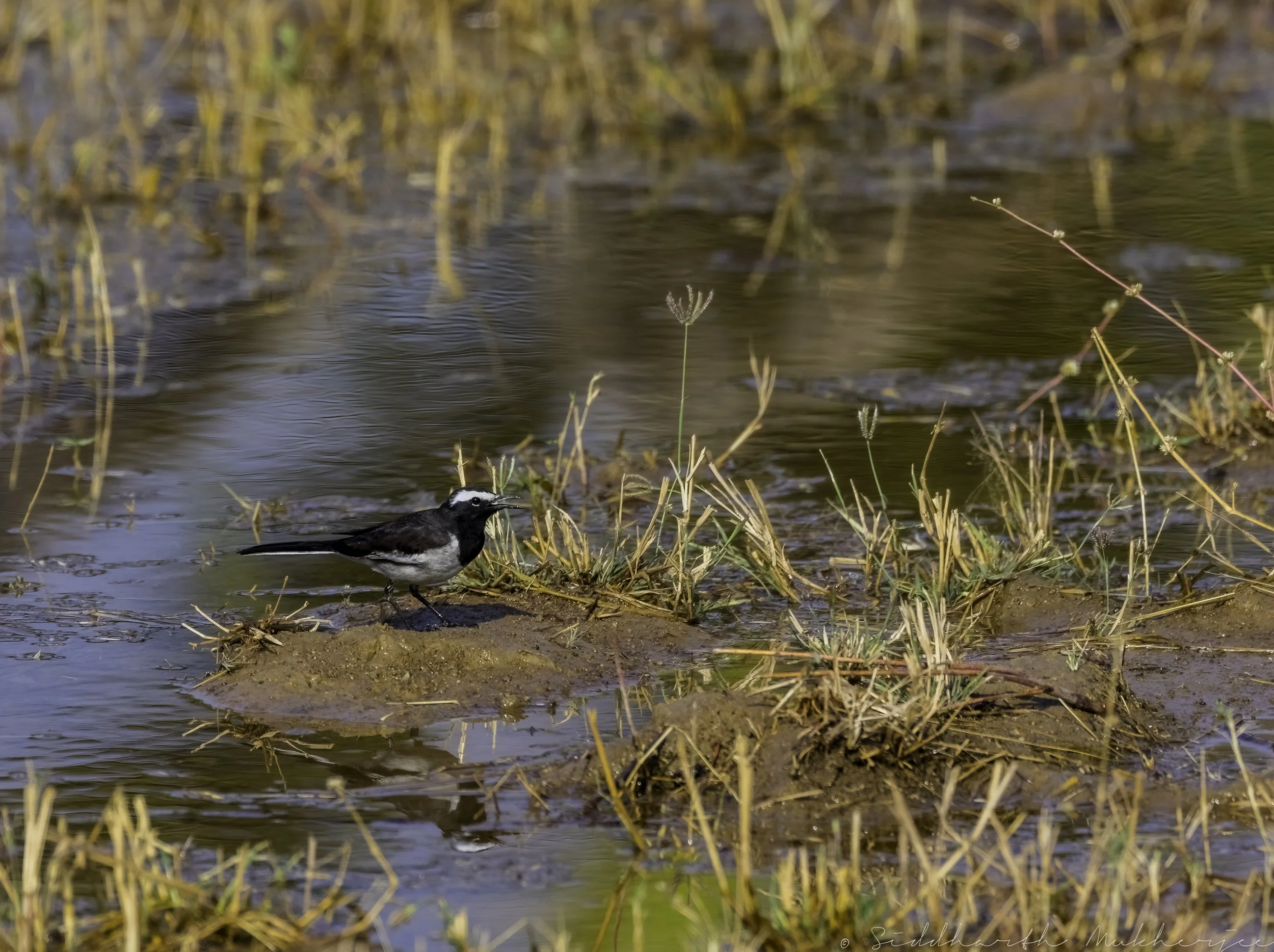
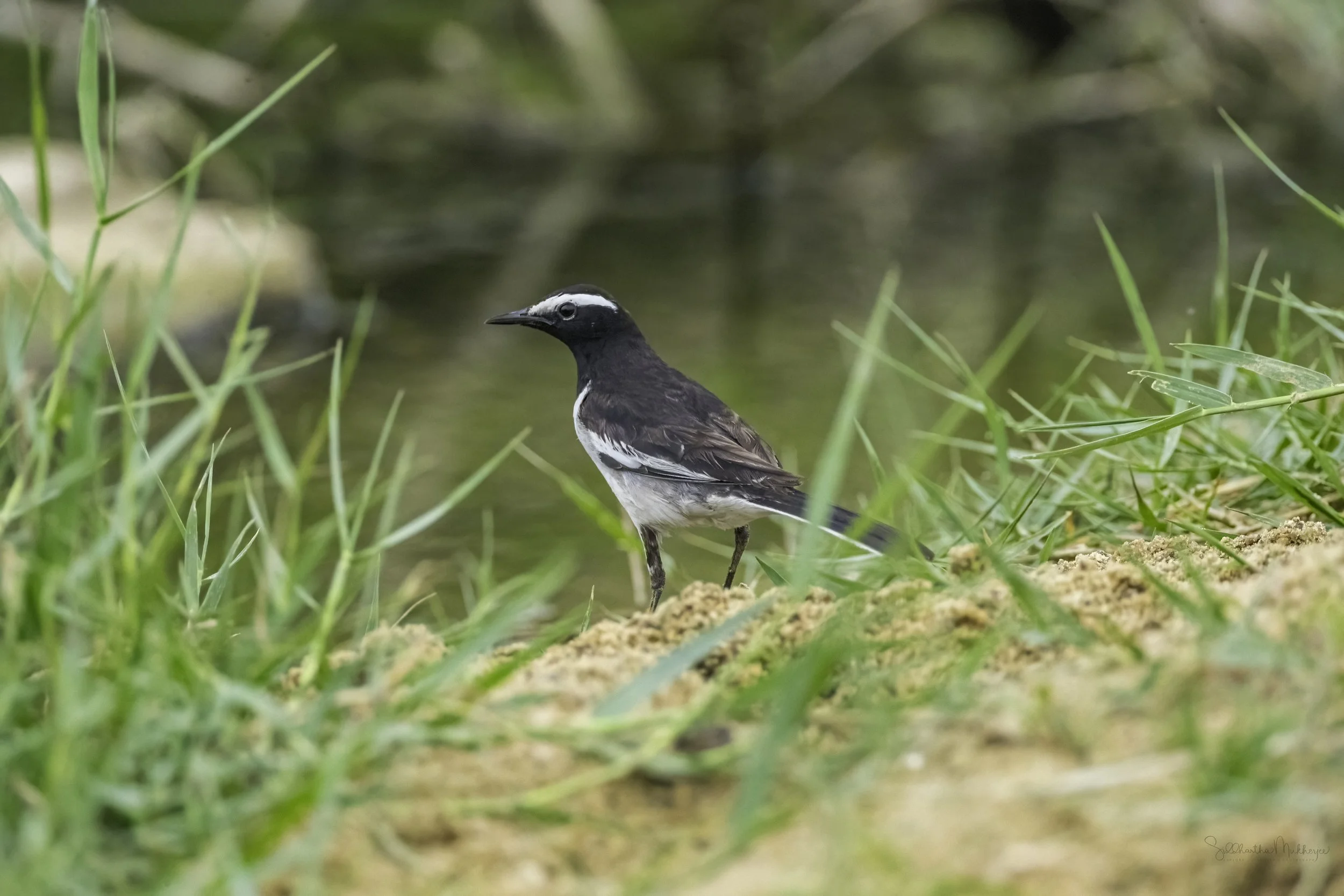
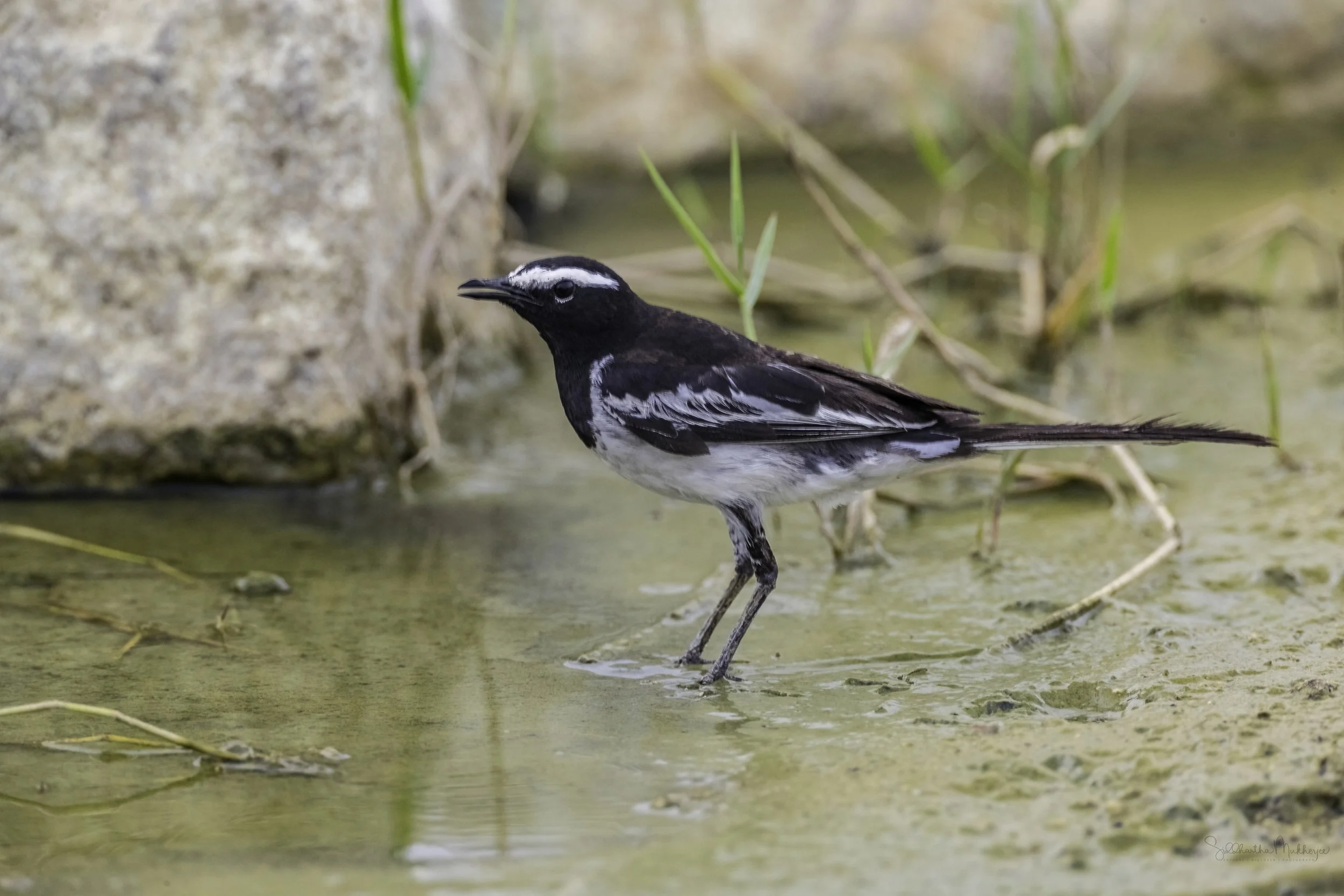
The White-browed Wagtail is a striking study in contrast, wearing a crisp suit of pitch black and pure white. Seeing it up close reveals a bird built perfectly for life on slippery rocks and fast-flowing margins. It measures between 21 to 24 centimetres from the tip of its slender bill to the end of its elongated tail, making it noticeably larger and more robust than migratory wagtails. Its wingspan stretches across 26 to 30 centimetres and ddults typically weigh between 25 and 31 grams. It possesses long, slender black legs (tarsi) and highly elongated toes equipped with sharp claws, which provide exceptional grip on wet, mossy surfaces.
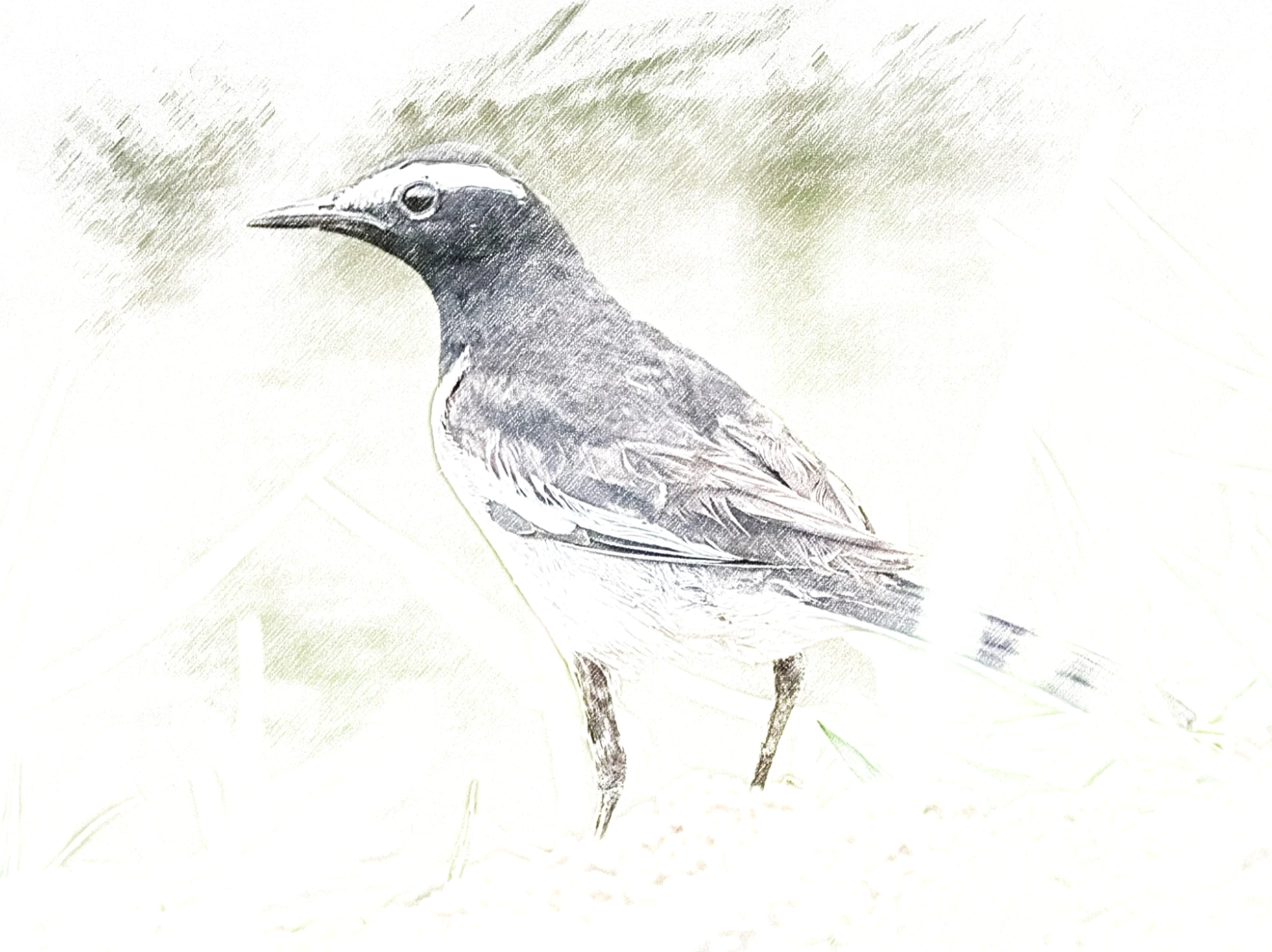
The adult bird features a solid black hood, mantle, and back. The defining field mark is its prominent, clean white supercilium—a bold eyebrow stripe that starts at the base of the bill and sweeps back above the dark eye, giving the bird an alert, intense expression. The underparts, from the throat down to the vent, are a spotless, gleaming white, though the flanks can sometimes show a faint greyish wash.
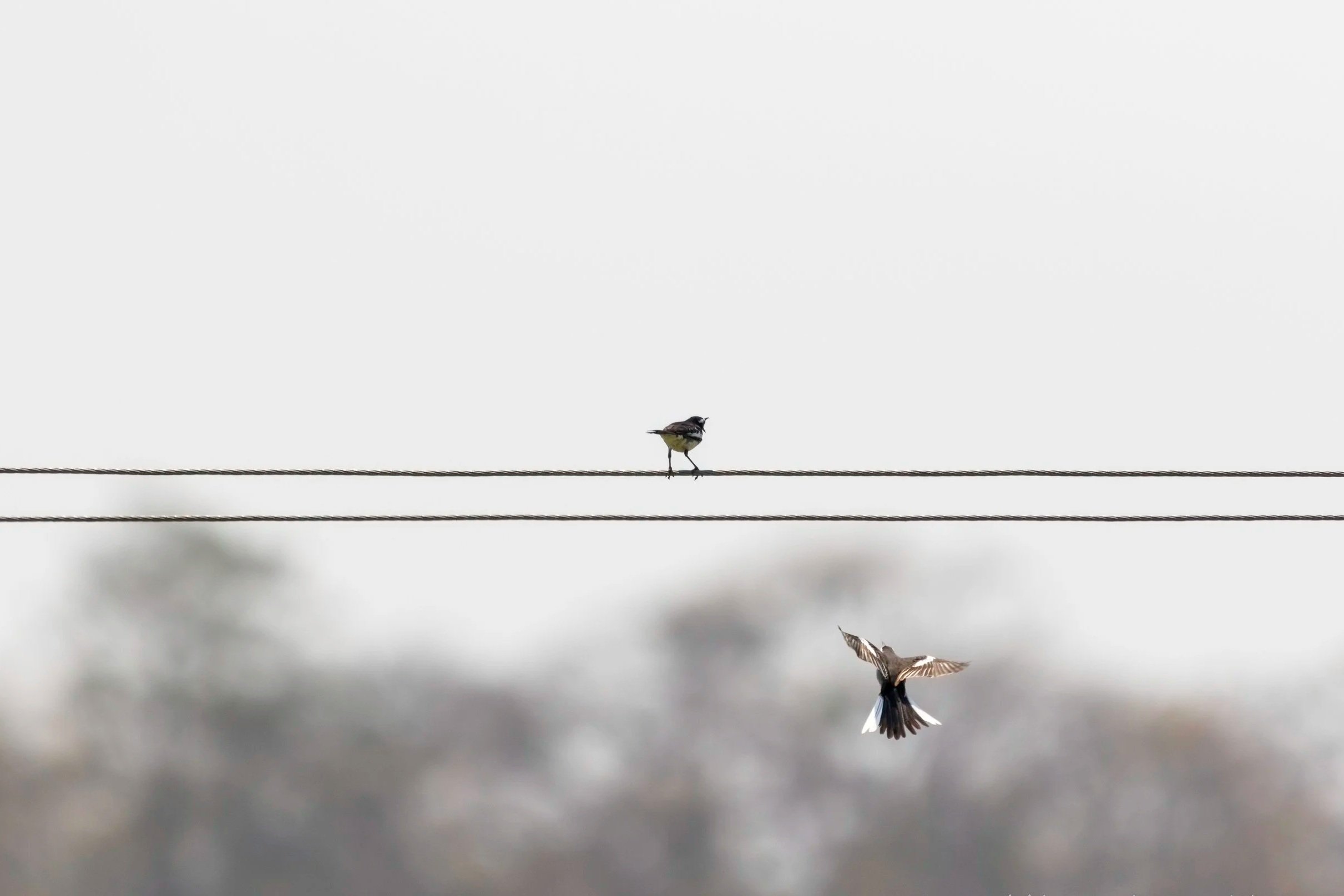
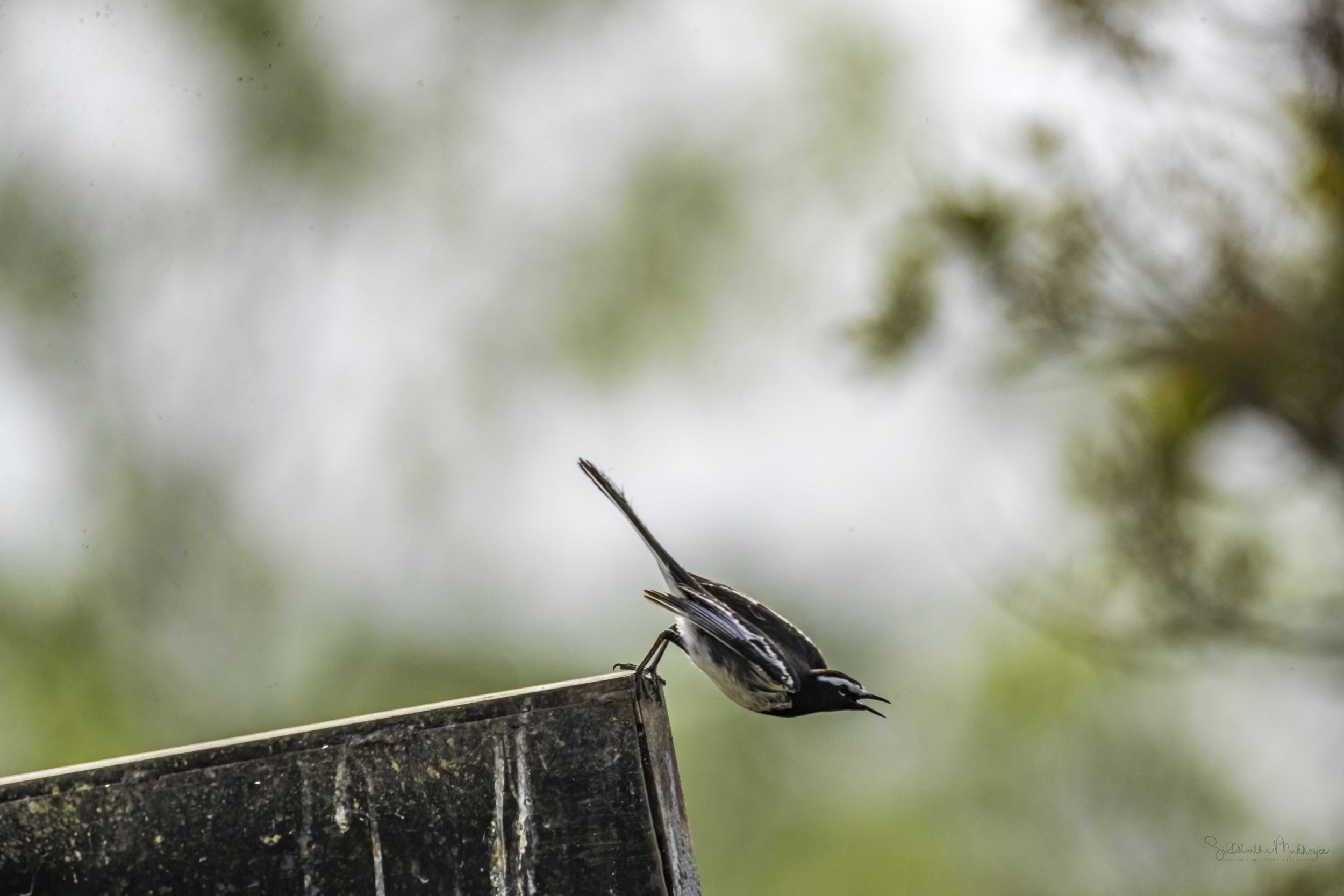
When grounded, its folded wings show a complex pattern of black feathers edged heavily with white. In flight, these markings transform into a broad, brilliant white wing-band that flashes vividly against the forest backdrop. The central tail feathers are deep black, while the outer pairs are stark white, creating a flickering strobe effect whenever the tail is wagged or spread during territorial displays.
Unlike many passerines, the sexes look remarkably alike. However, a keen observer can note that females occasionally display a slightly duller, charcoal-black or deeply dark grey mantle instead of the velvety black of the males. Juveniles are distinct, swapping the rich black for a smoky, brownish-grey tone, with a less defined, buff-coloured eyebrow.
Distinguishing the White-browed from its Cousins
Telangana and the wider Eastern Ghats landscape host several wagtail species, particularly during the winter migration. Confusing them is easy for the untrained eye, but the White-browed Wagtail stands apart through specific structural and tonal differences.
Versus the White Wagtail (Motacilla alba)
The White Wagtail is a winter visitor from northern latitudes. While it shares a black-and-white palette, its distribution of colour is entirely different. The White Wagtail features a predominantly white face, cheeks, and forehead, interrupted by a black cap and a distinct black bib on the breast. The White-browed Wagtail, by contrast, always retains a solid black face and throat, with the white confined strictly to that singular, striking eyebrow stripe. The White Wagtail’s back is also a pale, neutral grey, whereas the resident White-browed is jet black.
Versus the Grey Wagtail (Motacilla cinerea)
Arriving from Himalayan streams in October, the Grey Wagtail shares the rocky stream habitats of the Eastern Ghats. However, it is easily separated by its coloration. The Grey Wagtail sports a slate-grey back and a vibrant, bright yellow belly and vent. It is also slimmer, with a noticeably longer, more delicate tail that it pumps at a much faster, frantic frequency than the deliberate, rhythmic stroke of the White-browed.
Versus the Citrine (Motacilla citreola) and Western Yellow (Motacilla flava) Wagtails
These two winter migrants are birds of marshy grasslands, wet fields, and muddy lake margins. Both feature extensive yellow over their bodies. The adult male Citrine boasts a brilliant, fully yellow head, while the Western Yellow shows a combination of olive-green backs and yellow underparts, completely lacking the stark, tuxedo-like appearance of the White-browed Wagtail.
The White-browed Wagtail is endemic to the Indian subcontinent. While it can be found across most of India—excluding the high Himalayas and the hyper-arid core of the Thar Desert—the rocky river valleys of Telangana represent a premier habitat for the species.
Situated in the Nallamala Hills, Amrabad offers the ideal landscape for this species. The reserve is carved by deep gorges, seasonal nullahs, and the massive stretch of the Krishna River. Here, the wagtails occupy the rocky riverbeds below the Srisailam dam and the undisturbed interior forest streams like the Dindi. They find refuge on the exposed boulders, utilizing the dense riverine thickets for nesting away from terrestrial predators.
Located in the northern sector of the state within the Godavari river basin, Kawal presents a different topography. Its dry deciduous forests are crisscrossed by streams like the Kadam River and numerous forest pools (kuntas). In Kawal, the White-browed Wagtail relies heavily on the perennial pools and sandy riverbeds lined with terminalia and teak trees, hunting along the water margins shared with drinking herds of spotted deer and wild boar.
Other Telangana and Pan-India Locations
Outside the core tiger reserves, the species is adaptable. It is commonly sighted around the rocky edges of Pakhal Lake in Warangal, the margins of Pocharam Dam in Medak, and along the boulders of the Musi River down-stream of Hyderabad. Across India, its strongholds include the boulder-strewn rivers of the Western Ghats, the stone quarry pools of Madhya Pradesh, and the rocky banks of the Ganges and Yamuna in northern India.
The fundamental requirement for a White-browed Wagtail is the intersection of water, bare stone, and open sky. Unlike the migratory Citrine or Yellow Wagtails, which prefer soft mud, reeds, and water hyacinth, the White-browed is a obligate rocky-shore specialist.
This preference creates interesting habitat overlaps:
With the River Tern and Small Pratincole: On the wide, exposed rocky islands of the Krishna River in Amrabad, the wagtail hunts for insects alongside nesting River Terns (Sterna aurantia) and Small Pratincoles (Glareola lactea).
With the Crested Kingfisher and Indian Cormorant: While the kingfisher and cormorant harvest the deeper waters for fish, the wagtail patrols the splash-zone waterline, snatching up displaced aquatic invertebrates.
The Urban/Rural Shift: In agricultural zones, they adapt to man-made structures. They can be found walking along concrete irrigation canals, village washing ghats, and bridge piers, occupying an ecological niche similar to the house sparrow or oriental magpie-robin, provided clean water is nearby.
The behaviour of the White-browed Wagtail is defined by high energy and strict territoriality. They are almost never seen sitting still; they are a perpetual motion machine of running, fluttering, and tail-wagging. The wagtail is primarily an insectivore. It runs nimbly over slick rocks, its eyes scanning for midges, mosquitoes, dragonflies, aquatic beetles, and snails. It utilizes a foraging technique known as "run-picking," darting forward to snatch an insect before it can fly. It also practices "flush-chasing," flashing its white wing-patches to startle resting insects from rock crevices, snapping them out of the air with a short, acrobat flight.
Unlike its migratory cousins, which are mostly silent during their winter stay save for flight calls, the White-browed Wagtail is a magnificent singer. The male delivers a remarkably loud, clear, and melodious song consisting of whistled phrases, trills, and repetitive notes. This song is used to defend its linear river territory, which typically spans 300 to 500 metres of a stream bank.
They are strictly monogamous and form long-term pair bonds. The breeding season aligns with the pre-monsoon and monsoon periods (March to September), when water levels fluctuate and insect life peaks. The nest is a compact, cup-shaped structure made of roots, twigs, dried grass, and wool, hidden away under a rock overhang, inside a bridge weep-hole, or within the roots of a riverine tree.
The Shadow of Change: Habitat Loss and Behavioral Shifts
Despite its current status as a species of "Least Concern" globally, the White-browed Wagtail is facing quiet, localized crises across Telangana due to rapid environmental changes.
Deforestation and Siltation
In areas outside the protected boundaries of Amrabad and Kawal, illegal logging and deforestation along hill slopes lead to severe soil erosion. During the monsoon, topsoil washes into forest streams, filling up rocky pools with deep silt. This siltation smothers the gravel beds where aquatic insects breed. Deprived of its primary food source, the White-browed Wagtail is forced to abandon these forested hill streams entirely.
Damming and Sand Mining
The construction of check-dams and massive irrigation projects alters the natural flow of Telangana's rivers. Submergence destroys rocky rapids, replacing them with deep, still reservoirs that lack the shallow, boulder-strewn margins the birds require. Conversely, illegal river sand mining strips away the foraging banks.
Behavioral Anomalies
These disruptions have triggered noticeable changes in the bird's natural lifestyle:
Forced Urbanization: Displaced from natural river systems, pairs are migrating toward concrete urban environments, nesting in high-risk areas like active construction sites, drainage pipes, and railway tracks.
Dietary Shifts: In polluted water bodies where sensitive aquatic insects have died off, wagtails have been observed scavenging around human refuse, targeting flies on garbage piles—a drastic shift from their clean, riverine hunting traditions.
Elevated Nest Predation: Nests built on concrete structures or near villages are highly vulnerable to feral dogs, domestic cats, and crows, leading to lower breeding success rates compared to the protected interiors of Kawal or Amrabad.
Through the Lens: Photographing the River-Walker
Photographing the White-browed Wagtail within Telangana's tiger reserves is an exercise in patience, technical skill, and wilderness survival. It requires entering a world where you are far from the top of the food chain. The best time is to arrive before the light and setting up along an interior stream which might mean walking through paths tracked by leopards and sloth bears under the guidance of a local Chenchu tribal tracker. You sit low, knees pressed against cold basalt stones, with the camera mounted just inches above the water level on a ground pod.
The White-browed Wagtail is an exposure nightmare for digital sensors. Its plumage contains no middle tones—only blinding, reflective whites and deep, light-absorbing blacks.
Exposure Strategy: To avoid blowing out the white supercilium or the chest while retaining detail in the dark mantle, dial down the exposure compensation, typically between -0.7 and -1.3 EV.
Shutter Speed: Because the tail is in constant, rapid motion, a minimum shutter speed of 1/2000th of a second is necessary to freeze the action and capture the sharp texture of the feathers.
Through the viewfinder, the world narrows. The wagtail hops closer, step by step, completely unaware of the camouflaged lens poking through the brush. It stops on a red-tinted granite stone. The low-angle morning sun hits its eye, illuminating the clean, white brow against the dark background of the shaded Nallamala forest. The bird dips its body, pumps its tail twice, and lets out a clear, ringing whistle. The shutter fires in a quiet burst. In that single, sharp frame, the essence of the bird is captured: an emblem of wild, clean waters, dancing on the edge of a changing world.
‡‡‡‡‡

Related Posts



A small passerine bird in the wagtail family Motacillidae. A widespread wagtail, favoring wet meadows, marshland, grassy and muddy lakeshores. Occurs in fields and often near livestock during migration.
#wildartworks, #Canon, #Bird, #Birdinginthewild, #BirdWatching, #Wildlife, #conservationphotography, #bhigwan, #BhigwanBirdSanctuary, #Kumbhargaon, #ujnibackwaters, #westernyellowwagtail, #wagtail,