
Indian Jungle Crow
Corvus macrorhynchos culminatus
A distinct peninsular species endemic to the plains & hills of the Indian subcontinent south of the Himalayas
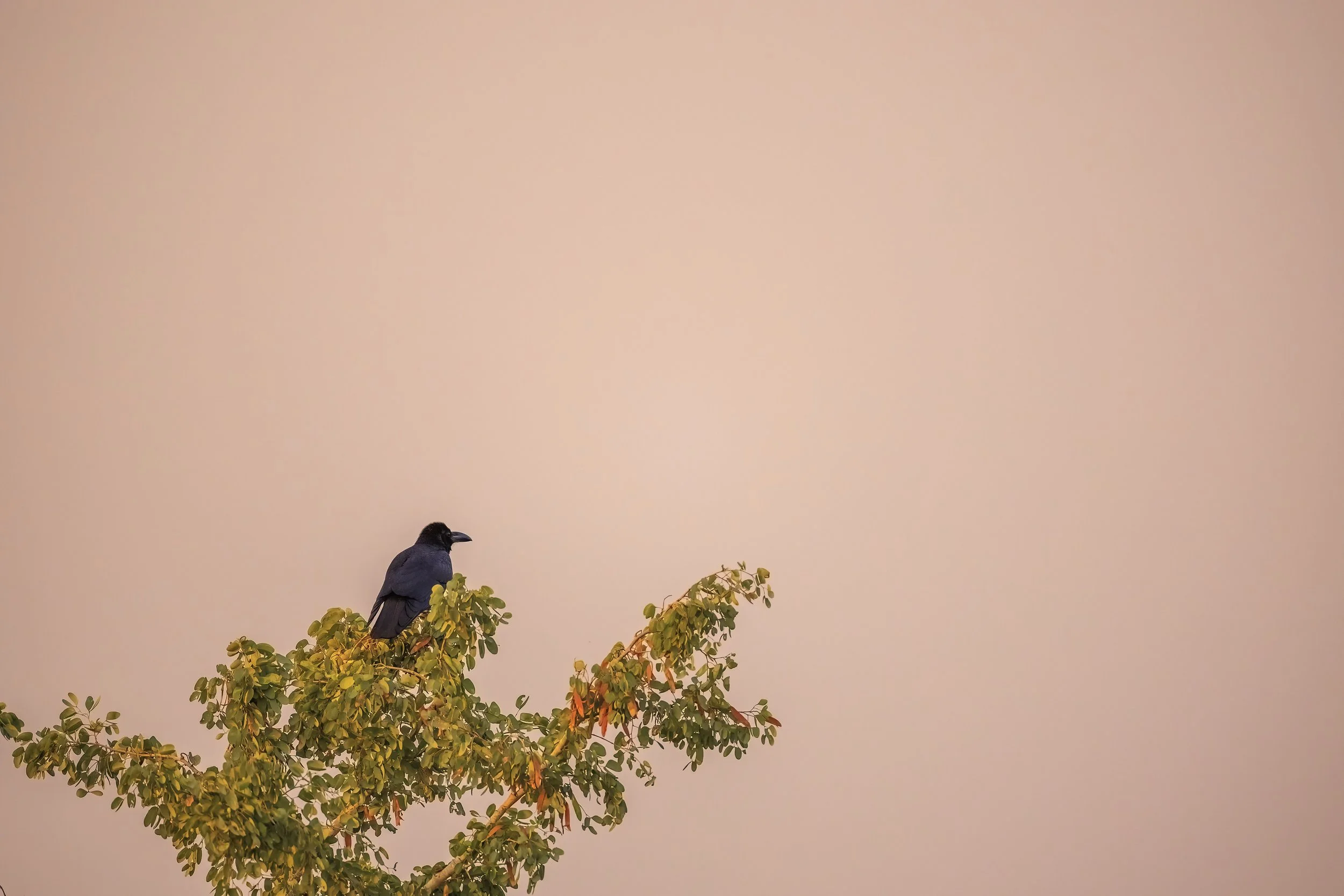
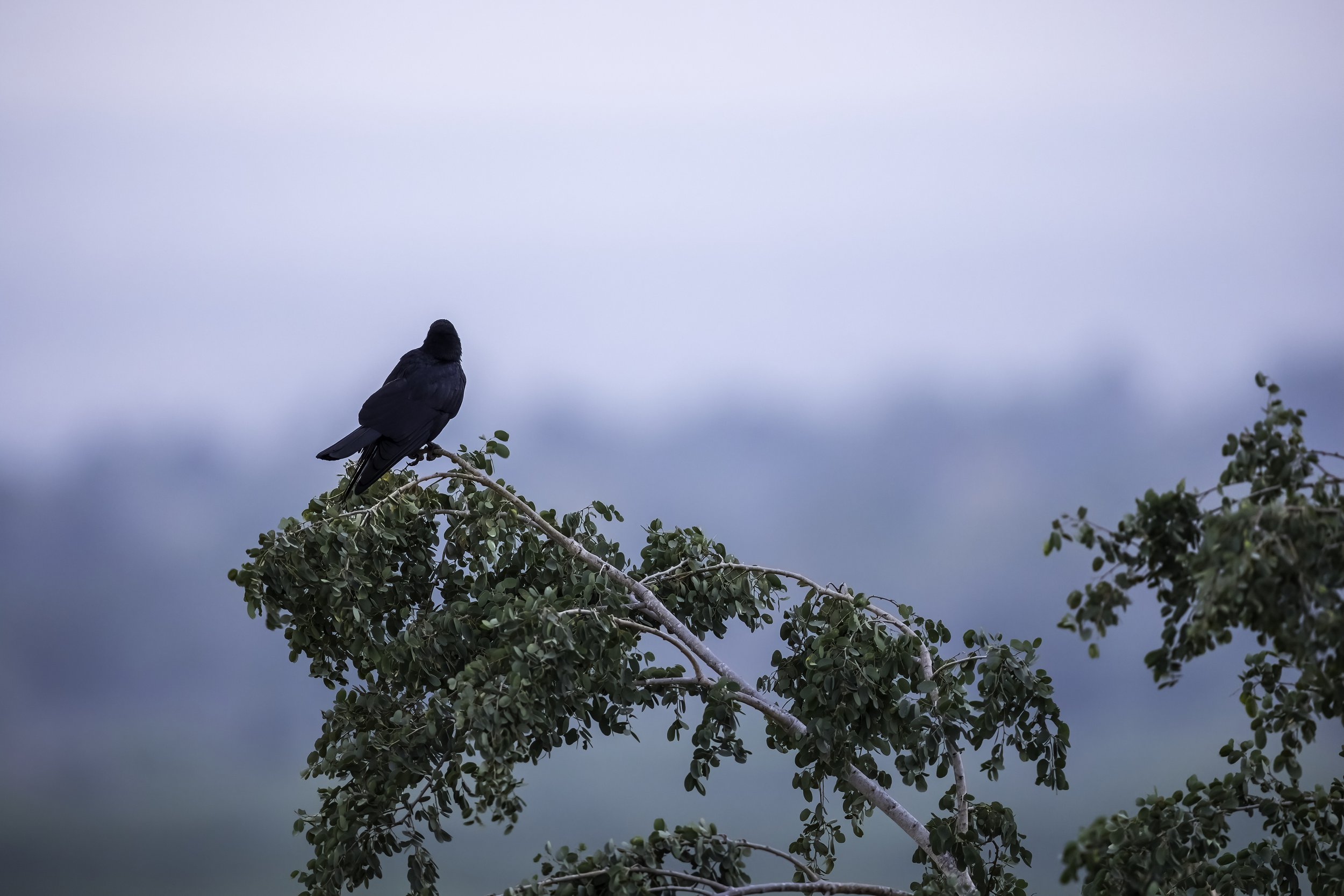
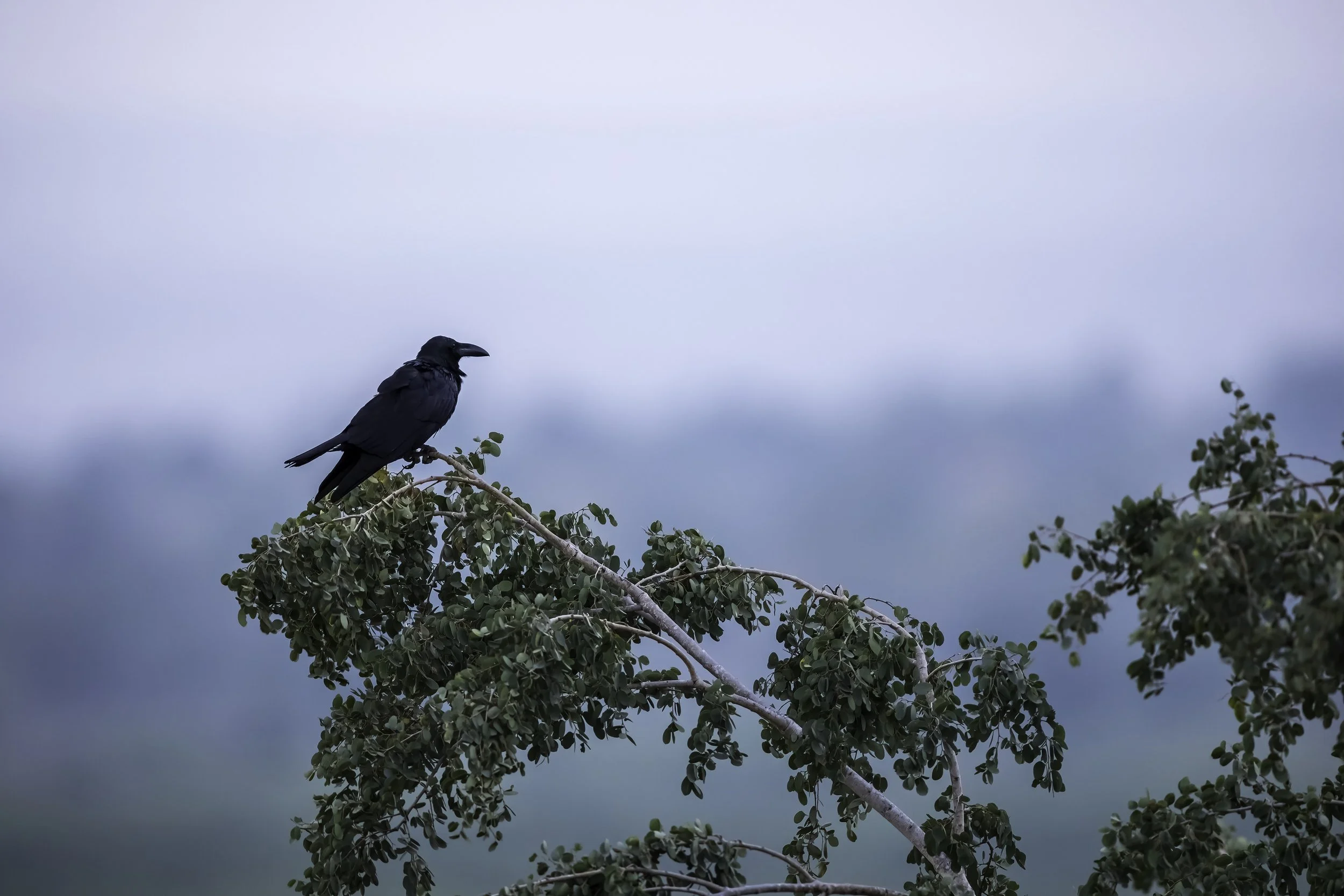
The first rays of dawn over the Nallamala Hills do not arrive with a gentle chorus, but with a sharp, resonant command. It is a deep, throaty “caa-haa-caa” that pierces the heavy mist hanging over the valleys of the Amrabad Tiger Reserve. Perched high upon the skeleton of a leafless teak tree, a silhouette takes shape against the crimson sky. This is the Indian Jungle Crow (Corvus culminatus), an ancient sentinel of India’s deciduous forests. For centuries, this master of adaptability has occupied a unique space in the subcontinent's ecology. Often misunderstood and eclipsed by its urban cousin, the House Crow (Corvus splendens), the Indian Jungle Crow is a distinct, highly intelligent spirit of the wilderness. It thrives in the raw, untamed corridors of Telangana, from the riverine landscapes of the north to the rugged gorges of the south. To follow this bird is to understand how the altering pulse of India’s forests impacts its most resilient inhabitants.
The Large-billed Crow vs the Indian Jungle Crow
But let me clear a long standing confusion first - The naming confusion surrounding the Large-billed Crow (Corvus macrorhynchos) and the Indian Jungle Crow (Corvus culminatus) stems from a major shift in ornithological taxonomy. Historically, these names were used interchangeably because the two birds were considered the same species—collectively lumped together under the broad umbrella of the "jungle crow" or "large-billed crow" complex across Asia. However, recent genetic, vocal, and morphological studies have officially split them into two entirely distinct, separate species.
The Taxonomic Evolution
For decades, the Indian Jungle Crow (Corvus culminatus) was classified simply as a smaller, lowland subspecies of the broader Large-billed Crow (Corvus macrorhynchos). Because both birds are completely glossy black and possess noticeably heavy, thick beaks compared to the Grey-necked House Crow (Corvus splendens), birdwatchers and early taxonomists used the names fluidly. Modern science has since drawn a clear line: the Large-billed Crow is now recognized as a massive, northern, and montane specialist, while the Indian Jungle Crow is a distinct peninsular species endemic to the plains and hills of the Indian subcontinent south of the Himalayas, including Telangana.
Telangana is endowed with rich diversity of flora and fauna (Species Directory). It has dense teak forests on the northern part along the banks of river Godavari and to the south along the banks of the Krishna. As per the Champion & Seth Classification of Forest Types (1968), the forests in Telangana belong to three Forest Type groups, which are further divided into 12 Forest Types. The State Government’s massive greening programme, 'Telangana Ku Harita Haram', aims at achieving the twin objectives of increasing the forest cover and reduce pressure on the existing forest resources, through massive community participation by Vana Samrakshna Samithis (VSS) and Eco-Development Committees (EDCs) in Protected Areas and Watershed Development Committees in the Watershed areas. Recorded Forest Area (RFA) in the State is 26,904 km² of which 20,353 km² is Reserved Forest, 5,939 km² is Protected Forest and 612 km² is Unclassed Forests.
Three National Parks and nine Wildlife Sanctuaries constitute the Protected Area network of the State covering 5.08% of its geographical area and our focus area today is within the north western fringe of the Nallamalla forest - the Amrabad Tiger Reserve - India's second-largest tiger reserve by core area (2,611 km²). Known for its rugged terrain, deep gorges, and dry deciduous forests, it hosts Bengal tigers, leopards, and over 300 bird species. The river Krishna flows through it, supporting rich biodiversity and the indigenous Chenchu tribes.
Maddimadugu Range, Amrabad Tiger Reserve
The Maddimadugu Range serves as a vital ecological corridor within the broader Amrabad Tiger Reserve, anchoring the reserve's south-eastern territory along the rugged contours of the Nallamala Hills. Dominated by dense dry deciduous woodlands, rocky plateaus, and deep sandstone gorges, this range borders the vast catchment area of the Krishna River. During the peak summer months, the range plays a crucial role in regional wildlife dynamics; as water sources dry up across adjacent landscapes, apex predators like the Bengal Tiger and Indian Leopard routinely swim across the Krishna River to seek refuge, water, and denser canopy cover within the cooler valleys of Maddimadugu.
Ecologically, the range has taken center stage in Telangana's wildlife management through the establishment of a specialized Prey Augmentation Centre. Spanning over 35 hectares of heavily secured, chain-link fenced habitat, this soft-release facility was specifically built to counteract a historical deficit of large herbivores in the sector. By systematically translocating excess populations of Spotted Deer (Chital), Nilgai, and Sambhar from urban parks like Hyderabad's Nehru Zoological Park, conservationists are actively building a self-sustaining prey base. This targeted boost in herbivore biomass directly supports the territory of the reserve’s expanding wild cat population, which has steadily risen to over 33 tigers.
For birdwatchers and wildlife photographers, the Maddimadugu Range provides a pristine, low-traffic environment to observe deep-forest dynamics and avian behavior. The presence of large grazing herds in the prey-enrichment zones attracts a high concentration of Indian Jungle Crows (Corvus culminatus), which can be seen foraging for ticks on the backs of deer or tracking the movements of predators moving through the undergrowth. The range effortlessly blends its rich wildlife territory with cultural heritage, housing the remote Maddi Madugu Sri Anjaneya Swamy Temple. This balance creates a fascinating edge-effect where forest-dwelling corvids, raptors, and large mammals interact right along the boundary of human spiritual paths and untamed wilderness.
There are also numerous Chenchu sacred groves in the vicinity. These “Sacred Groves”, hidden "islands" of dense, untouched vegetation that serve as the spiritual anchors for the Chenchus in their small, bee-hive shaped, traditional settlements, known as pentas. These groves are more than just clusters of old-growth trees; they are the spiritual sanctuaries of the tribe, acting as living temples where deities like Garelamai Sama, the goddess of the forest, are believed to dwell. The tribe, which has 26 distinct gotras (clans), performs rituals for deities like Garelamai Sama and Gangamma (the Water Goddess), often during the month of Shravan.
Because these patches of land are considered the residence of the divine, hunting and logging are strictly forbidden within their boundaries. This traditional belief system has created accidental but vital biodiversity hotspots, preserving rare flora and fauna that thrive under the tribe’s spiritual protection. The Chenchus live by a strict ethos of reciprocity—taking only what is necessary, such as leaving honey larvae behind to ensure the bees return, maintaining a perfect balance between man and nature. To step into a Chenchu Sacred Grove is to enter a space where human law bows to divine order. No axe is ever raised here & even the collection of fallen wood is often forbidden, ensuring these pockets remain pristine refuges for rare medicinal plants and the very wildlife the reserve seeks to protect.
Read more about the Chenchu Sacred Groves.
Indian Jungle Crow
The Indian Jungle Crow is a resident across mainland India, south of the Himalayan foothills, bounded by the western deserts and extending east toward Bengal. Within Telangana, it finds refuge in the state's most critical wildlife zones, acting as an ecological indicator of forest health.
In the southern part of the state, the Indian Jungle Crow rules the skies of the Amrabad Tiger Reserve. Spanning over 2,600 km² across the Nagarkurnool and Nalgonda districts, this reserve features an undulating landscape of deep gorges, rocky plateaus, and dry deciduous forests. Here, the Jungle Crow acts as an aerial lookout. It tracks the movements of apex predators like leopards and Bengal Tigers, waiting to scavenge the remnants of their kills.
Moving north to the Mancherial District, the species transitions into the Kawal Tiger Reserve. Nestled within the Sahyadri mountain ranges along the banks of the Godavari River, Kawal provides a rich habitat dominated by dense teak (Tectona grandis) and bamboo thickets. In these undisturbed, thick canopies, the jungle crow is a true forest bird, nesting in towering tree forks far removed from human settlements.
Beyond these flagship tiger reserves, populations are scattered across:
The Pakhal Wildlife Sanctuary in Warangal
The Eturnagaram Wildlife Sanctuary
The relict forest patches of the Ananthagiri Hills in Vikarabad
Whenever these birds venture near rural farmland fringes or forest check-posts, they aggressively defend their territory against intruding house crows.
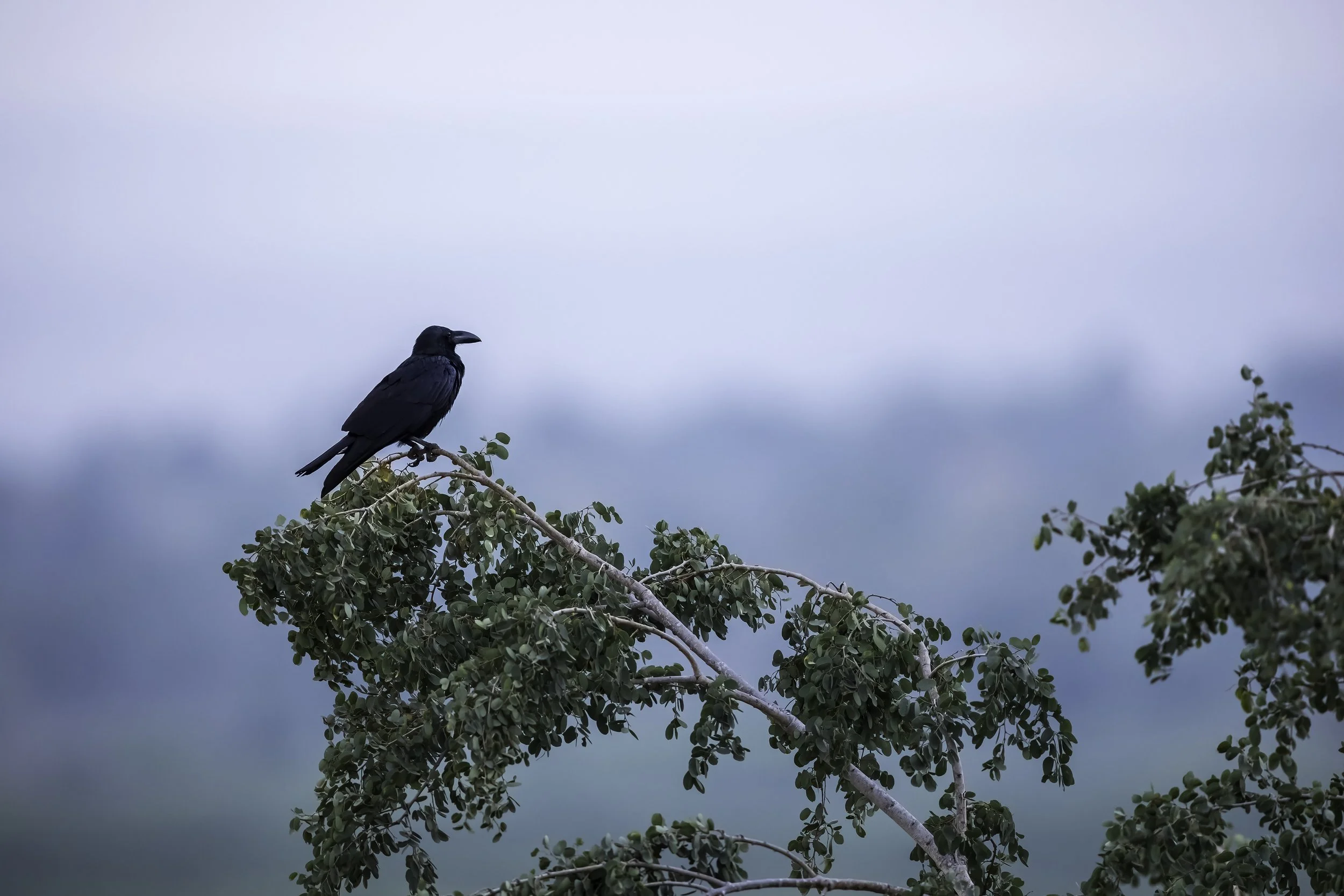
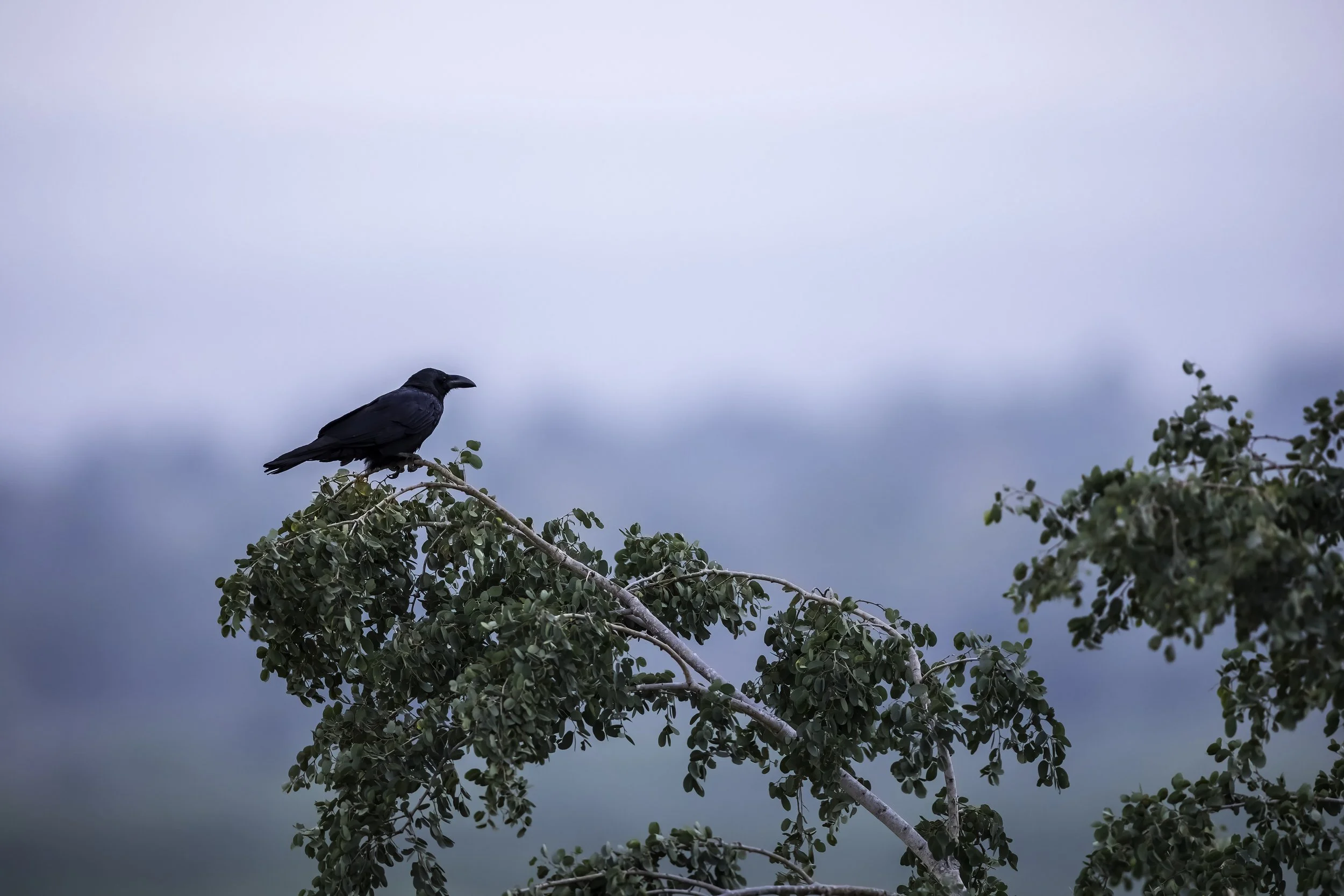
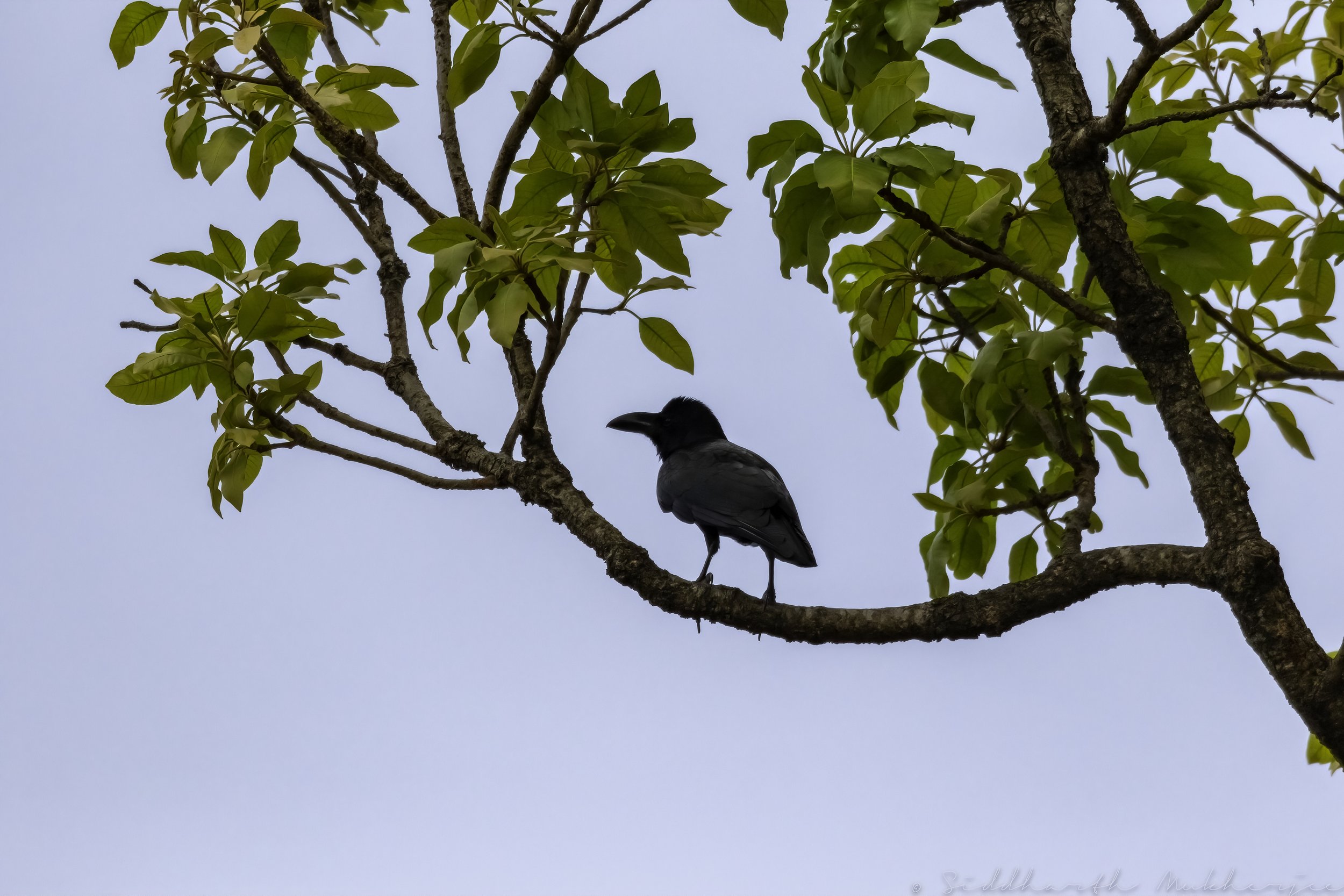
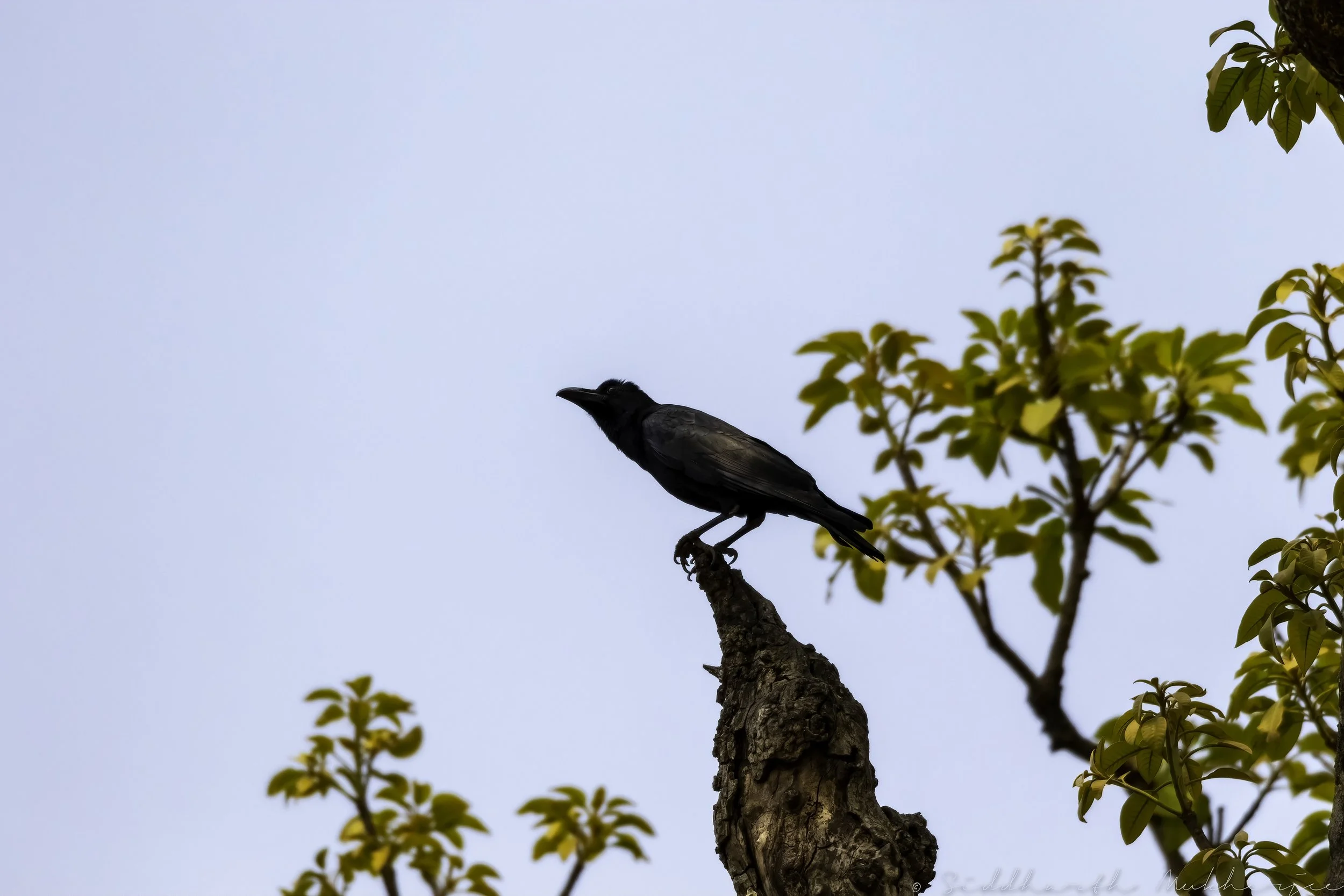
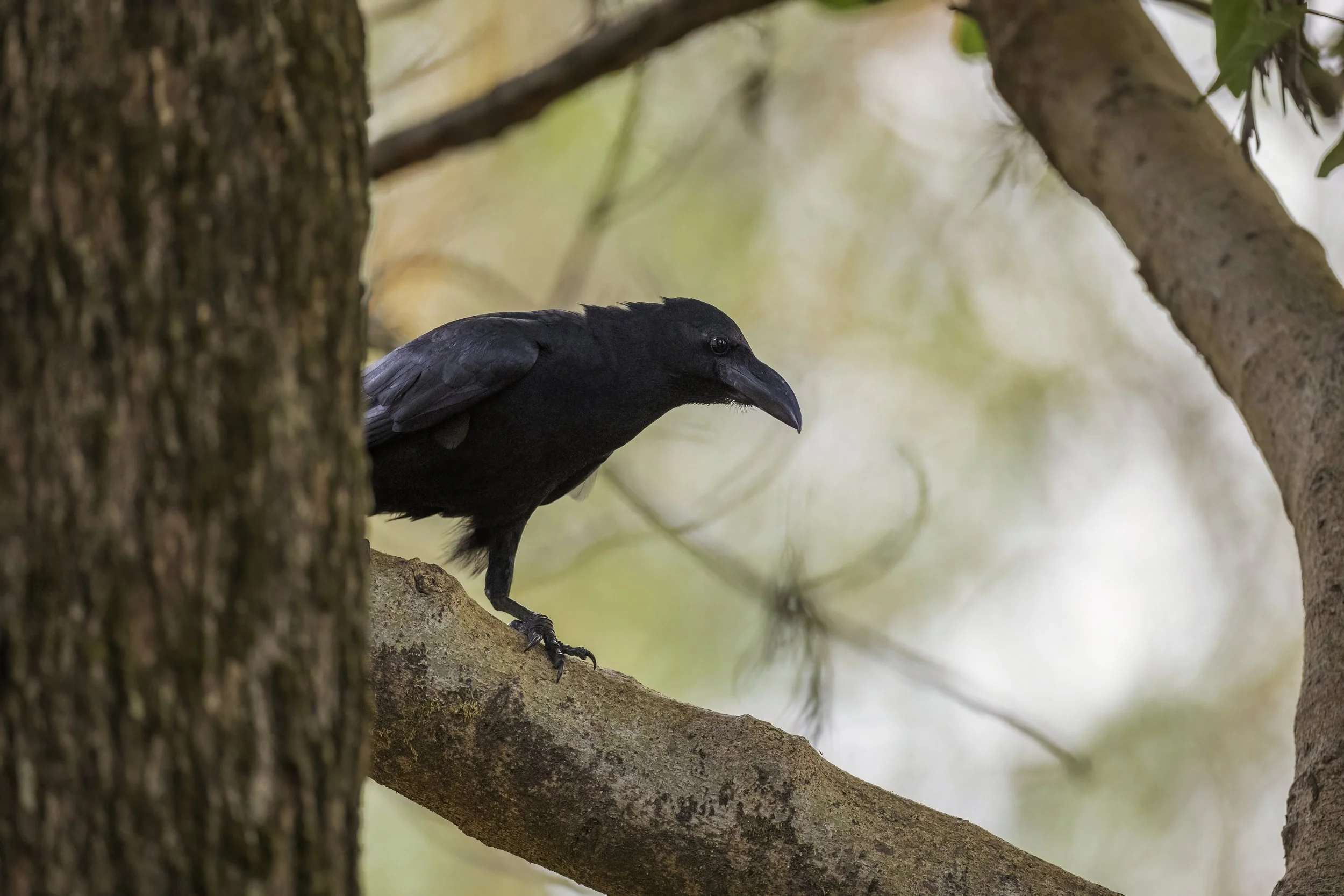
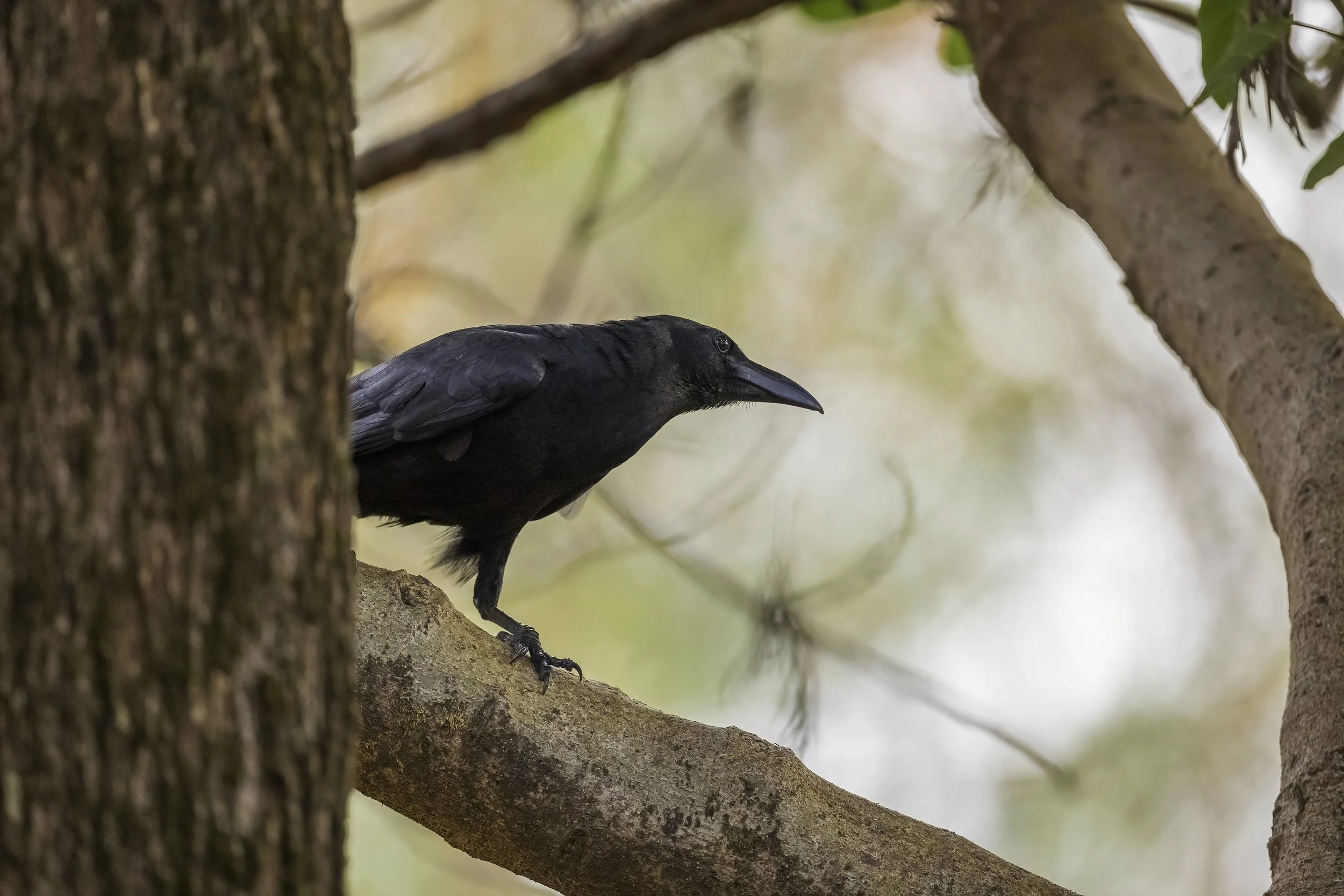
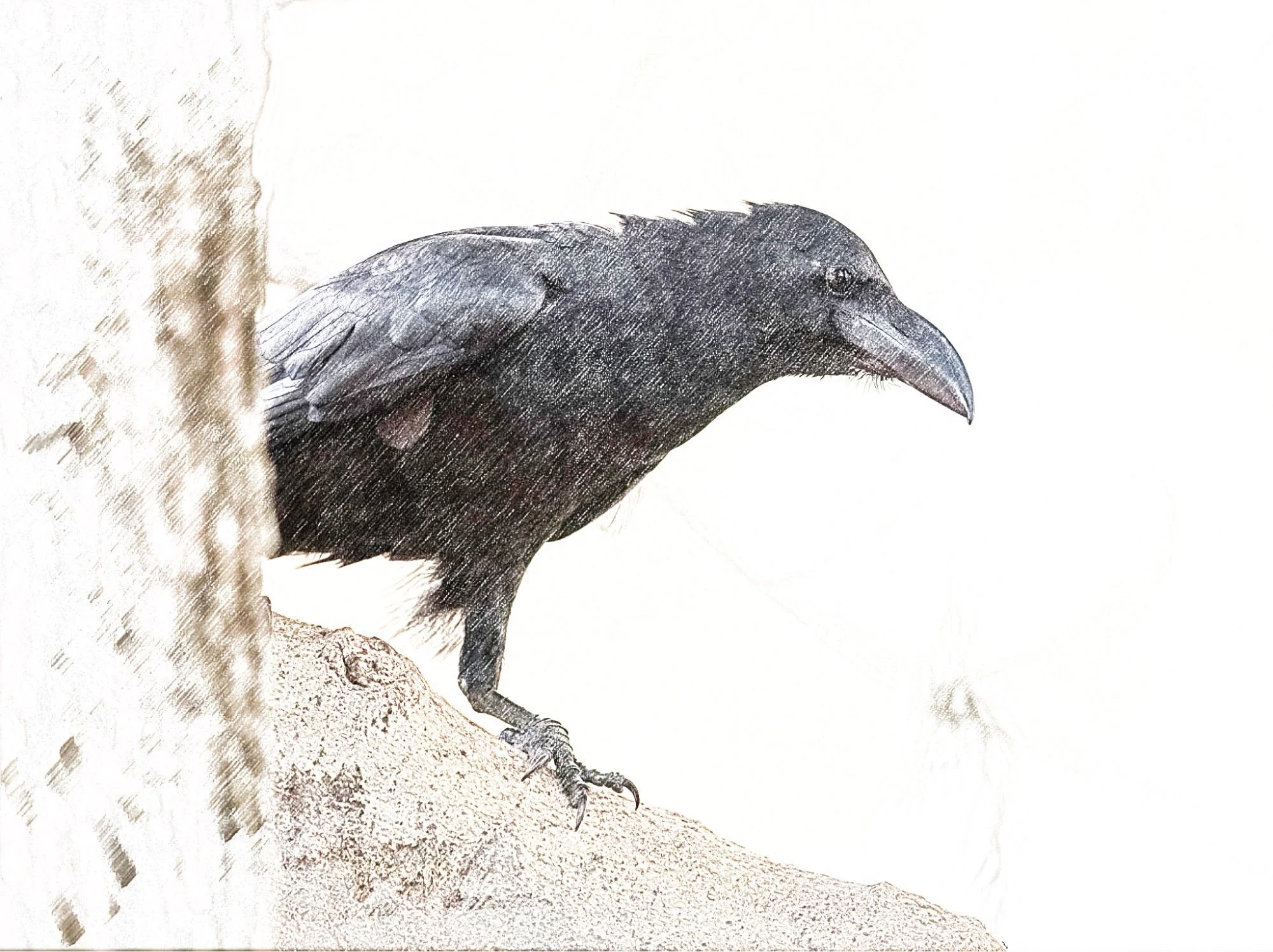
The Indian jungle crow is an imposing corvid, radiating a sense of heavy, muscular power. They feature a total body length of 47 cm to 50 cm with an average Weight ranging between 450 - 700 grams. Their wingspan is between 100 - 115 cms and the bill length is between 52 - 67 mm (slenderer and finer-tipped than the northern sub-species). Their plumage colour is a uniform glossy jet-black with deep purple and blue-metallic iridescence. The Irises are a dark hazel brown in adults and smoky blue in the juveniles. Their feet & tarsi is exceptionally stout, rough, and entirely matte black. Its silhouette is defined by a steeply peaked forehead and a prominent, heavy bill. The upper edge of the bill (the culmen) is distinctly arched. Thick, backward-pointing rictal bristles cover the nostrils at the base of the beak.
Unlike many birds with contrasting plumage, the Jungle Crow relies on structure for its beauty. Under the intense Indian sun, its uniform black feathers flash with a brilliant violet and purple sheen. When it vocalises, it puffs out its throat, revealing long, lanceolate throat hackles that vibrate with every note. Field identification of the Indian jungle crow requires a sharp eye, as it shares its range with several lookalikes across the Deccan Plateau and the Eastern Ghats.
Indian Jungle Crow vs. House Crow
The House Crow (Corvus splendens) is smaller (about 40 cm long) and lighter on its feet. The definitive difference lies in the neck and mantle. The house crow sports a prominent, smoky-grey collar that contrasts with its black face and body. The jungle crow is entirely glossy black from beak to tail. Furthermore, house crows are strictly urban human commensals, whereas the jungle crow prefers woodlands and forest interiors.
Indian Jungle Crow vs. Large-billed Crow (Himalayan Complex)
Historically lumped together, modern taxonomy separates the Indian Jungle Crow (Corvus culminatus) from the larger Large-billed Crow (Corvus macrorhynchos) of the Himalayas and East Asia.
The Himalayan variant (Corvus macrorhynchos intermedius) is much heavier, weighing up to 1,000 grams with a massive bill.
Tail shapes differ significantly: the Indian Jungle Crow has a rounded tail, while the Himalayan bird features a wedge-shaped tail and glides extensively while flying.
Indian Jungle Crow vs. Greater Coucal
To an untrained observer catching a quick glimpse through thick brush, the Greater Coucal (Centropus sinensis)—also known as the Crow-pheasant—can cause confusion due to its size and dark appearance. However, the coucal belongs to the cuckoo family and possesses bright, chestnut-bronze wings that contrast sharply with its black body. It also has a long, broad, horizontal tail, bright red eyes, and a clumsy, low-flying style quite unlike the strong, rhythmic wingbeats of the jungle crow.
Habitat Preferences and Overlaps
The Indian jungle crow is primarily a bird of dry and moist deciduous forests, open woodlands, scrublands, and agricultural margins. In Telangana, its habitat directly overlaps with several notable species:
Sunda Crow Overlap: In border zones where dense forests meet humid valleys, it successfully outcompetes smaller corvids, pushing them deeper into undisturbed thickets.
Raptor Interactions: It frequently shares nesting and foraging spaces with the Crested Serpent Eagle and the Oriental Honey-Buzzard. The crows regularly form mobs to harass these raptors and steal their food.
Mammalian Symbiosis: In the grasslands of Kawal and Amrabad, jungle crows can be seen riding on the backs of Chital and Sambhar. They provide a cleaning service by plucking ticks and parasites from the deer's fur, while using the elevated position to spot insects stirred up by the moving herds.
The intelligence of the Indian Jungle Crow rivals that of primates. They exhibit advanced problem-solving skills, regional dialects, and a complex social structure. They are apex opportunists, eating everything from wild figs and lizards to carrion and bird eggs. Jungle crows frequently use water to soften dry food. If a crow finds a stale piece of hide or hard seed pack, it carries the item to a forest stream or animal watering hole, submerging it until it is soft enough to tear apart. They have also been observed swallowing sand and small gravel after consuming oily carrion to help digest tough connective tissues.
Habitat Loss and Behavioral Shifts
Large-scale deforestation, monoculture plantations, and human encroachment are fracturing Telangana’s ancient woodlands, causing dramatic behavioral changes in this resilient bird.
Dietary Transition: As wild fruiting trees and native fauna decline, jungle crows increasingly rely on highway roadkill and open trash dumps near forest borders.
Hyper-Aggression and Nest Predation: With less foraging space available, jungle crows have become aggressive hunters. Field biologists in Kawal have reported an increase in crows raiding the nests of smaller forest birds like flycatchers and babblers, devouring eggs and hatchlings to survive.
Unusual Hunting Strategies: Stripped of their traditional food sources, these crows have turned to active group hunting. Pairs have been observed isolating and killing live Three-striped Palm Squirrels (Funambulus palmarum), a predatory behavior rarely seen when the forest ecosystem is balanced.
Capturing the Indian jungle crow on camera within Telangana's tiger reserves is a test of patience, technical skill, and respect for nature. Imagine moving quietly through the core zone of the Kawal Tiger Reserve. The air smells of damp earth and teak leaves. Suddenly, an alarm call from a chital rings out. You spot the jungle crow. It flies low across the path, its wings making a distinct rushing sound, before landing on a low branch. Photographing an entirely black bird against a bright forest background is notoriously difficult. The camera's light meter is easily fooled by the bright sunlight filtering through the canopy, often turning the crow into a featureless black silhouette. To capture the true beauty of the bird, you must adjust the exposure compensation manually, setting it between -0.7 and -1.3 EV. This darkens the background but preserves the fine textures of the crow's plumage.
As the morning sun breaks through the trees, it hits the bird at a perfect angle. The pitch-black feathers instantly come alive, glowing with rich indigo and violet highlights. The crow tilts its head, its dark brown eye catching the light, and opens its heavy, curved beak to unleash a deep call that echoes through the trees. Its throat hackles flare out, creating a dramatic, textured look. The camera captures the image perfectly. The shot reveals that this bird is no mere pest; it is a majestic, intelligent guardian of the woods, tracking the ancient rhythms of the jungle.
The Indian jungle crow reminds us that every creature plays a vital role in our ecosystems. As human activity continues to change the landscapes of Telangana, the survival and adaptability of this intelligent bird will offer crucial lessons on how wildlife responds to a changing world.
‡‡‡‡‡

Related Posts



The Indian Jungle Crow reminds us that every creature plays a vital role in our ecosystems. As human activity continues to change the landscapes of Telangana, the survival and adaptability of this intelligent bird will offer crucial lessons on how wildlife responds to a changing world.
#WildArtWorks #AmrabadTigerReserve #TelanganaTourism #WildlifeConservation #NallamalaHills #EcoTourism #IndiaBiodiversity #Panchgani #UmaMaheshwaram #Kawal #IndianJungleCrow #Crow #intelligentbird