
Greater Coucal
Centropus sinensis
Forests and parks of Telangana & India
The mist hanging over the Nallamala Hills did not rise so much as it dissolved into the heat of an April morning. From the edge of a deep, dry-deciduous valley in the Amrabad Tiger Reserve, a resonant, low-register boom vibrated through the humid air: coop-coop-coop-coop. It was a sound so deep it felt mechanical, like an ancient pump drawing water from the depths of the earth. To a casual traveller, the call could easily be mistaken for the distant grunt of a Langur or the low warning of a predator. But to the forest keepers, this was the signature rhythm of the Greater Coucal (Centropus sinensis)—the enigmatic, ground-dwelling cuckoo known locally across India as the Crow Pheasant. In Telugu it is s officially known as జెముడుకాకి (Jemudu Kaki). It is also referred to locally as సమురు కాకి (Samuru Kaki) or మహోక కాకి (Mahoka Kaki).
In the rich tapestry of Indian folklore, the Greater Coucal occupies a dual space as both a mysterious shaman of the forest and an omen of impending change. Across several rural communities in Telangana and central India, the bird is known as the Chemooka or Koti-pitta. It is deeply tied to traditional weather lore. Because its deep, resonant coop-coop-coopcalls intensify during periods of high humidity, local farmers view the bird as an infallible rain prophet. Hearing a coucal call repeatedly from the highest branch of a tree is considered a direct signal from nature that the monsoon is about to break over the dry Deccan fields.
Telangana is endowed with rich diversity of flora and fauna (Species Directory). It has dense teak forests on the northern part along the banks of river Godavari and to the south along the banks of the Krishna. As per the Champion & Seth Classification of Forest Types (1968), the forests in Telangana belong to three Forest Type groups, which are further divided into 12 Forest Types. The State Government’s massive greening programme, 'Telangana Ku Harita Haram', aims at achieving the twin objectives of increasing the forest cover and reduce pressure on the existing forest resources, through massive community participation by Vana Samrakshna Samithis (VSS) and Eco-Development Committees (EDCs) in Protected Areas and Watershed Development Committees in the Watershed areas. Recorded Forest Area (RFA) in the State is 26,904 km² of which 20,353 km² is Reserved Forest, 5,939 km² is Protected Forest and 612 km² is Unclassed Forests.
Three National Parks and nine Wildlife Sanctuaries constitute the Protected Area network of the State covering 5.08% of its geographical area and our focus area today is within the north western fringe of the Nallamalla forest - the Amrabad Tiger Reserve - India's second-largest tiger reserve by core area (2,611 km²). Known for its rugged terrain, deep gorges, and dry deciduous forests, it hosts Bengal tigers, leopards, and over 300 bird species. The river Krishna flows through it, supporting rich biodiversity and the indigenous Chenchu tribes.
Yenkathala/ Enkathala/ Ramnathgudpalle Grasslands
About 60 kilometers from the capital city of Hyderabad in Telangana lie the Yenkathala or Enkathala grasslands. Apart from the multitude of birds and winter migrants, the rare Indian Grey Wolf has also been spotted here along with a number of foxes. The dry deciduous forests ecoregion of the central Deccan Plateau covers much of the state, including Hyderabad. The characteristic vegetation is woodlands of Hardwickia binata and Albizia amara. Over 80% of the original forest cover has been cleared for agriculture, timber harvesting, or cattle grazing, but large blocks of forest can be found in the Amrabad Tiger Reserve, Nagarjuna Sagar - Srisailam Tiger Reserve and elsewhere. The more humid Eastern Highlands moist deciduous forests cover the Eastern Ghats in the eastern part of the state. The Central Deccan forests have an upper canopy at 15–25 meters, and an understory at 10–15 meters, with little undergrowth.
Grasslands are natural carbon sinks and therefore crucial to the global carbon cycle due to their high rates of productivity, enhanced carbon sequestration rates & geographical extent keeping global temperatures more or less in balance. They are also breeding grounds for many migratory and endangered species like the Indian Grey Wolf of which only about 3,000 are left in the wild. It is a common response from people to think forests when green cover is mentioned but grasslands are of equal import. These open natural ecosystems urgently need attention and government initiatives for protection and conservation. In Telangana, grasslands are located in the districts of Vikarabad, Nizamabad, Khammam, Siddipet and Nalgonda. The wildlife in these fragile ecosystems today face numerous threats like hunting, spread of the canine distemper virus which affects foxes, wolves & several other species, rabies from feral dogs and most crucially, habitat loss.
Greater Coucal
Beyond weather prediction, the coucal is surrounded by a wealth of occult myths and traditional medicine beliefs. A widespread folk legend in the Deccan Plateau claims that the bird possesses deep knowledge of forest alchemy. It is said that the coucal searches for a mythical, glowing herb known as Sanjeevani to line its deep, dome-shaped nest. According to local lore, this herb can revive the dead and heal any fracture. For generations, this myth made the bird a target for occult practitioners, who believed that finding a coucal’s nest would grant them access to hidden forest secrets. Despite these superstitious pressures, the bird's secretive nature and ability to slip quietly into dense briars have allowed it to survive, remaining an enduring symbol of the mysteries hidden within India's wild landscapes.
The Anatomy of an Omen
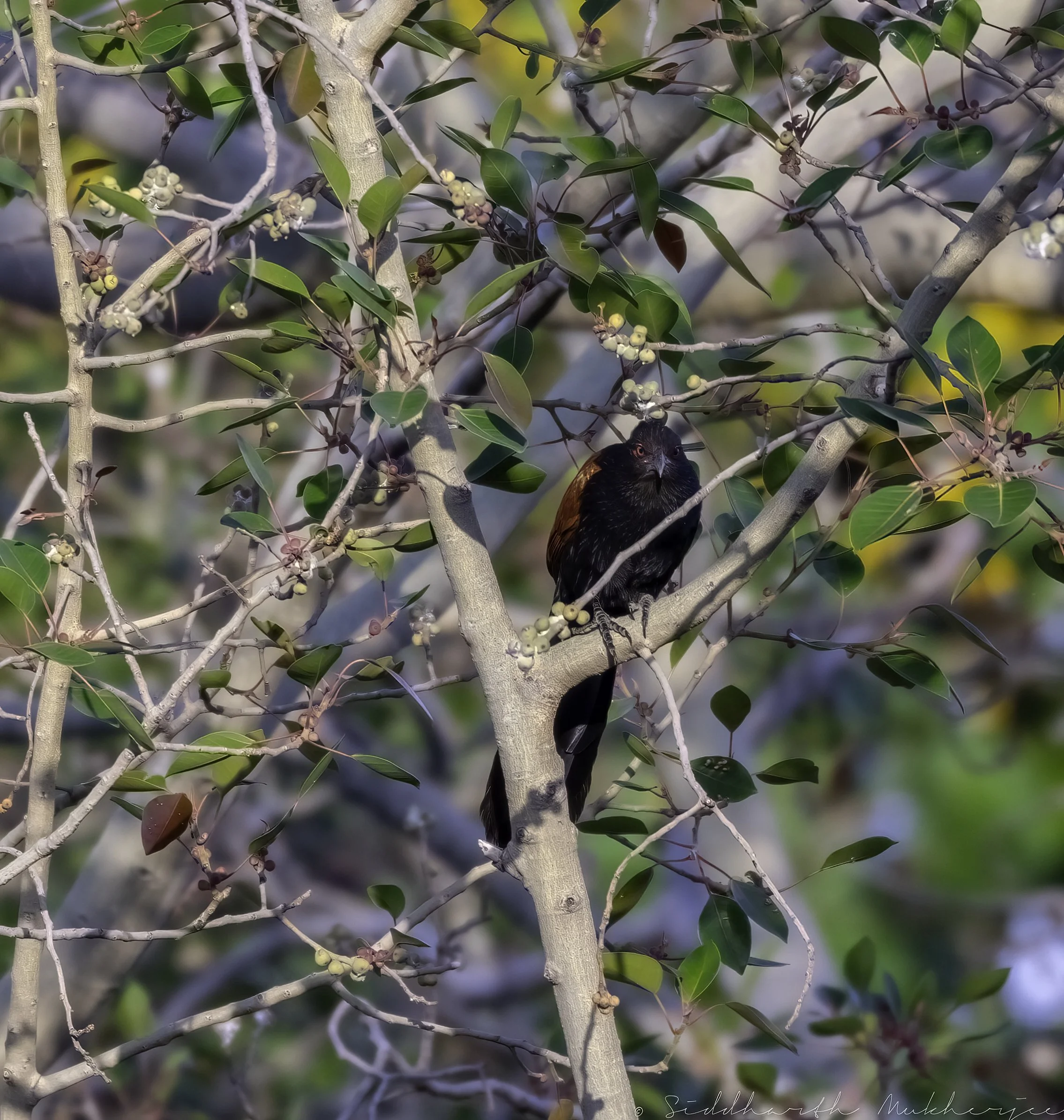
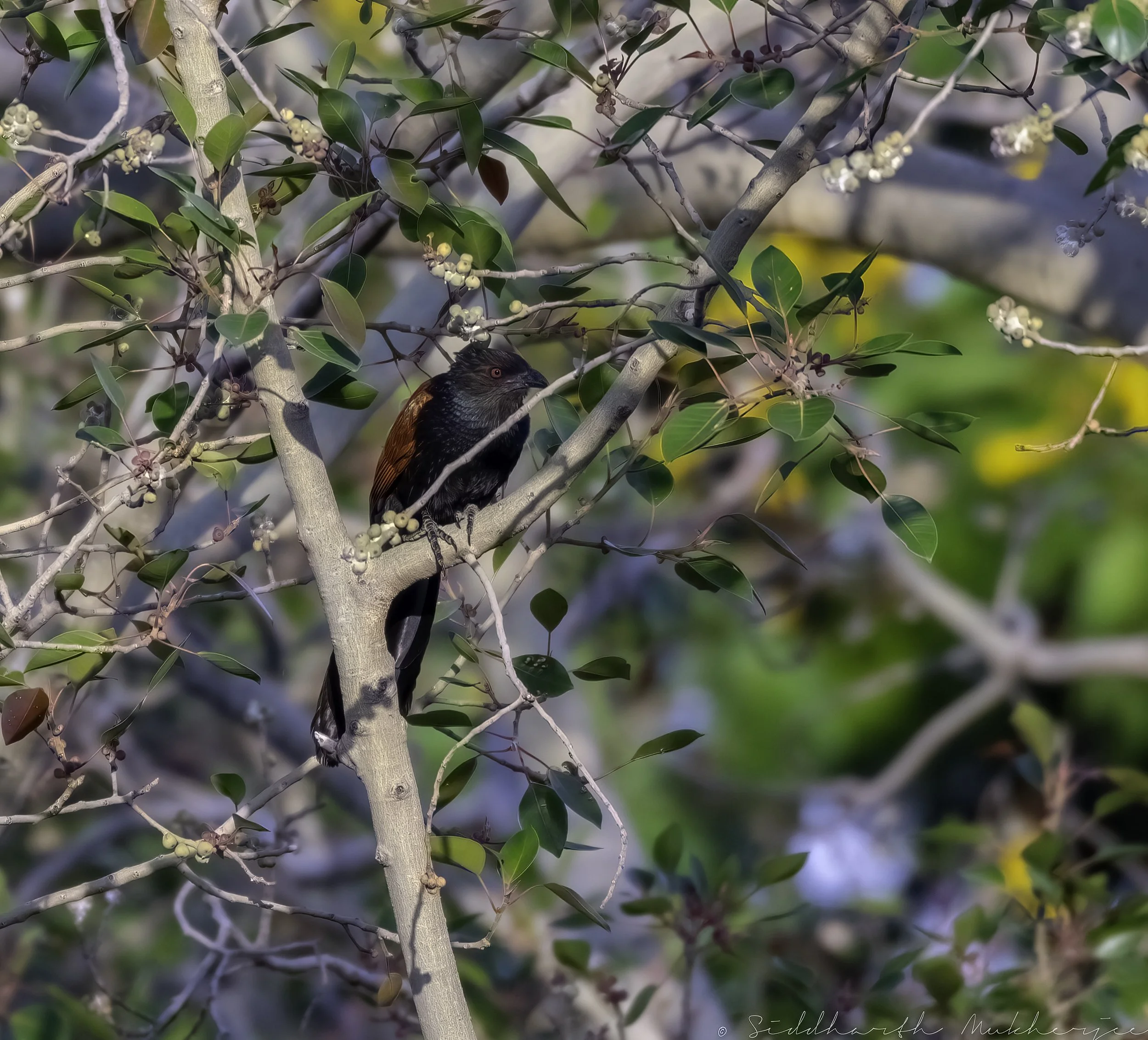
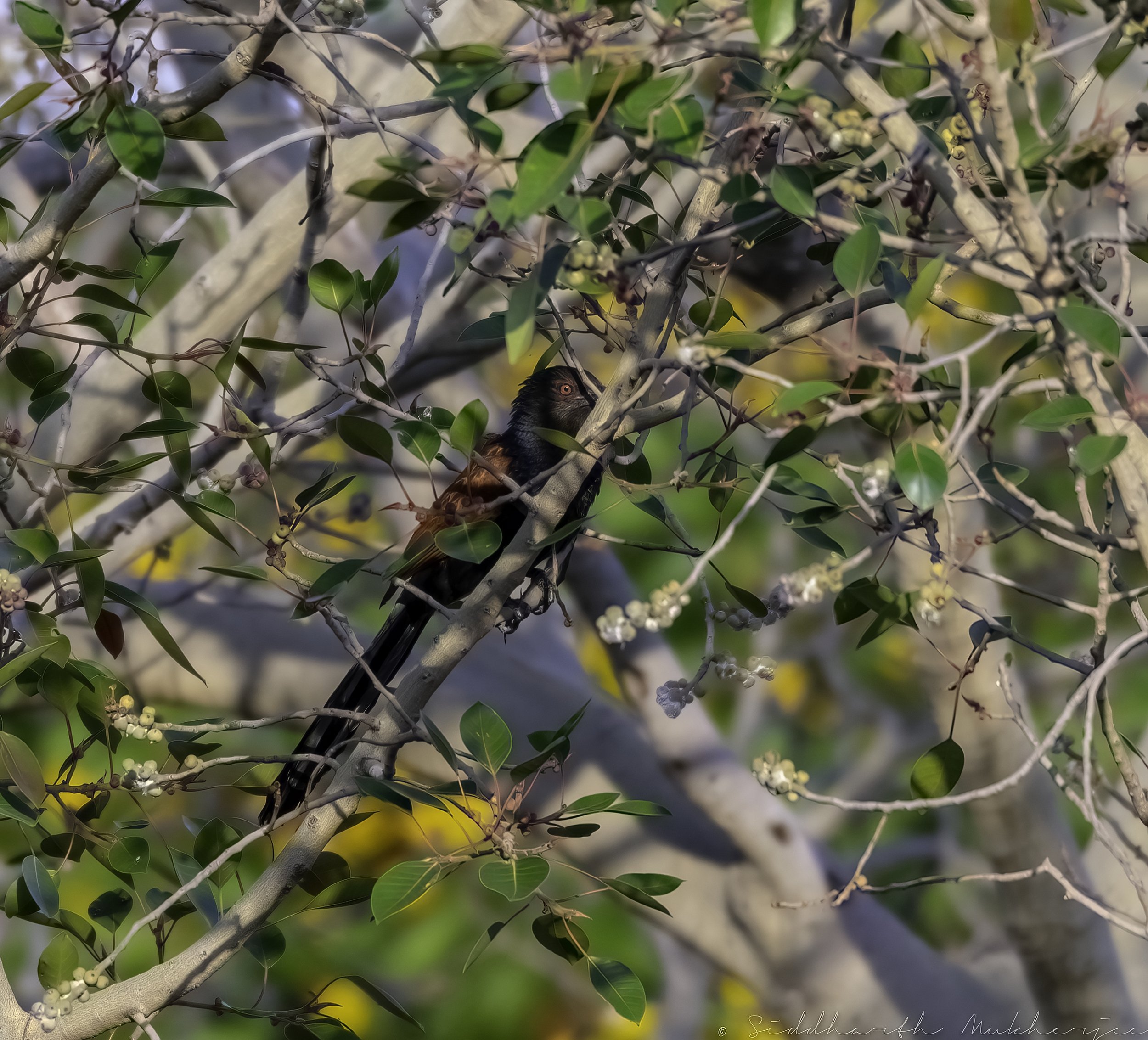
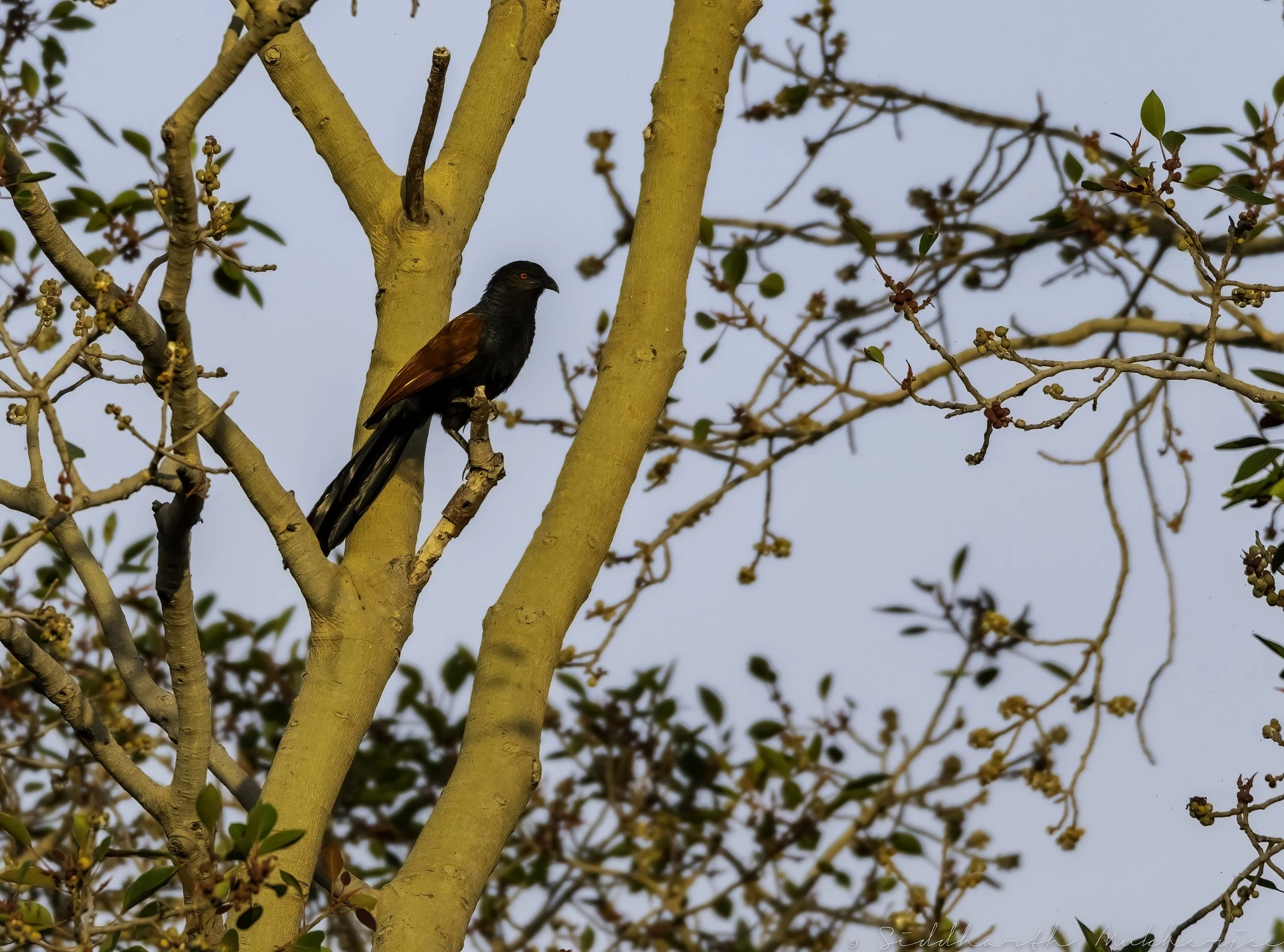
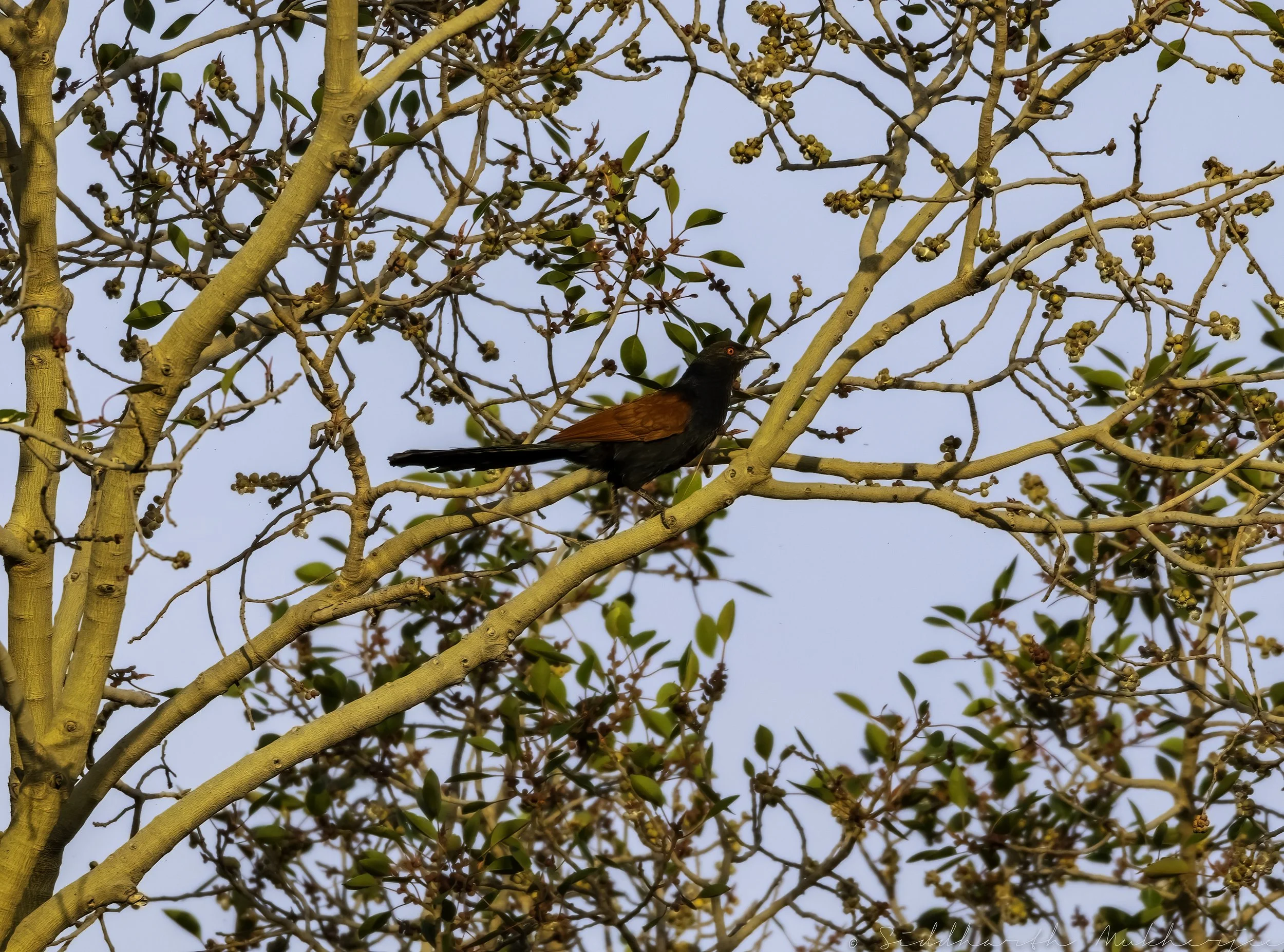
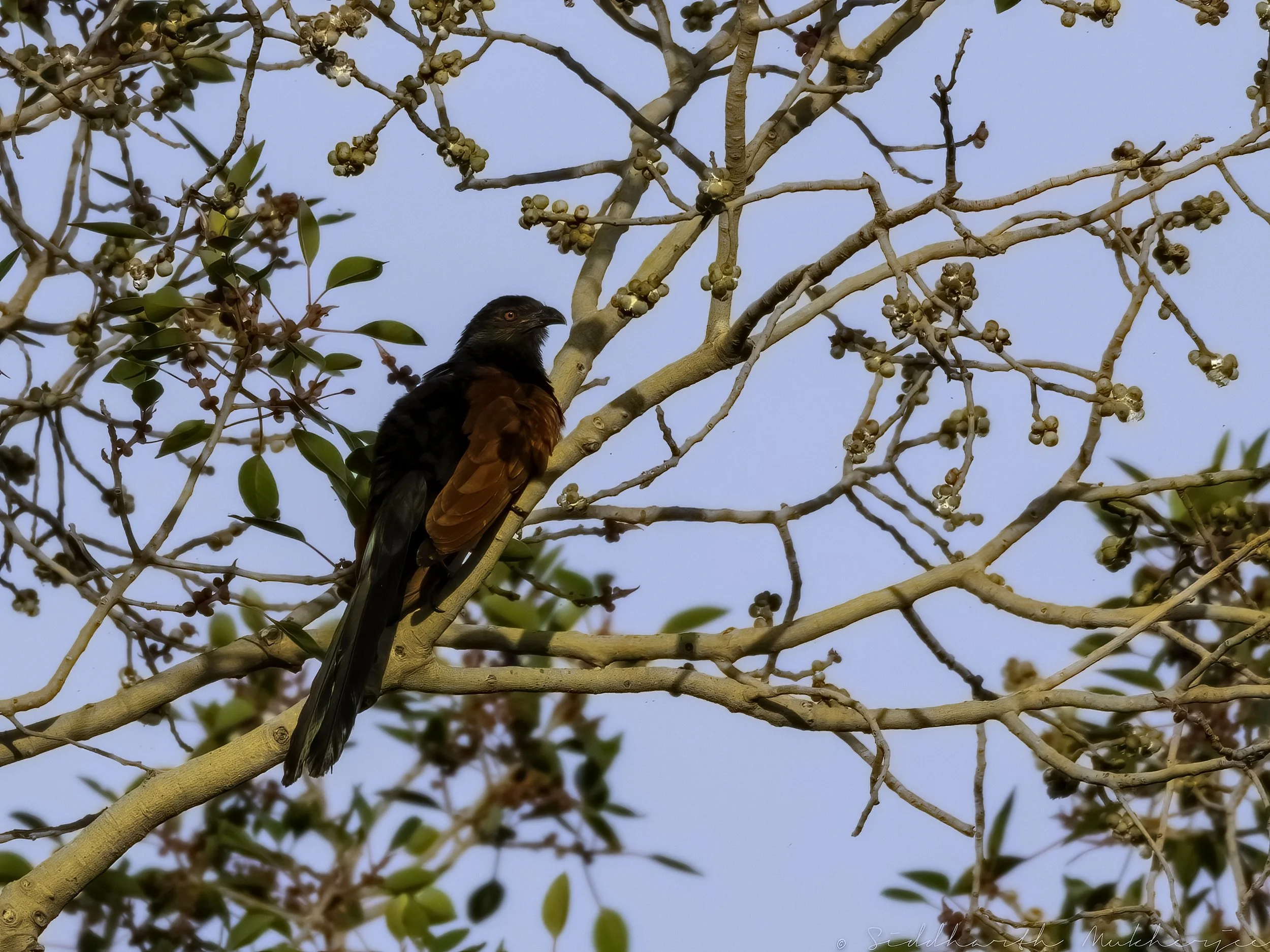
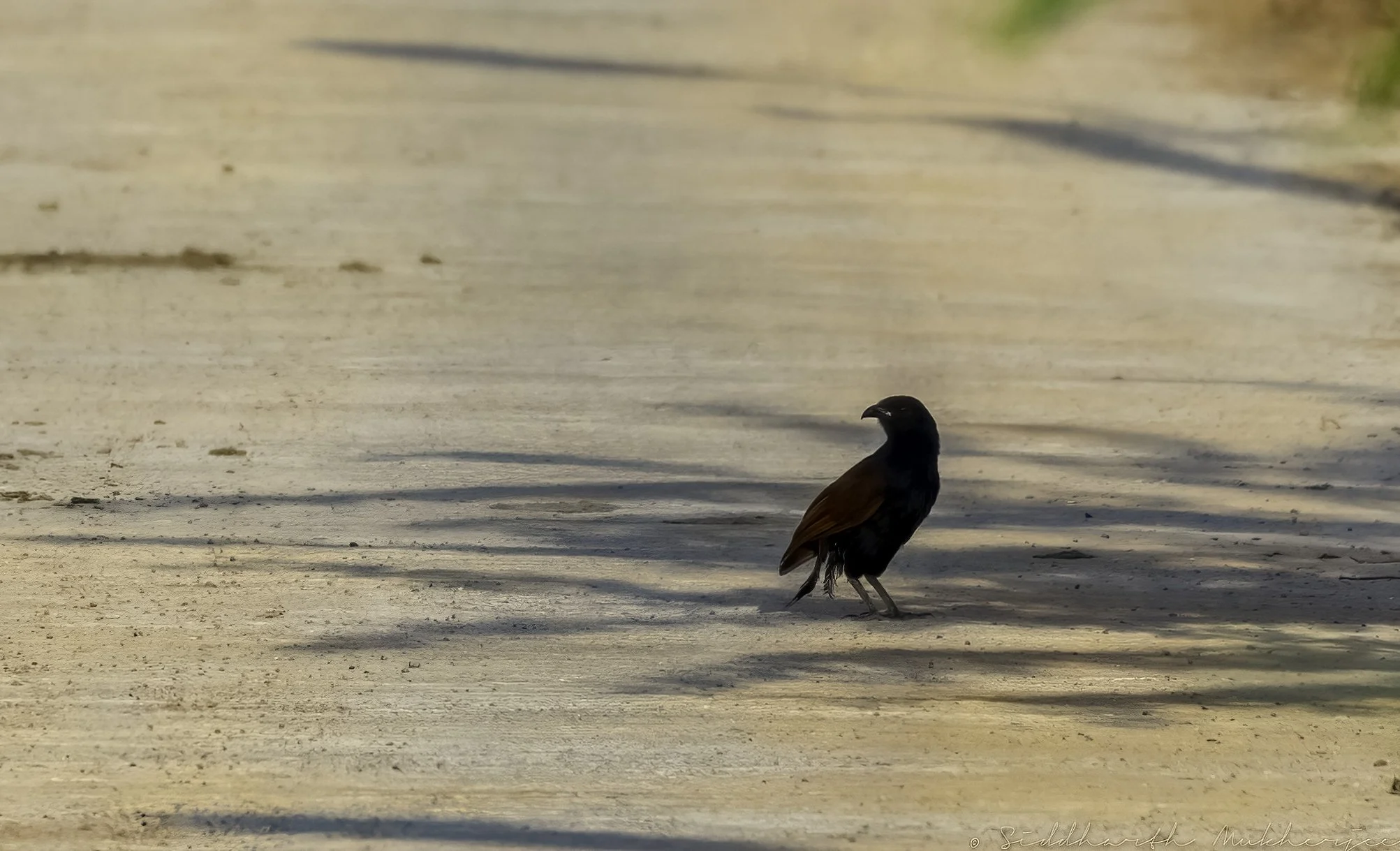
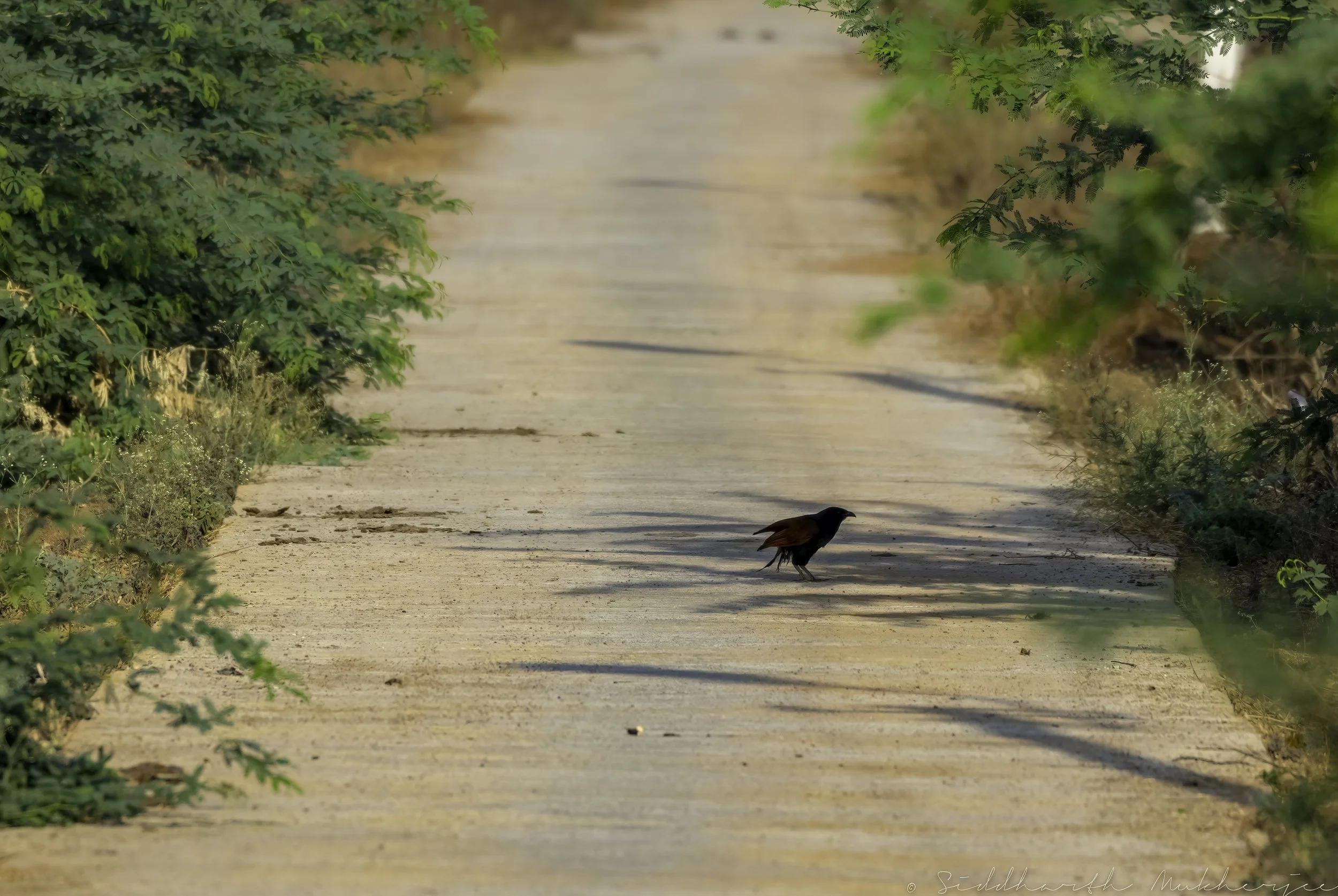
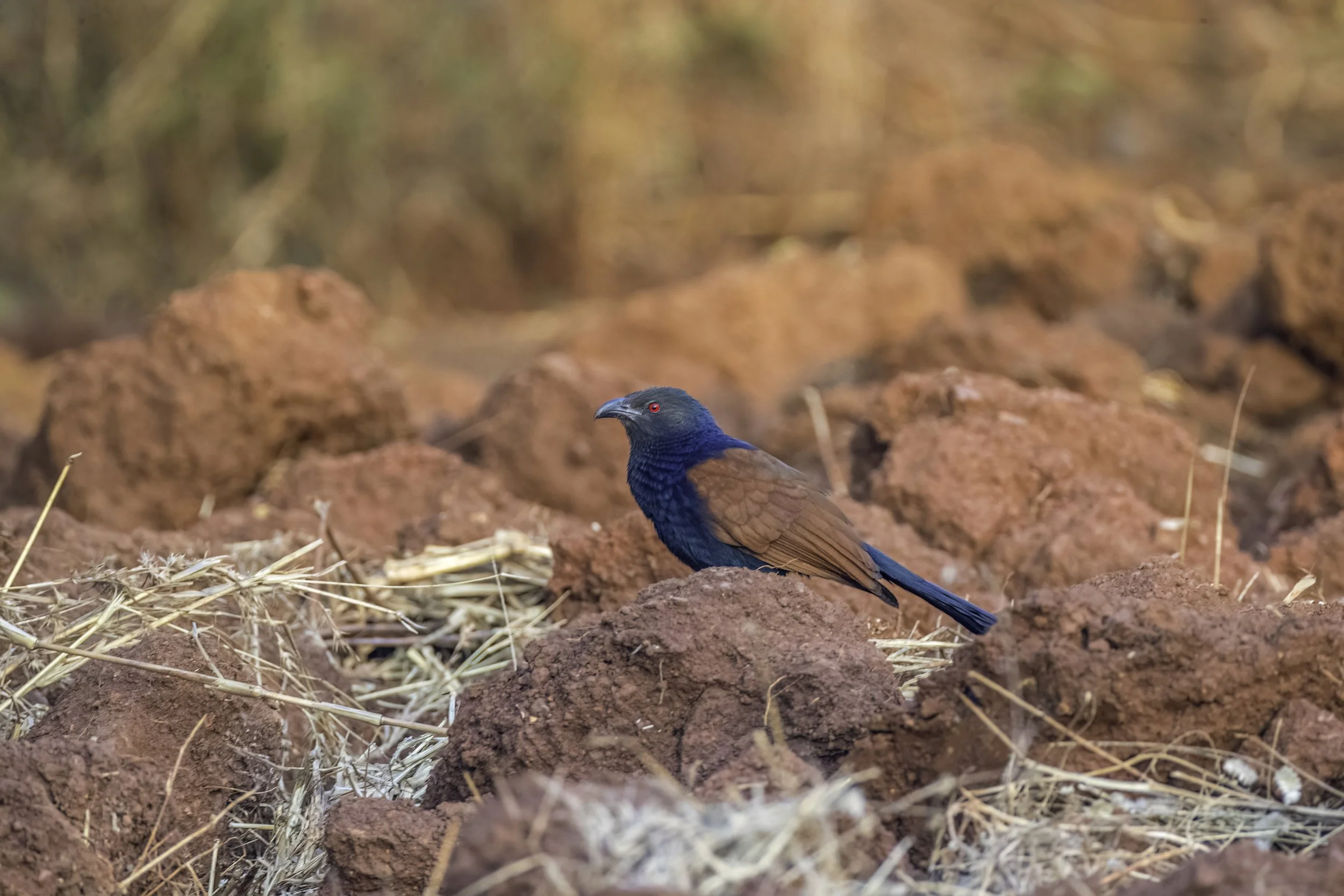
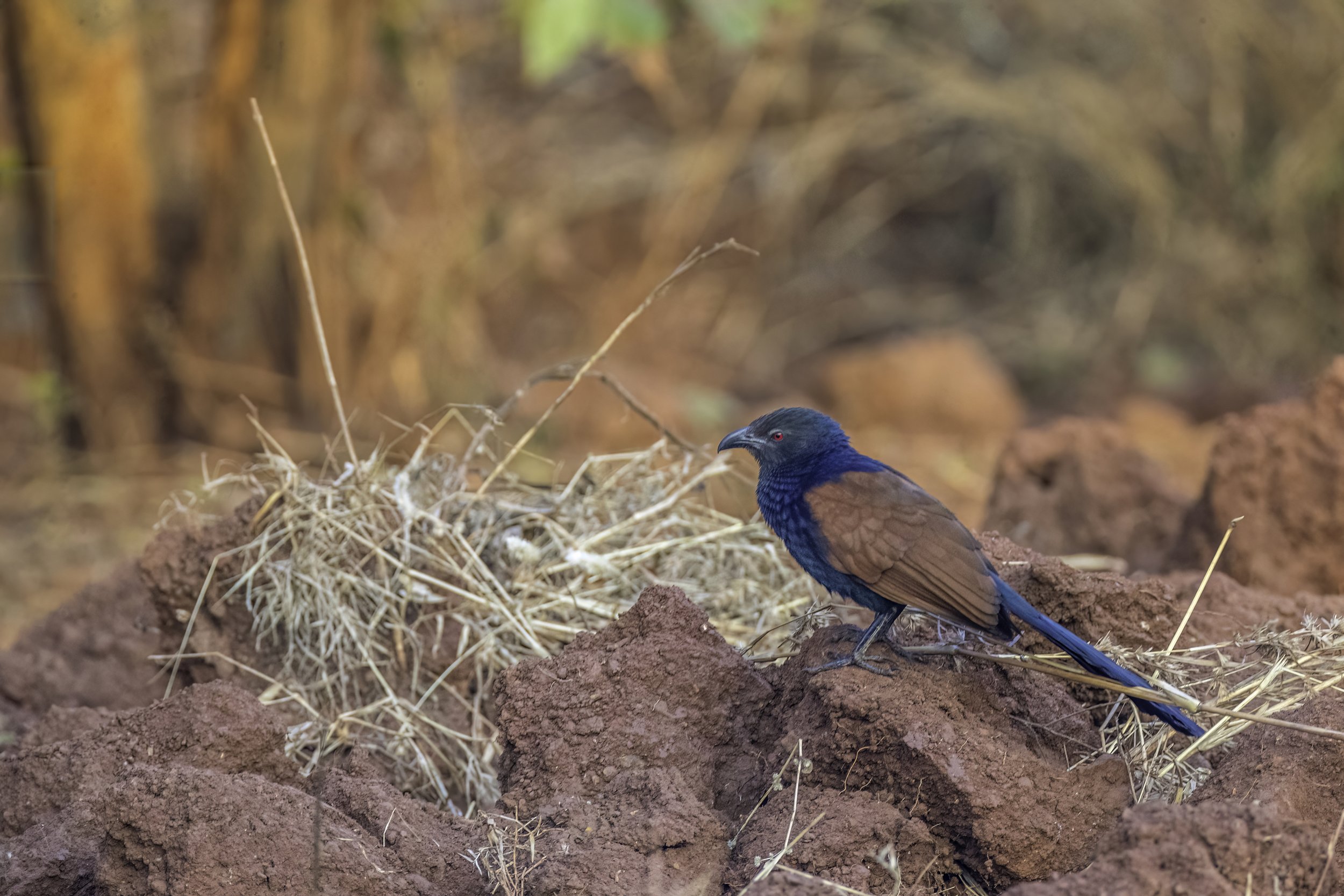
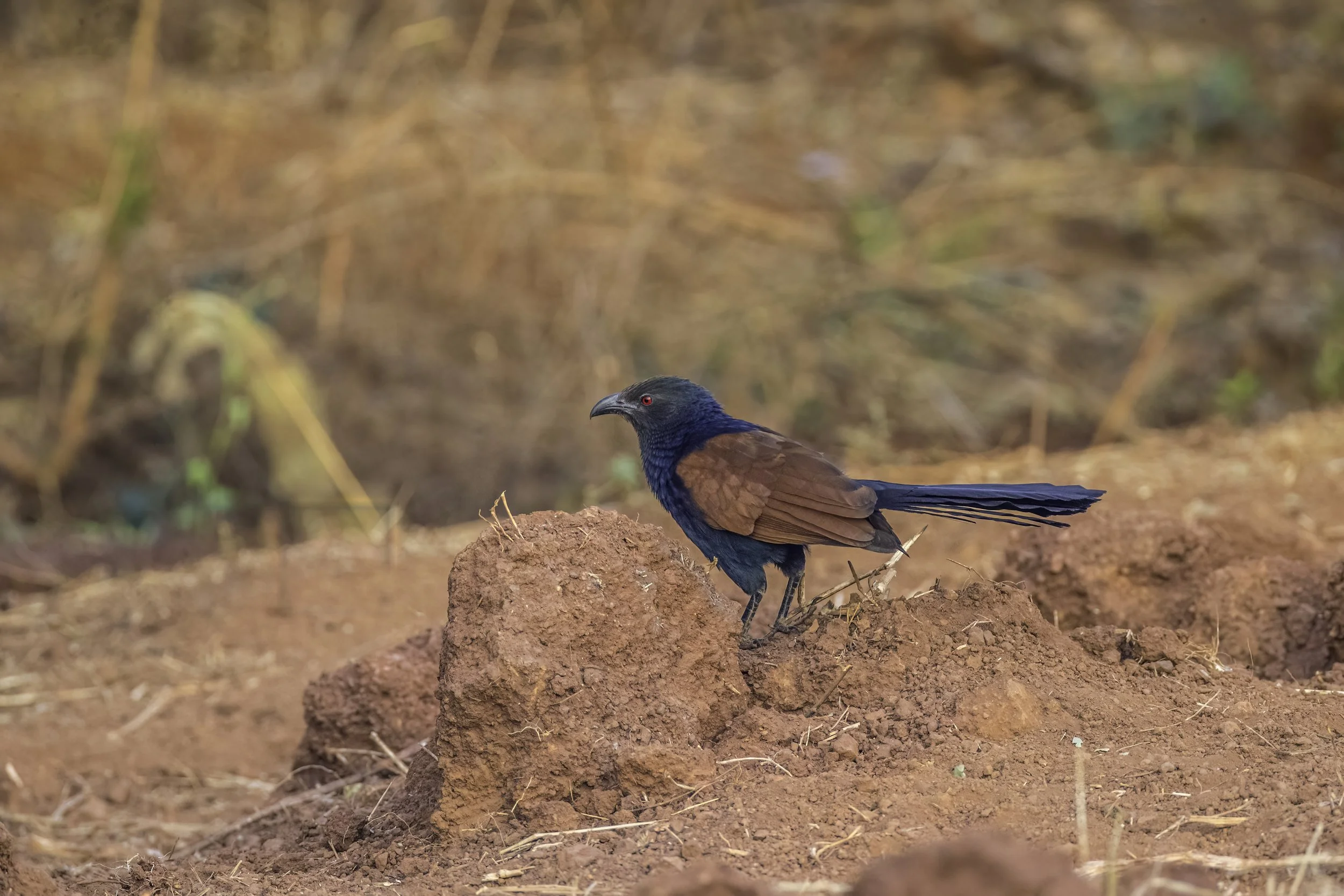
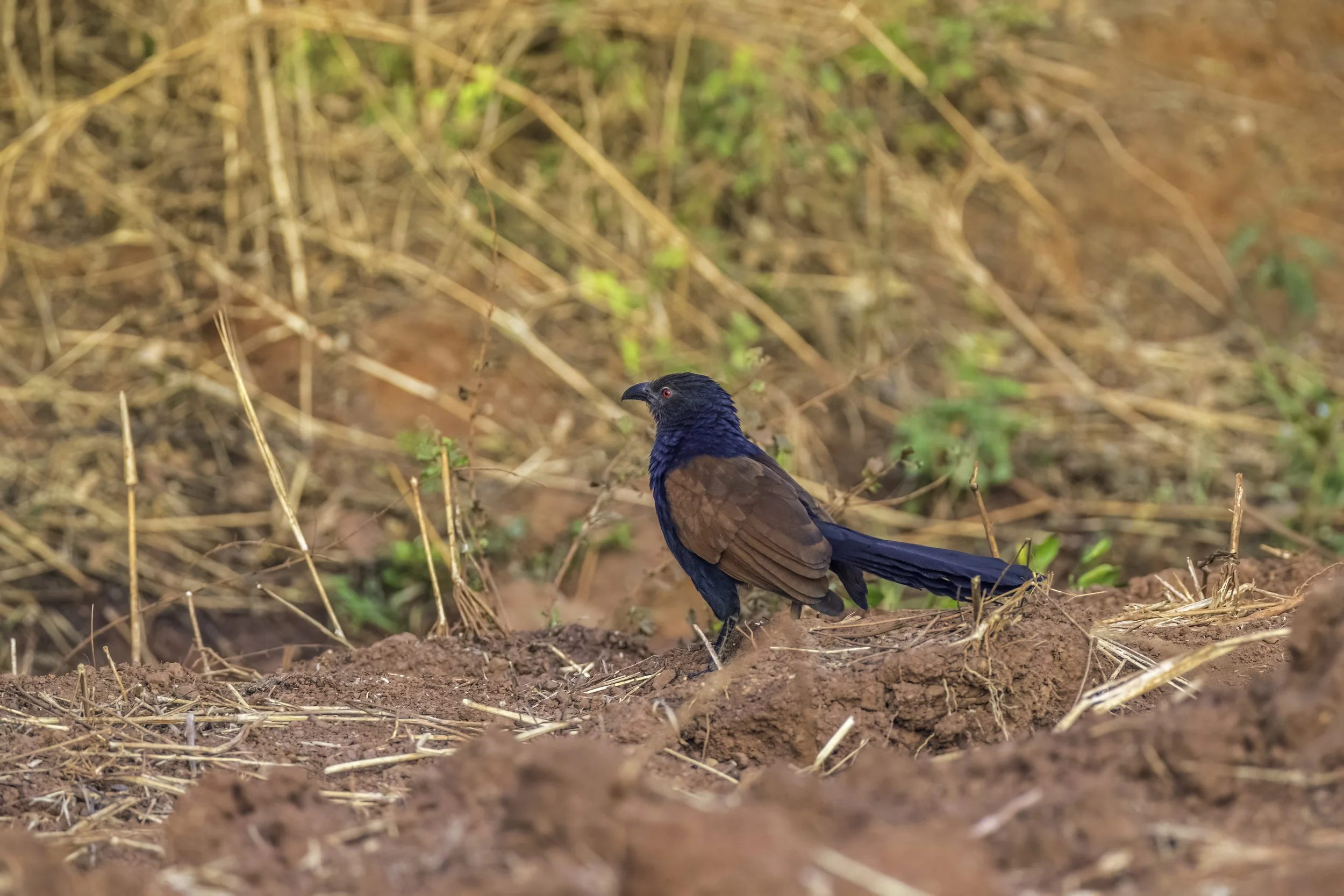
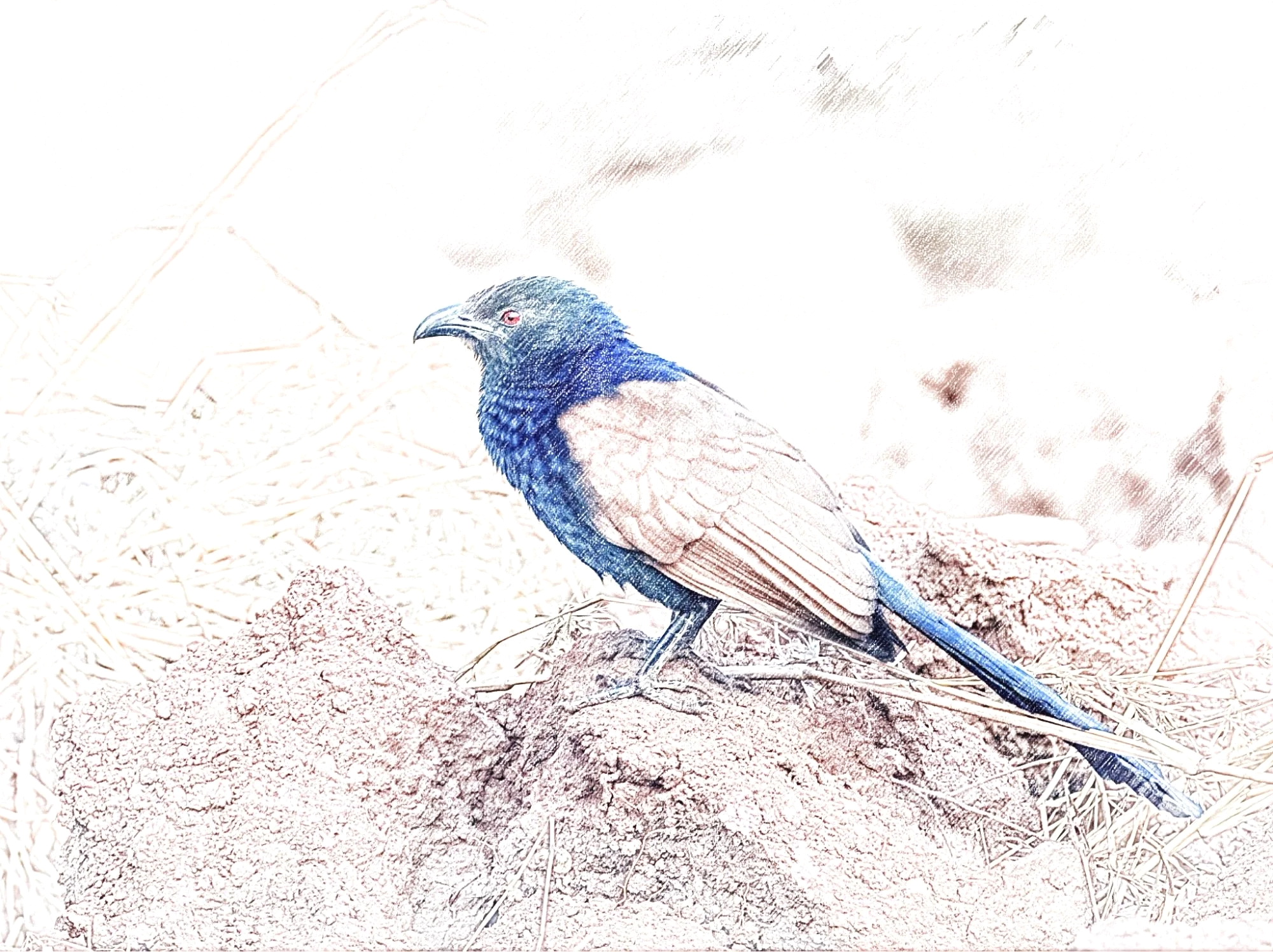
Stepping cautiously onto a dusty fire line, the bird finally revealed itself. The Greater Coucal is a striking study in contrasts, an avian anomaly that bridges the gap between the familiar and the exotic. Measuring a substantial 48 centimetres in length and weighing between 230-300 grams, it is one of the largest members of the cuckoo family (Cuculidae). Its structural design mimics a cross between a sleek jungle crow and a long-tailed pheasant. The head, neck, mantle, and entire underside are draped in an intense, velvety black that catches the light to reveal an iridescent purple and deep violet gloss. In vivid contrast, its back and broad, rounded wings are blanketed in a rich, saturated chestnut-brown. The tail is long, heavy, and slightly graduated, shimmering with a dark, greenish-black sheen under direct sunlight. The most arresting feature, however, is its face: set against the dark plumage are two glowing, ruby-red eyes that pierce through the dense undergrowth like tiny embers. Its bill is black, sharp, and heavily curved downward, designed perfectly for a predatory lifestyle. Unlike true cuckoos, the sexes are monomorphic; males and females look identical, though females tend to be marginally larger. The juveniles present a completely different canvas. They are much duller, lack the clean metallic gloss, and are heavily marked with greyish-white bars on their underparts and tails. Their wings are streaked with variable dark brown lines, a cryptic camouflage essential for surviving their early months on the forest floor.
The Coucal and Its Look-alikes
The Eastern Ghats and Deccan Plateau harbor several species that can confuse an untrained eye. Differentiating the Greater Coucal from its relatives requires looking closely at size, eye colour, and wing markings.
The Lesser Coucal (Centropus bengalensis): Occasionally overlapping in wet grasslands and riverine fringes, the Lesser Coucal is significantly smaller (around 38 cm). It possesses a much more stubby bill, dark brown eyes, and distinctly pale, whitish shafts or streaks on its wing coverts even into adulthood. When in flight, the Lesser Coucal displays a lighter, sandy-chestnut wing lining compared to the solid, dark underside of the Greater Coucal.
The Sirkeer Malkoha (Taccocua leschenaultii): Often seen in the same dry scrub and deciduous patches of Telangana, this bird shares the long-tailed, ground-foraging silhouette. However, the Malkoha is covered in sandy, earthy-brown tones rather than black and chestnut, and features a brilliant cherry-red bill tipped with yellow, making confusion impossible once seen clearly.
The Western Ghats Variations: While the southern race Centropus sinensis parroti dominates Telangana and central India, populations moving toward the Western Ghats can occasionally dwarf down, mimicking the size of lesser coucals but maintaining the diagnostic ruby eyes, deep bill, and unstreaked adult wings.
The Greater Coucal is an remarkably adaptable bird, yet its soul belongs to the edges where dense thickets meet open country. Across Telangana, it has established its presence in both pristine protected reserves and human-dominated agricultural matrixes.
Amrabad Tiger Reserve: Spanning the rugged Nallamala hill tracks over Nagarkurnool and Nalgonda districts, Amrabad presents a landscape of steep gorges, rocky cliffs, and Southern Tropical Dry Deciduous forests. Here, the Greater Coucal finds a haven along the banks of the Krishna River and its seasonal tributaries. It occupies the low-set fig tangles, dense bamboo breaks, and areas where tall grasses carpet the valleys. In Amrabad, it shares its home with the rare Yellow-throated Sparrow, the Chousingha (Four-horned Antelope), and the tigers that prowl the deep ravines.
Kawal Tiger Reserve: Located in northern Telangana along the basin of the Godavari River, Kawal is famed for its dense, ancient teak (Tectona grandis) and bamboo ecosystems. The Coucal thrives in Kawal's riverine zones and open grasslands, clambering through the understory of cassia bushes and terminalia trees. In these teak sanctuaries, its habitat directly overlaps with foraging Indian Gaurs, Barking Deer, and packs of Wild Dogs.
Urban and Riparian Refugia: Beyond the premier tiger reserves, the bird is well-recorded across Telangana's diverse wetlands and parks. Sighted regularly from the Manjeera Crocodile Wildlife Sanctuary in Sangareddy to the rocky borders of Narayanpet and the outskirts of Karimnagar, it utilizes the reeds surrounding man-made reservoirs and rural paddy fields. Even within Hyderabad, places like the Kondapur Botanical Gardens and the fringes of Osman Sagar host stable populations of this resident cuckoo.
To observe a Greater Coucal is to watch an evolutionary compromise. Despite being a member of the cuckoo order, it is entirely non-parasitic; pairs form strong monogamous bonds, build their own deep, dome-shaped nests out of twigs and leaves, and diligently raise their own young. The coucal is a notorious ground-dwelling opportunist. It is an exceptionally weak flier, preferring to move with a series of heavy, laboured wing beats followed by short glides. Instead of taking to the skies, it uses its powerful legs to hop, clamber, and sprint through tangled briars. Its diet is predatory and vast. It hunts by slowly walking through grass, turning over leaf litter to uncover insects, grasshoppers, snails, and scorpions. It is a bold hunter, known to attack small vertebrates, including rodents, nestlings of ground-nesting birds, and even venomous saw-scaled vipers. In Telangana's rural areas, it also feeds on toxic wild berries like the Yellow Oleander (Cascabela thevetia), showing a high tolerance for natural plant toxins.
While the State of India's Birds report lists the Greater Coucal as a stable, non-specialized resident experiencing an overall increasing trend nationally, local populations in Telangana tell a more complex story of adaptation and stress.
In reserves like Kawal, historical pressures from illegal teak felling, sand mining, and cattle grazing have fragmented the pristine understory. When the dense brambles and bamboo thickets vanish, the Coucal is forced out of the forest interior. Biologists have noted that in disturbed zones, the birds increasingly shift their nesting sites closer to forest check-posts, highways, and village boundaries. This adaptation exposes them to a higher risk of feral dog attacks and vehicular collisions. Furthermore, with temperatures in northern Telangana soaring past 47°C during peak summers, natural forest watering holes dry up. Coucals have begun displaying unusually bold behavior, abandoning their shy nature to venture into agricultural fields and open irrigation channels. In areas where agricultural conversion has introduced monoculture plantations, such as oil palms, the coucals have adapted by feeding on the fleshy fruit pulp. This shift has earned them an unfair reputation as agricultural pests among local farmers.
Photographing a Greater Coucal in the wild sanctuaries of Telangana is an exercise in patience and low-light management.
On a recent expedition inside the core area of Kawal Tiger Reserve, near the Kalpakunta waterhole, the forest was quiet. The sun was low, casting long, dramatic shadows through the massive teak trees. Suddenly, a Coucal emerged from a patch of dried bamboo. It didn't fly; it stepped onto a fallen log, moving with deliberate, dinosaur-like movements. For a wildlife photographer, the Greater Coucal presents a difficult technical challenge. Its plumage is a deep, light-absorbing black mixed with high-contrast chestnut. If you overexpose to capture the intricate purple gloss on its neck, you risk blowing out the warm tones of its wings. If you underexpose to preserve the highlights, the bird disappears into a dark, shape-less silhouette.
Setting the camera to a low aperture (f/4) to isolate the bird from the cluttered jungle background, the lens tracked its movement. The bird paused, sensing the click of the shutter. It turned its head, and the low morning light hit its face perfectly. For a split second, its ruby-red eye glowed like a polished gemstone against the dark forest background. The camera captured the moment: the sharp curve of its beak, the rich texture of its chestnut wings, and the long tail balanced perfectly on the dry log. A moment later, with a soft grunt, the bird hopped off the log and vanished back into the thick brush. It left behind only the fading echo of its deep call, a reminder of the ancient, wild spirit that continues to endure across the changing landscapes of Telangana.
The Silent Shrinkage: Habitat Loss in Telangana’s Tiger Reserves
The continuous pressure of habitat loss is fundamentally reshaping the protected ecosystems of Telangana, creating severe bottlenecks for the state’s wildlife. In the Kawal Tiger Reserve, the integrity of one of India's richest teak and bamboo forests is systematically compromised by a multi-pronged crisis of fragmentation. Unchecked encroachments for Podu (slash-and-burn) cultivation, widespread timber smuggling, and illegal sand mining along the seasonal streams of the Godavari basin strip away the essential understory vegetation that smaller animals rely on for cover. Concurrently, infrastructure development—including highway expansions, railway networks, and nearby open-cast coal mines—acts as an aggressive physical barrier. This cuts off critical wildlife corridors that historically allowed tigers and other key species to migrate from the source populations of Maharashtra into northern Telangana. A study led by Imran Siddiqui of HYTICOS published in Oryx found that while Kawal’s prey base can support over 35 tigers, severe habitat fragmentation and broken corridors prevent the establishment of a breeding population. Read the full study in Cambridge Core.
Further south, in the rugged terrains of the Amrabad Tiger Reserve, habitat degradation takes on a distinct socio-ecological dimension. Decades of intensive grazing by thousands of migratory livestock and domestic cattle herds have triggered widespread overgrazing across the Nallamala hills. This constant biotic pressure has depleted the native grasses, paving the way for aggressive invasive weeds like Lantana camara and Cassia tora. These unpalatable weeds choke the forest floors and starve indigenous herbivores of essential fodder. This degradation is worsened by linear infrastructure projects, such as the busy state highway stretching toward Srisailam, which splits the park’s core area. The resulting vehicular noise, plastic pollution from heavy tourist traffic, and recurring forest fires disrupt the natural behavior of native species. This forces wildlife out of their natural, secure interior habitats and into increasingly frequent, dangerous contact with human settlements.
‡‡‡‡‡

Related Posts


The Asian Koel is a large shy bird, distinctive in all plumages, usually secretive, keeping to the interior of dense trees in many habitats belonging to the cuckoo order of birds, the Cuculiformes. It is found in the Indian Subcontinent, China & Southeast Asia. It forms a superspecies with the closely related black-billed koels, and Pacific koels which are sometimes treated as subspecies. This is a bird without borders, frequently heard but rarely seen.
#wildartworks #canon #Wildlife #wildlifephotography #telanganabirds #natgeoindia #conservationphotography #indian_wildlifes #indianwildlifeofficial #wildlifeonearth #planet_untamed_magazine #bbcearth #natgeowild #birdsofthedeccan #hyderabadbirds #lakesofhyderabad #ameenpur, #biodiversityheritagesite, #HyderabadBiodiversity, #heritagesite, #ameenpurlake, #ancientmanmadelake, #manmadelake, #asiankoel, #koel, #manjeera, #sungeibuloh, #ranganathittubirdsanctuary, #bhigwanbirdsanctuary, #bishanangmokiopark, #chincholi, #chandrampally, #indianbirds,